
Lens System Focal Length Calculation
We are given a system of two separated lenses with a resultant focal length ($f_{eq}$) and a separation distance ($d$). We need to find the individual focal lengths ($f_1$ and $f_2$) of the component lenses.
The formula for the equivalent focal length of two thin lenses separated by a distance $d$ is:
$ \frac{1}{f_{eq}} = \frac{1}{f_1} + \frac{1}{f_2} - \frac{d}{f_1 f_2} $Given:
- Resultant focal length, $f_{eq} = 10$ cm
- Separation between lenses, $d = 2$ cm
Substituting the given values into the formula:
$ \frac{1}{10} = \frac{1}{f_1} + \frac{1}{f_2} - \frac{2}{f_1 f_2} $To simplify, multiply the entire equation by $10 f_1 f_2$:
$ f_1 f_2 = 10 f_2 + 10 f_1 - 20 $Rearranging the terms to facilitate testing the options:
$ f_1 f_2 - 10 f_1 - 10 f_2 = -20 $Add 100 to both sides to factor the expression (using the Simon's Favorite Factoring Trick):
$ (f_1 - 10)(f_2 - 10) = -20 + 100 $ $ (f_1 - 10)(f_2 - 10) = 80 $Testing Lens Focal Length Options
Now, we test each option using the derived equation $ (f_1 - 10)(f_2 - 10) = 80 $. The condition 'corrected for spherical aberration' is satisfied if the derived equation holds true for a given pair of focal lengths.
-
Option 1: $f_1 = 18$ cm, $f_2 = 20$ cm
Calculation: $ (18 - 10)(20 - 10) = (8)(10) = 80 $
This option satisfies the equation.
-
Option 2: $f_1 = 12$ cm, $f_2 = 14$ cm
Calculation: $ (12 - 10)(14 - 10) = (2)(4) = 8 $
This option does not satisfy the equation ($8 \neq 80$).
-
Option 3: $f_1 = 16$ cm, $f_2 = 18$ cm
Calculation: $ (16 - 10)(18 - 10) = (6)(8) = 48 $
This option does not satisfy the equation ($48 \neq 80$).
-
Option 4: $f_1 = 10$ cm, $f_2 = 12$ cm
Calculation: $ (10 - 10)(12 - 10) = (0)(2) = 0 $
This option does not satisfy the equation ($0 \neq 80$).
Conclusion
Only Option 1 yields the value 80 when substituted into the derived equation, confirming it as the correct pair of focal lengths for the lens system described.
Similar Questions
- A collimated beam of light of diameter $2 \text{ mm}$ is propagating along x-axis. The beam is required to be expanded in a collimated beam of diameter $14 \text{ mm}$ using a system of two convex lenses. If first lens has focal length $40 \text{ mm}$, then the focal length of second lens is ____________ $\text{mm}$.
- In a Young's double slit experiment set up, the two slits are kept $0.4\text{ mm}$ apart and screen is placed at $1\text{ m}$ from slits. If a thin transparent sheet of thickness $20 \, \mu\text{m}$ is introduced in front of one of the slits then center bright fringe shifts by $20\text{ mm}$ on the screen. The refractive index of transparent sheet is given by $\frac{\alpha}{10}$, where $\alpha$ is __________.
- In two separate Young's double-slit experimental set-ups and two monochromatic light sources of different wavelengths are used to get fringes of equal width. The ratios of the slits separations and that of the wavelengths of light used are $2 : 1$ and $1 : 2$ respectively. The corresponding ratio of the distances between the slits and the respective screens ($D_1/D_2$) is ___________.
- The size of the images of an object, formed by a thin lens are equal when the object is placed at two different positions $8 \text{ cm}$ and $24 \text{ cm}$ from the lens. The focal length of the lens is ________ $\text{cm}$.
- If sunlight is focused on a paper using convex lens, it starts burning the paper in shortest time when the lens is kept at $30\text{ cm}$ above the paper. If the radius of curvature of the lens is $60\text{ cm}$ then the refractive index of the lens material is $\frac{\alpha}{10}$. The value of $\alpha$ is __________.
A ring is placed at the bottom of a trough containing four immiscible liquids of refractive indices $1.0, 2.0, 3.0$ and $4.0$ poured one above the other of heights $10$ cm, $20$ cm, $30$ cm, and $40$ cm respectively. The apparent depth at which the ring appears, when seen from outside is____________ cm.
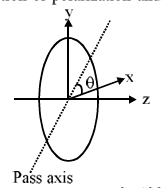
A plane polarized light is incident on a polariser with its pass axis making angle $\theta$ with x-axis, as shown in the figure. At four different values of $\theta$, $\theta = 8^\circ, 38^\circ, 188^\circ$ and $218^\circ$, the observed intensities are same. What is the angle between the direction of polarization and x-axis ?
- Light from a point source in air falls on a spherical glass surface (refractive index, $\mu$=1.5 and radius of curvature = 50 cm). The image is formed at a distance of 200 cm from the glass surface inside the glass. The magnitude of distance of the light source from the glass surface is __________ m.
- A ray of light suffers minimum deviation when incident on a prism having angle of the prism equal to $60^\circ$. The refractive index of the prism material is $\sqrt{2}$. The angle of incidence (in degrees) is ________.
- In a Young's double slit experiment, two slits are located 1.5 mm apart. The distance of screen from slits is 2 m and the wavelength of the source is 400 nm. If the 20 maxima of the double slit pattern are contained within the central maximum of the single slit diffraction pattern, then the width of each slit is $x\times10^{-3}$ cm, where x-value is ________.
Important Questions from Optics
- A collimated beam of light of diameter $2 \text{ mm}$ is propagating along x-axis. The beam is required to be expanded in a collimated beam of diameter $14 \text{ mm}$ using a system of two convex lenses. If first lens has focal length $40 \text{ mm}$, then the focal length of second lens is ____________ $\text{mm}$.
- In a Young's double slit experiment set up, the two slits are kept $0.4\text{ mm}$ apart and screen is placed at $1\text{ m}$ from slits. If a thin transparent sheet of thickness $20 \, \mu\text{m}$ is introduced in front of one of the slits then center bright fringe shifts by $20\text{ mm}$ on the screen. The refractive index of transparent sheet is given by $\frac{\alpha}{10}$, where $\alpha$ is __________.
- In two separate Young's double-slit experimental set-ups and two monochromatic light sources of different wavelengths are used to get fringes of equal width. The ratios of the slits separations and that of the wavelengths of light used are $2 : 1$ and $1 : 2$ respectively. The corresponding ratio of the distances between the slits and the respective screens ($D_1/D_2$) is ___________.
- The size of the images of an object, formed by a thin lens are equal when the object is placed at two different positions $8 \text{ cm}$ and $24 \text{ cm}$ from the lens. The focal length of the lens is ________ $\text{cm}$.
- A ray of light travelling in air is incident on one face of a parallel glass slab of thickness $t$ and refractive index $\mu$ at an angle of incidence $i$. Total time spent by the ray inside the slab is


