
Question
In $^1H$ NMR, the multiplicity pattern expected for the highlighted protons in the following compounds is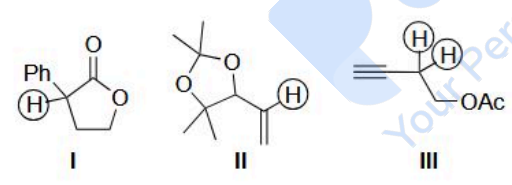
The correct answer is
I = dd, II = ddd, III = td
Step-by-step Analysis:
The question is about predicting the multiplicity (or splitting pattern) of protons in 1H NMR for the given compounds. In NMR spectroscopy, the splitting pattern of a proton is determined by the number of neighboring protons (n) using the n+1 rule.
-
For Compound I:
- The circled hydrogen is adjacent to two non-equivalent protons (one is another hydrogen in the ring and one is phenyl hydrogen).
- This leads to a doublet of doublets (dd) splitting, due to coupling with two distinct sets of protons.
-
For Compound II:
- The circled hydrogen has three different neighboring hydrogens due to different chemical environments (one from the methyl group and two different from the asymmetric carbon).
- This results in a doublet of doublets of doublets (ddd) pattern.
-
For Compound III:
- The circled hydrogen is adjacent to two equivalent hydrogens and experiences long-range coupling with an ethynyl hydrogen.
- This creates a triplet of doublets (td) pattern due to two equivalent and one nonequivalent proton.
Conclusion: Based on the above analysis, the correct multiplicity assignments are:
Option: I = dd, II = ddd, III = td
This matches with the given correct answer.
Was this answer helpful?
Important Questions from Nmr
- According to Karplus equation, the vicinal proton-proton coupling constant is minimum when the value of dihedral angle is
- The $^1H$ NMR of mixture of ethyl iodide and bromoform gives three signals at $\delta$ 6.80, 3.20 and 1.85 ppm with integration of 1, 3, 4.5, respectively. The molar ratio of ethyl iodide and bromoform is
- $^{13}C$ NMR spectrum of DMSO-$d_6$ gives a signal at $\delta$ 39.7 ppm as a
- The ${}^{31}\text{P}\{^1\text{H}\}$ NMR spectrum of $2,2,6,6-\text{N}_4\text{P}_4\text{Cl}_4(\text{NMe}_2)_4$ is expected to show
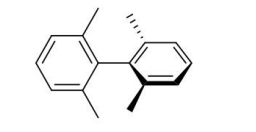
The number of signals observed in the proton decoupled $^{13}\text{C}$ NMR spectrum of the following compound is
Need Expert Advice?


