Understanding $^{13}C$ NMR Splitting in DMSO-$d_6$
The question asks for the multiplicity of the $^{13}C$ NMR signal for DMSO-$d_6$ at $\delta$ 39.7 ppm. This signal corresponds to the methyl carbons.
DMSO-$d_6$, or deuterated dimethyl sulfoxide, has the structure $(CD_3)_2S=O$. The key feature affecting the splitting of the $^{13}C$ signal is the presence of deuterium ($D$) atoms attached to the methyl carbons.
Determining the Signal Multiplicity
In NMR spectroscopy, the splitting of a signal depends on the coupling between the observed nucleus ($^{13}C$) and nearby nuclei with non-zero spin. Deuterium ($D$) has a nuclear spin quantum number $I = 1$.
The multiplicity of the $^{13}C$ signal is determined by the number of equivalent deuterium atoms coupled to it, using the formula for signal splitting:
$ \text{Number of lines} = 2nI + 1 $Where:
- $n$ = number of equivalent coupled nuclei (deuterium atoms)
- $I$ = nuclear spin quantum number of the coupled nuclei (deuterium)
In DMSO-$d_6$, each methyl carbon is bonded to three deuterium atoms ($n=3$). The spin of deuterium is $I=1$.
Plugging these values into the formula:
$ \text{Number of lines} = (2 \times 3 \times 1) + 1 = 6 + 1 = 7 $A signal split into 7 lines is known as a septet.
Therefore, the $^{13}C$ NMR signal of DMSO-$d_6$ at $\delta$ 39.7 ppm appears as a septet due to coupling with the three deuterium atoms.
Important Questions from Nmr
- According to Karplus equation, the vicinal proton-proton coupling constant is minimum when the value of dihedral angle is
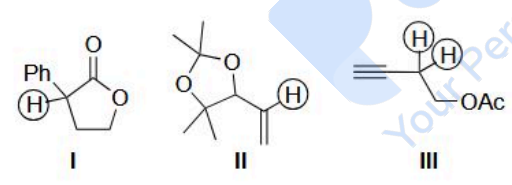
In $^1H$ NMR, the multiplicity pattern expected for the highlighted protons in the following compounds is
- The $^1H$ NMR of mixture of ethyl iodide and bromoform gives three signals at $\delta$ 6.80, 3.20 and 1.85 ppm with integration of 1, 3, 4.5, respectively. The molar ratio of ethyl iodide and bromoform is
- The ${}^{31}\text{P}\{^1\text{H}\}$ NMR spectrum of $2,2,6,6-\text{N}_4\text{P}_4\text{Cl}_4(\text{NMe}_2)_4$ is expected to show
The number of signals observed in the proton decoupled $^{13}\text{C}$ NMR spectrum of the following compound is