
Karplus Equation and Minimum Coupling
The Karplus equation is a fundamental concept in Nuclear Magnetic Resonance (NMR) spectroscopy that relates the magnitude of the coupling constant ($J$) between two vicinal nuclei (typically protons separated by three bonds) to the dihedral angle ($\phi$) between the C-H bonds involved.
This relationship helps chemists understand the three-dimensional structure (conformation) of molecules by analyzing the observed coupling constants.
Understanding the Karplus Equation Trend
The Karplus equation indicates that the magnitude of the vicinal coupling constant ($J$) varies significantly with the dihedral angle ($\phi$) between the coupled protons.
The general trend observed is:
- Coupling is strongest (maximum $J$ value) when the dihedral angle is near $0^\circ$ and $180^\circ$.
- Coupling is weakest (minimum $J$ value) when the dihedral angle is near $90^\circ$.
Identifying the Minimum Coupling Angle
Mathematically, the Karplus equation often involves terms like $\cos^2(\phi)$ and $\cos(\phi)$. Let's analyze the value of these terms at the given angles:
- At $\phi = 0^\circ$: $\cos(0^\circ) = 1$, $\cos^2(0^\circ) = 1$.
- At $\phi = 60^\circ$: $\cos(60^\circ) = 0.5$, $\cos^2(60^\circ) = 0.25$.
- At $\phi = 90^\circ$: $\cos(90^\circ) = 0$, $\cos^2(90^\circ) = 0$.
- At $\phi = 120^\circ$: $\cos(120^\circ) = -0.5$, $\cos^2(120^\circ) = 0.25$.
- At $\phi = 180^\circ$: $\cos(180^\circ) = -1$, $\cos^2(180^\circ) = 1$.
The equation shows that the coupling constant ($J$) is minimized when the dihedral angle ($\phi$) is approximately $90^\circ$, as both the $\cos(\phi)$ and $\cos^2(\phi)$ terms contribute minimally or become zero at this angle, depending on the specific form of the equation used.
Therefore, the vicinal proton-proton coupling constant reaches its minimum value when the dihedral angle is $90^\circ$.
Important Questions from Nmr
- The $^1H$ NMR of mixture of ethyl iodide and bromoform gives three signals at $\delta$ 6.80, 3.20 and 1.85 ppm with integration of 1, 3, 4.5, respectively. The molar ratio of ethyl iodide and bromoform is
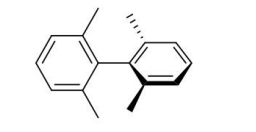
The number of signals observed in the proton decoupled $^{13}\text{C}$ NMR spectrum of the following compound is
The organic compound that displays following data is
$^1\text{H}$ NMR ($400\text{ MHz}$): $\delta \ 7.38\text{ (d)}, \ 7.25\text{ (d)}, \ 1.29\text{ (s) ppm}$
The correct match of the circled protons in Column $\text{P}$ with the $^1\text{H}$ NMR chemical shift ($\delta\text{ ppm}$) in Column $\text{Q}$ is
P Q I 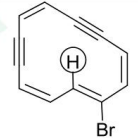
A 6.72 II 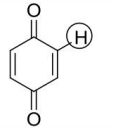
B 16.4 III 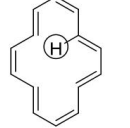
C -0.61 - The ${}^{31}\text{P}\{^1\text{H}\}$ NMR spectrum of $2,2,6,6-\text{N}_4\text{P}_4\text{Cl}_4(\text{NMe}_2)_4$ is expected to show


