
If $\frac{AB}{AC} = \frac{BD}{DC}$ then $\angle ABC$ is: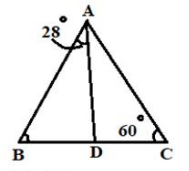
To solve this problem, we need to use the Angle Bisector Theorem. According to this theorem, if a line divides the opposite side of a triangle in the ratio of the other two sides, then it is an angle bisector of the opposite angle.
In the given triangle, we have:
\(\frac{AB}{AC} = \frac{BD}{DC}\)
This means that \(AD\) is the angle bisector of \(\angle BAC\). Therefore, \(\angle BAD = \angle DAC\).
Given \(\angle BAD = 28^\circ\) and \(\angle DAC = 28^\circ\), the total angle at \(A\) is:
\(\angle BAC = \angle BAD + \angle DAC = 28^\circ + 28^\circ = 56^\circ\)
We also know that \(\angle ACD = 60^\circ\).
Since \(\angle ACD\) and \(\angle ABC\) are angles of triangle \(ABC\), we can use the triangle angle sum property:
\(\angle ABC + \angle BAC + \angle ACD = 180^\circ\)
Substituting the known values, we get:
\(\angle ABC + 56^\circ + 60^\circ = 180^\circ\)
Solving for \(\angle ABC\):
\(\angle ABC = 180^\circ - 56^\circ - 60^\circ = 64^\circ\)
Therefore, the correct answer is
$64^\circ$
.
Similar Questions
- In $\Delta PQR$, QR is extended up to S, so that RS = RP. If $\angle RPQ = 55^\circ$ and $\angle PRS = 110^\circ$, then find the measure of $\angle PQS$.
- In a triangle, if angle $A = 30^\circ$ and angle $B = 45^\circ$, then what is the angle of C?
- The total measure of angles in a triangle is:
- ABC is a triangle. BI and CI are angle bisectors of $\angle ABC$ and $\angle ACB$. $\angle BAC = 45^\circ$. Find the measure of $\angle BIC$.
- A side of the triangle is 15 cm and the height of the triangle from this side is 6 cm. Find the area of triangle.
- Area of an equilateral triangle is $49\sqrt{3}\text{ cm}^2$. Find the side of the triangle.
- In a triangle the ratio of angles is 2 : 3 : 4. Find the difference between the greatest and the smallest angle.
- The perimeter of an equilateral triangle is $36\sqrt{3}$ m. Find the height (in metres).
- Write a Pythagorean triplet whose smallest member is 8.
- The lengths of two sides of a triangle are 7 cm and 8 cm respectively and the measure of the angle included between these two sides is $60^\circ$. The length (in cm) of the third side of the triangle is:
Important Questions from Triangles
Among the following options, which are NOT sides of a triangle?
In a Δ ABC, if ∠A = 120° and AB = AC, then the values of ∠B and ∠C are respectively:
In the equilateral Δ ABC, the base BC is trisected at D and E. The line through D, Parallel to AB, meets AC at F and the line through E parallel to AC meets AB at G. If EG and DF intersect at H, then what is the ratio of the sum of the area of parallelogram AGHF and the area of the Δ DHE to the area of the Δ ABC?
The product of the perimeter of a triangle, the radius of its in‐circle, and a number gives the area of the triangle. The number is
A man goes 24 m towards east and then 10 m towards north. How far is he away from his initial position?



