
Identifying Blood Groups
Blood group identification is crucial for safe blood transfusions. It relies on detecting specific antigens present on the surface of red blood cells.
The Role of Agglutination
The process of identification of blood groups primarily involves observing the agglutination reaction. Here's how it works:
- Known antibodies (anti-A, anti-B, anti-D for Rh factor) are mixed with a sample of the patient's red blood cells.
- If a specific antigen is present on the red blood cells, the corresponding antibody will bind to it.
- This binding causes the red blood cells to clump together, a visible reaction called agglutination.
- The pattern of agglutination (or lack thereof) determines the blood group (e.g., A, B, AB, O) and Rh status (positive or negative).
Why Other Options Are Incorrect
The other options describe different immunological reactions not used for routine blood group typing:
- Precipitation: This reaction involves soluble antigens and antibodies forming a visible precipitate, typically used in other diagnostic tests, not blood cell typing.
- Neutralization: This is the process where antibodies inactivate harmful substances like toxins or viruses. It doesn't involve clumping of blood cells.
- Opsonization: This process tags pathogens for destruction by immune cells like phagocytes. It's part of the immune response, not blood typing.
Therefore, agglutination is the specific reaction used to identify blood groups by causing red blood cells to clump when specific antigens and antibodies interact.
Important Questions from Antigen Antibody Reaction
- The pair(s) of lanthanide ions whose ground state term symbols have same spin multiplicity (2S+1) and orbital angular momentum (L), but different spin-orbit coupling (J) is(are)
(Given: Atomic number: Nd = 60; Pm = 61; Ho = 67; Er = 68) The interaction between an antigen (Ag) and a single-chain antibody (Ab) was studied using Scatchard analysis. The result is shown below.
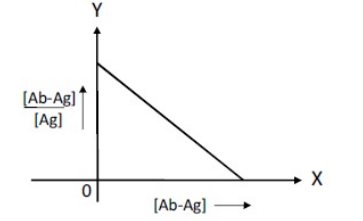
The affinity of interaction and the total concentration of antibody, respectively, can be determined from
Generally, the coordination number and the nature of the electronic absorption band ($f\rightarrow f$transition) of lanthanide (III) ion in their complexes are, respectively,
- The calculated and observed magnetic moments differ considerably for an aqua complex of a lanthanide(III) ion as a result of low lying states of high J. The ion, among the following, is
- The correct electronic configuration and spin only magnetic moment of $Gd^{3+}$ (at.no. 64) are


