
How does strain analysis help in understanding the nature of rock deformation. Discuss centre to centre method of estimation of two dimensional strain.
Strain analysis is crucial for understanding rock deformation as it quantifies the changes in shape, size, and orientation of rocks due to applied stresses. By measuring strain, geologists can decipher the kinematics of deformation, infer stress conditions, and reconstruct the tectonic history of a region. It helps in characterizing various deformational styles, such as brittle fracturing, ductile flow, and their interplay.
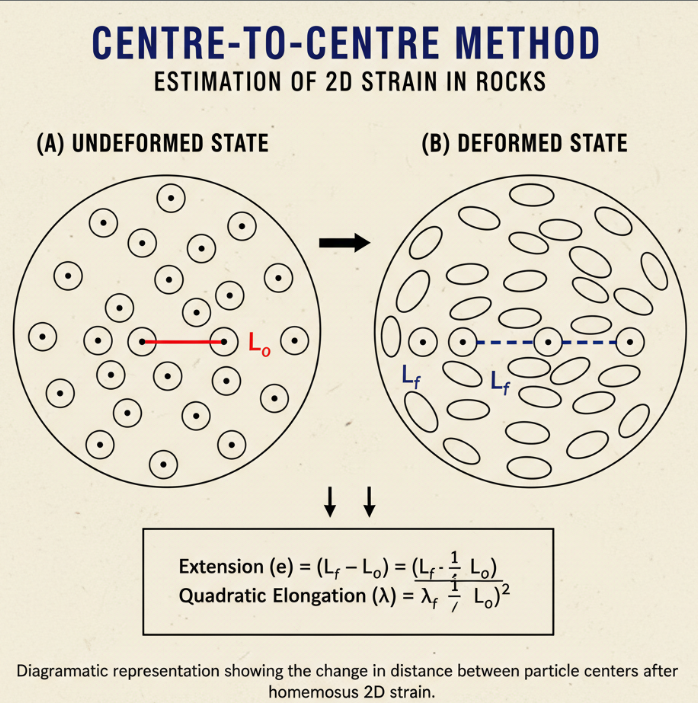
One method for estimating two-dimensional strain is the centre-to-centre method. This technique is particularly useful for analyzing deformed aggregates of objects, such as ooids, pebbles, or fossils, within a rock. The method relies on measuring the changes in the distances between the centers of these objects before and after deformation.
Here’s how the centre-to-centre method works:
- Selection of Objects: Identify a set of randomly distributed, roughly circular or elliptical markers within the rock sample that can be clearly distinguished.
- Measurements:
- Measure the distances between the centers of all adjacent pairs of markers in several different directions on a two-dimensional section.
- Record the initial (undeformed) and final (deformed) distances. In practice, the undeformed state is often inferred or estimated from the least deformed parts of the rock or from knowledge of the original shape of the markers.
- Calculation of Strain:
- For each pair of markers, the extension (e) or shortening is calculated as: e = (Lf - Lo) / Lo, where Lf is the final distance and Lo is the initial distance.
- Alternatively, the quadratic elongation (λ) can be used: λ = (Lf / Lo)²
- By plotting these values against the orientation of the line connecting the centers, a strain ellipse can be constructed.
The strain ellipse visually represents the magnitude and orientation of the principal strains. The longest axis of the ellipse corresponds to the direction of maximum extension, and the shortest axis to the direction of maximum shortening.
Advantages: This method is relatively simple and can be applied to various types of deformed rocks. It provides a direct measure of finite strain.
Limitations: It assumes that the markers were initially uniform in size and randomly distributed. The accuracy depends on the quality of the markers and the number of measurements taken.
Answered By:
Sarvesh Jha
Sarvesh Jha is a seasoned government exam mentor with firsthand success in top exams like IBPS PO, SBI PO, CDS, RRB JE, SSC CGL, BPSC, and CTET. Known for his deep conceptual clarity and strategic approach, he has guided over 5000 students through personalized mentorship. He has been creating well researched content for last 5 years.

Similar Questions
Discuss the position of Asteroid belt within the solar system and comment on the composition of meteorites.
What are sheath folds? Discuss the deformational conditions of their formation.
What is Global Positioning System (GPS)? Explain its geological applications.
Discuss the statement giving suitable examples. "Physical weathering adds to the effectiveness of Chemical weathering".
Discuss the types of Penetrative and Non-penetrative lineations with the help of suitable diagrams and throw light on their genesis.
Discuss favourable conditions for fossilization.
Discuss different concepts of biozonation with neat diagrams.
Describe the lithology, type locality, age and depositional environment of Blaini Boulder Bed.
What engineering properties make Marble, Sandstone and Granite useful as building stone?
Explain different generic type of water and their significance in water supply.
Important Questions from Miscellaneous
How will you manage a case of misplaced copper-T (Cu-T)?
Describe the embryogenesis, clinical features and principles of management of cleft palate.
Write short notes in 150 words:
MetagenesisWrite short notes in 150 words:
Book lungsWrite short notes in 150 words:
Paedomorphosis



