
1. alcohols
2. aldehydes
3. ketones
4. $\alpha$-halocarboxylic acids
Understanding the Hell-Volhard Zelinsky Reaction
The Hell-Volhard Zelinsky (HVZ) reaction is a fundamental organic chemistry reaction primarily known for its ability to introduce a halogen (bromine or chlorine) at the alpha-position ($\alpha$-position) of a carboxylic acid.
Reaction Mechanism and Products
The HVZ reaction typically involves treating a carboxylic acid with elemental halogen (like $Br_2$ or $Cl_2$) in the presence of a catalytic amount of phosphorus ($P$) or phosphorus tribromide ($PBr_3$).
The process generally follows these steps:
- The carboxylic acid reacts with $P$ or $PBr_3$ to form an acyl halide. For example, using $PBr_3$: $$3 RCH_2COOH + PBr_3 \rightarrow 3 RCH_2COBr + H_3PO_3$$
- The acyl halide then undergoes enolization. The enol form is readily halogenated at the $\alpha$-carbon because the double bond is conjugated with the carbonyl group. $$RCH_2COBr \rightleftharpoons RCH=C(OH)Br$$ $$RCH=C(OH)Br + Br_2 \rightarrow RCHBrCOBr + HBr$$
- The resulting $\alpha$-halo acyl halide can then react with another molecule of the starting carboxylic acid to regenerate the acyl halide and form the $\alpha$-halocarboxylic acid. $$RCHBrCOBr + RCH_2COOH \rightarrow RCHBrCOOH + RCH_2COBr$$
The net result is the formation of an $\alpha$-halocarboxylic acid.
Why Other Options Are Incorrect
- Alcohols: Alcohols are typically formed through reduction reactions or hydrolysis of esters/alkyl halides, not directly by the HVZ reaction.
- Aldehydes: Aldehydes can sometimes be formed from carboxylic acids via reduction, but the HVZ reaction specifically targets the $\alpha$-position for halogenation, not the carbonyl carbon itself to form an aldehyde.
- Ketones: Ketones are usually formed from the oxidation of secondary alcohols or through Friedel-Crafts acylation, neither of which is the direct outcome of the HVZ reaction.
Conclusion
Based on the mechanism and outcome, the Hell-Volhard Zelinsky reaction specifically produces $\alpha$-halocarboxylic acids.
Important Questions from Aldehydes, Ketones and Carboxylic Acids
Phenol is brominated in solvent CS₂ at low temperature. The product formed are:
What is not true regarding compound [B]?
(A) They are higher boiling liquids than aldehydes and ketones due to extensive H bonding
(B) They are soluble in Benzene
(C) They produce alkane when heated with soda lime
(D) Produces CO₂ when treated with NaHCO₃
Choose the correct answer from the options given below:
Which of the following is the correct statement for hybridization of C-atom and number of π bonds in the Carbonyl group?
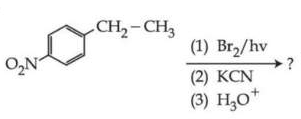
What is the product formed in the following reaction sequence?
What will be the product formed when cyclohexanone undergoes Aldol condensation?


