Assertion (A) : Rabindranath Tagore won the Nobel Prize in Literature for Geetanjali.
Reason (R) : Geetanjali is a collection of poems reflecting spiritual themes.
In the light of the above statements, choose the most appropriate answer from the options given below :
Analyzing Assertion (A)
Assertion (A) states that Rabindranath Tagore won the Nobel Prize in Literature for Geetanjali. This statement is factually correct. Rabindranath Tagore was awarded the Nobel Prize in Literature in 1913, primarily for his collection of poems known in English translation as Gitanjali (Song Offerings).
Analyzing Reason (R)
Reason (R) states that Geetanjali is a collection of poems reflecting spiritual themes. This statement is also factually correct. The poems in Gitanjali explore deep spiritual and philosophical ideas, often focusing on devotion, nature, and the divine.
Evaluating the Explanation
While both Assertion (A) and Reason (R) are true, Reason (R) does not provide the direct and complete explanation for why Tagore won the Nobel Prize. The Nobel Committee cited Tagore's work for its "profoundly sensitive, fresh and beautiful verse, by which, he has in his own creative mind made his poetic genius a living part of the literature of the West." Although the spiritual themes contribute to the beauty and depth of the verse, they are a characteristic of the poetry rather than the sole or primary reason for the award, which focuses on overall literary merit and impact.
Conclusion
- Assertion (A) is correct.
- Reason (R) is correct.
- Reason (R) is not the correct explanation of Assertion (A).
Therefore, the most appropriate answer is that both statements are correct, but (R) is not the correct explanation of (A).
Similar Questions
Match List - I with List - II.
List - I List - II A. Apple, Orange, Fruits I. 
B. Son, Mother, Father II. 
C. Cat, Dog, Elephant III. 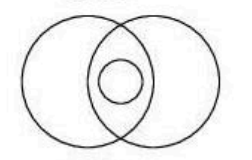
D. Player, Cricket, Ground IV. 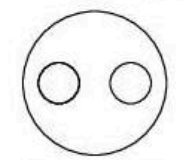
Choose the correct answer from the options given below :For the sets $A=\{0, 1, 2, 3\}$, $B=\{2, 3\}$, $C=\{1, 2, 4\}$, Match List - I with List - II.
List - I List - II A. $A - B$ I. $\{2\}$ B. $B \cap C$ II. $A$ C. $A \cup B$ III. $\{1, 2\}$ D. $A \cap C$ IV. $\{0, 1\}$ Choose the correct answer from the options given below :
Match List - I with List - II : On the basis of share of expenditure in given pie chart.
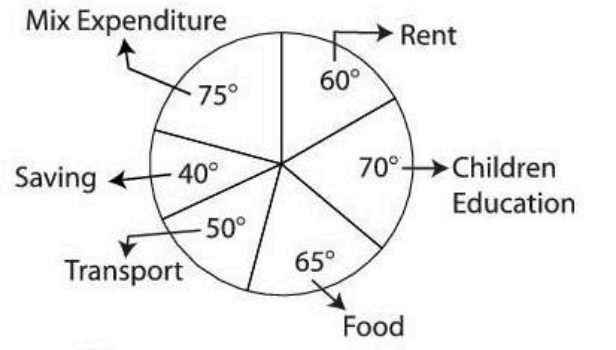
List - I List - II A. Percentage of Expenditure on Rent I. $11.11$ B. Percentage of Expenditure on Transport II. $13.89$ C. Percentage of Expenditure on Saving III. $16.67$ D. Percentage of Expenditure on Food IV. $18.06$ Choose the correct answer from the options given below :
- According to the author, the Indian people
- Indians do not do anything beneficial to society unless
- The author says that India
- The author suggests that
- What value does the author want to build into the educational system ?
- Given below are two statements: one is labelled as Assertion (A) and the other is labelled as Reason (R).
Assertion (A): All even numbers are divisible by two.
Reason (R) : An even number is defined as a number divisible by two.
In the light of the above statements, choose the most appropriate answer from the options given below: - Given below are two statements : one is labelled as Assertion (A) and the other is labelled as Reason (R).
Assertion (A) : Iron rusts faster in moist air.
Reason (R) : Moisture accelerates the oxidation process.
In the light of the above statements, choose the most appropriate answer from the options given below :
Important Questions from Mixed Topic (CUET PG)
- Kalpsutra, the illustrated canonical text is from:-
- The Harappan city almost exclusively devoted to craft production was-:
- Mohandas Karamchand Gandhi launched quit India movement after the failure of:-
- The "Objectives Resolution" was introduced in constituent assembly by:-
- Who among the following was not a member of the constituent assembly:-