Every society must develop in its people a social responsibility. This is something that we, in India, have been falling short of. We are very individualistic and don't relate ourselves to our society as such. Very seldom do we actually go out and do something, which is beneficial to the society and which does not have a side-benefit for ourselves, as individuals and this is another thing that must be built into the education system. Our young boys and girls coming out must have a feeling for our society. There is a special responsibility that you have, that we all have in building up the spirit. We have to see that what we learn is not used only for our own personal benefits, that every task we do is such that it benefits the weak and the poor, as Gandhiji has said. India, today, is striving out into the modern world. We are looking ahead to new technology, to high technology, new methods, new types of employment and a new dynamism in our economic growth. But while we look ahead, we must not forget the millions who are still below the poverty line. When we look at technology, when we look at science, when we look at development, our attention must not be diverted from what is still a major block in India - the poor and deprived groups and everything we do must be targeted in a manner that the benefit will flow to the weak, the deprived and the depressed.
Author's Value for the Educational System
The question asks about the specific value the author wishes to integrate into the educational system. Analyzing the options reveals a focus on the purpose of individual contribution.
Identifying the Core Educational Goal
The author emphasizes a particular model for societal engagement through education. Let's examine the choices:
- Option 1 suggests pure individualism.
- Option 2 proposes working for society without seeking personal rewards.
- Option 3 reverses the focus, prioritizing individuals over society.
- Option 4 mandates side-benefits for social work.
Determining the Author's Desired Value
The author's intended value for the educational system centers on fostering a spirit of selfless contribution to society. This means encouraging individuals to contribute their efforts for the collective good, without the primary motivation being personal or financial gain. Option 2 directly reflects this principle, advocating for work benefiting the community without expectation of personal return.
Therefore, the value the author wants to build into the educational system is the understanding and practice of working for the benefit of society without expecting personal rewards.
Similar Questions
Match List - I with List - II.
List - I List - II A. Apple, Orange, Fruits I. 
B. Son, Mother, Father II. 
C. Cat, Dog, Elephant III. 
D. Player, Cricket, Ground IV. 
Choose the correct answer from the options given below :For the sets $A=\{0, 1, 2, 3\}$, $B=\{2, 3\}$, $C=\{1, 2, 4\}$, Match List - I with List - II.
List - I List - II A. $A - B$ I. $\{2\}$ B. $B \cap C$ II. $A$ C. $A \cup B$ III. $\{1, 2\}$ D. $A \cap C$ IV. $\{0, 1\}$ Choose the correct answer from the options given below :
Match List - I with List - II : On the basis of share of expenditure in given pie chart.
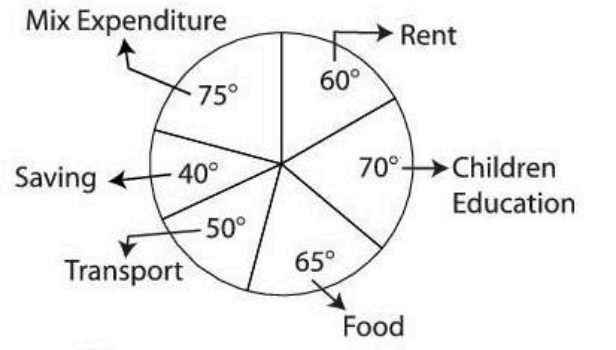
List - I List - II A. Percentage of Expenditure on Rent I. $11.11$ B. Percentage of Expenditure on Transport II. $13.89$ C. Percentage of Expenditure on Saving III. $16.67$ D. Percentage of Expenditure on Food IV. $18.06$ Choose the correct answer from the options given below :
- According to the author, the Indian people
- Indians do not do anything beneficial to society unless
- The author says that India
- The author suggests that
- Given below are two statements: one is labelled as Assertion (A) and the other is labelled as Reason (R).
Assertion (A): All even numbers are divisible by two.
Reason (R) : An even number is defined as a number divisible by two.
In the light of the above statements, choose the most appropriate answer from the options given below: - Given below are two statements : one is labelled as Assertion (A) and the other is labelled as Reason (R).
Assertion (A) : Iron rusts faster in moist air.
Reason (R) : Moisture accelerates the oxidation process.
In the light of the above statements, choose the most appropriate answer from the options given below : - Given below are two statements : one is labelled as Assertion (A) and the other is labelled as Reason (R).
Assertion (A) : Rabindranath Tagore won the Nobel Prize in Literature for Geetanjali.
Reason (R) : Geetanjali is a collection of poems reflecting spiritual themes.
In the light of the above statements, choose the most appropriate answer from the options given below :
Important Questions from Mixed Topic (CUET PG)
- Kalpsutra, the illustrated canonical text is from:-
- The Harappan city almost exclusively devoted to craft production was-:
- Mohandas Karamchand Gandhi launched quit India movement after the failure of:-
- The "Objectives Resolution" was introduced in constituent assembly by:-
- Who among the following was not a member of the constituent assembly:-