To solve this logical reasoning problem, we need to identify the pattern or rule that distinguishes the given letter-clusters and find the one that does not belong with the others.
Let's evaluate each option:
- GBI: Assign each letter a number based on its position in the alphabet (A=1, B=2, ..., Z=26). G=7, B=2, I=9.
If we look at the differences between the numbers: \(9 - 2 = 7\), and \(7 - 2 = 5\). Clearly, this follows a rule of subtracting the positions from each other. - AJG: A=1, J=10, G=7.
Differences: \(10 - 1 = 9\) (not matching the pattern), thus, doesn't work with the logic. - GBK: G=7, B=2, K=11.
Differences: \(11 - 2 = 9\), and \(7 - 2 = 5\) (matches none of the consistent patterns). It appears unrelated in consistent combinations to others because no sequential possibility exists. - CHG: C=3, H=8, G=7.
Differences: \(8 - 3 = 5\), \(8 - 7 = 1\). Consistency not inherent as well shows easily mistaken appearance.
Upon verification, AJG, CHG proceed with natural deduction, maintaining difference clarity yet comparably intricate upon attempt. GBI standard comprehension offers similarity with existing increments, proving its isolation.
Conclusion: Among the options, GBK is the letter-cluster that does not follow a specific discernible pattern consistent with others like GBI, AJG, or CHG. Hence, it is the different one.
Similar Questions
- Four letter-clusters have been given, out of which three are alike in some manner and one is different. Select the letter-cluster that is different.
Four letter-clusters have been given, out of which three are alike in some manner and one is different. Select the letter-cluster that is different.
- Four letter-clusters have been given, out of which three are alike in some manner and one is different. Select the letter-cluster that is different.
Five letter-clusters have been given, out of which four are alike in some manner and one is different. Select the letter-cluster that is different.
WXZ, RSU, MNP, KLM, EFH- Four letter-clusters have been given, out of which three are alike in some manner and one is different. Select the letter-cluster that is different.
- Four letter-clusters have been given, out of which three are alike in some manner and one is different. Select the letter-cluster that is different.
Four letter-clusters have been given, out of which three are alike in some manner and one is different. Select the one that is different.
- Four letter-clusters have been given, out of which three are alike in some manner and one is different. Select the letter-cluster that is different.
Select the combination of letters that when sequentially placed in the gaps of the given letter series will complete the series.
kb_fg_k_df_tkbd_gtkbdf_t
Identify the odd one out.
Important Questions from Classification
Directions for the following 3 (three) items : consider the given information and answer the three items that follow.
A, B, C, D, E, F and G are Lecturers from different cities—Hyderabad, Delhi, Shillong, Kanpur, Chennai, Mumbai and Srinagar (not necessarily in the same order) who participated in a conference. Each one of them is specialized in a different subject, viz., Economics, Commerce, History, Sociology, Geography, Mathematics and Statistics (not necessarily in the same order).
Further 1. Lecturer from Kanpur is specialized in Geography
2. Lecturer D is from Shillong
3. Lecturer C from Delhi is specialized in Sociology
4. Lecturer B is specialized in neither History nor Mathematics
5. Lecturer A who is specialized in Economics does not belong to Hyderabad
6. Lecturer F who is specialized in Commerce belongs to Srinagar
7. Lecturer G who is specialized in Statistics belongs to Chennai
Who is specialized in Geography?
A, B, C, D, E, F and G are Lecturers from different cities—Hyderabad, Delhi, Shillong, Kanpur, Chennai, Mumbai and Srinagar (not necessarily in the same order) who participated in a conference. Each one of them is specialized in a different subject, viz., Economics, Commerce, History, Sociology, Geography, Mathematics and Statistics (not necessarily in the same order).
Further 1. Lecturer from Kanpur is specialized in Geography
2. Lecturer D is from Shillong
3. Lecturer C from Delhi is specialized in Sociology
4. Lecturer B is specialized in neither History nor Mathematics
5. Lecturer A who is specialized in Economics does not belong to Hyderabad
6. Lecturer F who is specialized in Commerce belongs to Srinagar
7. Lecturer G who is specialized in Statistics belongs to Chennai
To which city does the Lecturer specialized in Economics belong?
A, B, C, D, E, F and G are Lecturers from different cities—Hyderabad, Delhi, Shillong, Kanpur, Chennai, Mumbai and Srinagar (not necessarily in the same order) who participated in a conference. Each one of them is specialized in a different subject, viz., Economics, Commerce, History, Sociology, Geography, Mathematics and Statistics (not necessarily in the same order).
Further 1. Lecturer from Kanpur is specialized in Geography
2. Lecturer D is from Shillong
3. Lecturer C from Delhi is specialized in Sociology
4. Lecturer B is specialized in neither History nor Mathematics
5. Lecturer A who is specialized in Economics does not belong to Hyderabad
6. Lecturer F who is specialized in Commerce belongs to Srinagar
7. Lecturer G who is specialized in Statistics belongs to Chennai
Who of the following belongs to Hyderabad?
In a school, there are five teachers A, B, C, D and E. A and B teach Hindi and English. C and B teach English and Geography. D and A teach Mathematics and Hindi. E and B teach History and French. Who teaches maximum numb, of subjects?
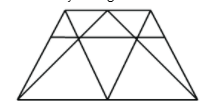
How many triangles are there in the given figure?