
(A) It has alpha-hydrogen atom.
(B) It does not have alpha-hydrogen atom.
(C) It does not undergo self-oxidation and reduction on heating with concentrated alkali.
(D) It undergo self-oxidation and reduction on heating with concentrated alkali.
Choose the correct answer from the options given below :
Cannizzaro Reaction Conditions Explained
The Cannizzaro reaction is a specific chemical process involving aldehydes that lack alpha-hydrogen atoms. When heated with a strong, concentrated alkali solution, these aldehydes undergo disproportionation. This means one aldehyde molecule is oxidized to form a carboxylate salt, and simultaneously, another molecule is reduced to form an alcohol.
Formaldehyde Structure and Alpha-Hydrogens
Formaldehyde, with the chemical formula $HCHO$, has the structure:
$H-CHO$
Crucially, formaldehyde does not have any alpha-hydrogens. The carbon atom in the carbonyl group (C=O) is directly attached only to hydrogen atoms, not to any alkyl group that could provide alpha-hydrogens.
Analysis of Statements Regarding Formaldehyde
- Statement (A): Claims formaldehyde has alpha-hydrogen atoms. This is incorrect.
- Statement (B): States formaldehyde lacks alpha-hydrogen atoms. This is correct and a prerequisite for the Cannizzaro reaction.
- Statement (C): Asserts that formaldehyde does not undergo self-oxidation and reduction with concentrated alkali. This is incorrect.
- Statement (D): Correctly states that formaldehyde undergoes self-oxidation and reduction upon heating with concentrated alkali. This is the definition of the Cannizzaro reaction occurring.
Deriving the Correct Answer
Formaldehyde's ability to undergo the Cannizzaro reaction is directly linked to its structure (lack of alpha-hydrogens) and its subsequent reaction pathway (self-oxidation/reduction) in the presence of a strong base.
Since statements (B) and (D) accurately describe these characteristics, they are the correct reasons. Therefore, the correct option combines (B) and (D).
Important Questions from Aldehydes, Ketones and Carboxylic Acids
Phenol is brominated in solvent CS₂ at low temperature. The product formed are:
What is not true regarding compound [B]?
(A) They are higher boiling liquids than aldehydes and ketones due to extensive H bonding
(B) They are soluble in Benzene
(C) They produce alkane when heated with soda lime
(D) Produces CO₂ when treated with NaHCO₃
Choose the correct answer from the options given below:
Which of the following is the correct statement for hybridization of C-atom and number of π bonds in the Carbonyl group?
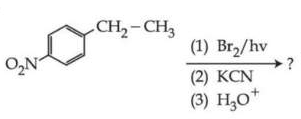
What is the product formed in the following reaction sequence?
What will be the product formed when cyclohexanone undergoes Aldol condensation?


