
For the traverse given below, the benchmark is at ground point L. The Reduced Level (RL) of L is 150.000 m. The direction of the traverse is from L to N. The readings on levelling staff using the same levelling instrument kept at Stations S1 and S2 during the traversing are shown in the figure. Matching the information given under Column 1 and Column 2, which one of the following options is CORRECT?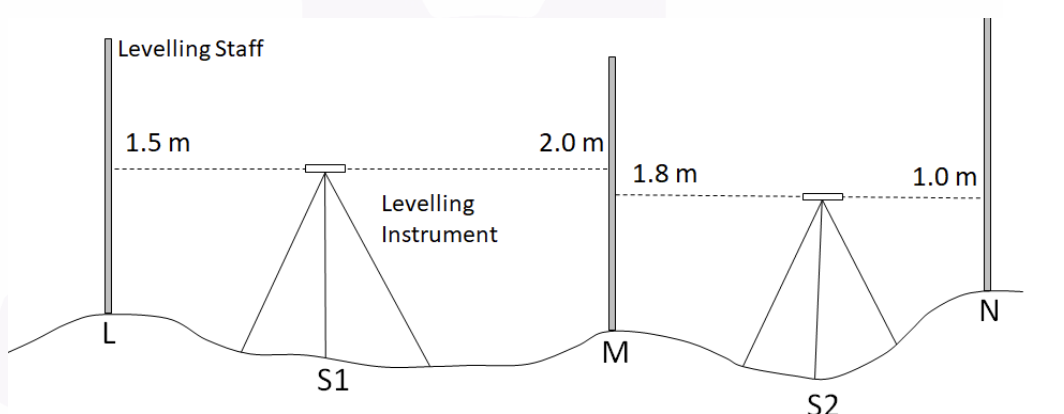
Column 1 Column 2 (P) 3.300 m (I) Sum of Back Sights (Q) 2.500 m (II) Sum of Fore Sights (R) 150.300 m (III) RL of Point N (S) 3.000 m (T) 150.500 m
To solve the problem, we need to match the column of values with their respective meanings. The key concepts here involve the use of surveying principles such as back sights, fore sights, and reduced levels.
- Understanding Back Sight (BS) and Fore Sight (FS):
- Back Sight (BS): It is the first reading taken on the leveling staff held on a known datum point (in this case, point L) to establish the instrument's elevation. Therefore, the Back Sight typically includes higher readings.
- Fore Sight (FS): This is the reading taken on the leveling staff held at the next point (further in the direction of survey) to determine a new level. Usually, these are lower as the leveling staff is moved to points lower from the benchmark.
- Matching Information:
- Sum of Back Sights: In this problem, the higher reading (3.300 m) corresponds to the sum of back sights, as back sights tend to be larger since they are from a known level.
- Sum of Fore Sights: This corresponds to a smaller reading (3.000 m), as these measurements are typically lower.
- RL of Point N: Given that the RL of the benchmark L is 150.000 m, the reading of 150.300 m corresponds to the RL at point N.
- Correct Match:
- (I) Sum of Back Sights - (P) 3.300 m
- (II) Sum of Fore Sights - (S) 3.000 m
- (III) RL of Point N - (R) 150.300 m
Thus, the correct option is: (I) - (P) ; (II) - (S) ; (III) - (R).
| Column 1 | Column 2 |
|---|---|
| (I) Sum of Back Sights | (P) 3.300 m |
| (II) Sum of Fore Sights | (S) 3.000 m |
| (III) RL of Point N | (R) 150.300 m |
Important Questions from Levelling
Which of the following errors can be eliminated by reciprocal measurements in differential leveling?
I. Error due to earth curvature
II. Error due to atmospheric refraction
Which of the following is the CORRECT ratio of refraction correction to curvature correction?
The following sights are taken on a “turning point”
If the bench mark is 560.50 m. and height of instrument is 561.365 m. then, what will be back sight ?
________ is a relatively permanent point of reference whose elevation w.r.t. some assumed datum is known.


