
Which of the following is the CORRECT ratio of refraction correction to curvature correction?
1/7
When performing surveying over long distances, the Earth's curvature and atmospheric refraction significantly affect the line of sight. To ensure accurate measurements, corrections must be applied for both phenomena. Understanding the ratio between these corrections is crucial for precise surveying calculations.
Curvature Correction Explained
The curvature correction accounts for the spherical shape of the Earth. If you imagine a perfectly level line of sight from a surveying instrument, it would follow a tangent to the Earth's surface. However, due to the Earth's curvature, the actual ground level drops below this tangent line. This effect causes observed readings to be higher than they would be on a flat plane. The correction for curvature is always subtractive from the staff reading to get the correct level.
The formula for curvature correction (\(C\)) is given by:
$$C = 0.0785 D^2$$
Where:
- \(C\) is the curvature correction in meters.
- \(D\) is the distance between the instrument and the staff in kilometers.
Refraction Correction Explained
The refraction correction accounts for the bending of light rays as they pass through the Earth's atmosphere. Light rays from a distant object bend downwards towards the Earth's surface due to the varying density of air at different altitudes. This atmospheric refraction makes objects appear higher than their actual position. Therefore, the observed staff reading will be lower than it should be. The correction for refraction is always additive to the staff reading.
The formula for refraction correction (\(R\)) is given by:
$$R = 0.0112 D^2$$
Where:
- \(R\) is the refraction correction in meters.
- \(D\) is the distance between the instrument and the staff in kilometers.
Calculating the Ratio of Refraction Correction to Curvature Correction
To find the ratio of refraction correction to curvature correction, we divide the formula for refraction correction by the formula for curvature correction:
$$\text{Ratio} = \frac{\text{Refraction Correction}}{\text{Curvature Correction}}$$
Substitute the formulas for \(R\) and \(C\):
$$\text{Ratio} = \frac{0.0112 D^2}{0.0785 D^2}$$
The \(D^2\) term cancels out, as it is common to both corrections, showing that the ratio is independent of the distance:
$$\text{Ratio} = \frac{0.0112}{0.0785}$$
Now, perform the division:
$$\text{Ratio} \approx 0.14267$$
This decimal value is approximately equal to the fraction \(1/7\):
$$\frac{1}{7} \approx 0.14285$$
Therefore, the correct ratio of refraction correction to curvature correction is approximately \(1/7\).
Key Takeaway on Correction Ratio
The refraction correction is typically about one-seventh (\(1/7\)) of the curvature correction. This means that atmospheric refraction partially compensates for the effect of Earth's curvature. The combined correction, which is the net effect, is calculated as the curvature correction minus the refraction correction (\(C - R\)).
$$\text{Combined Correction} = 0.0785 D^2 - 0.0112 D^2$$
$$\text{Combined Correction} = (0.0785 - 0.0112) D^2$$
$$\text{Combined Correction} = 0.0673 D^2$$
This combined correction is always subtractive from the staff reading to obtain the accurate level.
Important Questions from Levelling
For the traverse given below, the benchmark is at ground point L. The Reduced Level (RL) of L is 150.000 m. The direction of the traverse is from L to N. The readings on levelling staff using the same levelling instrument kept at Stations S1 and S2 during the traversing are shown in the figure.
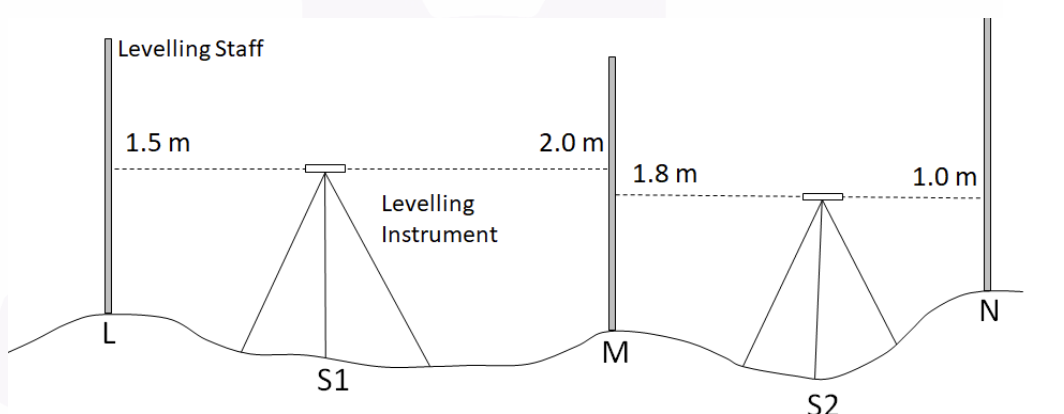
Column 1 Column 2 (P) 3.300 m (I) Sum of Back Sights (Q) 2.500 m (II) Sum of Fore Sights (R) 150.300 m (III) RL of Point N (S) 3.000 m (T) 150.500 m Matching the information given under Column 1 and Column 2, which one of the following options is CORRECT?
Which of the following errors can be eliminated by reciprocal measurements in differential leveling?
I. Error due to earth curvature
II. Error due to atmospheric refraction
The following sights are taken on a “turning point”
If the bench mark is 560.50 m. and height of instrument is 561.365 m. then, what will be back sight ?
________ is a relatively permanent point of reference whose elevation w.r.t. some assumed datum is known.


