
If the bench mark is 560.50 m. and height of instrument is 561.365 m. then, what will be back sight ?
In the field of surveying, particularly in leveling operations, it is crucial to understand the relationship between different measurements like the bench mark, height of instrument, and back sight. These values are fundamental for accurately determining elevations and carrying out surveying tasks effectively. This solution will explain how to calculate the back sight using the provided bench mark and height of instrument values.
Leveling Fundamentals: Understanding Bench Mark, Height of Instrument, and Back Sight
Leveling is a branch of surveying that deals with the measurement of relative heights or depths of points on the earth's surface. To perform leveling, various terms and concepts are used, which are essential for accurate calculations.
- Bench Mark (BM): A bench mark is a fixed reference point of known elevation (or reduced level) that is used as a datum for leveling surveys. It serves as a starting point for determining the elevations of other points.
- Height of Instrument (HI): The height of instrument is the elevation of the line of sight of the leveling instrument (like a dumpy level or an auto level) above a chosen datum. It is calculated by adding the back sight reading to the reduced level of the bench mark or the point where the staff is held for the back sight reading.
- Back Sight (BS): A back sight is the first staff reading taken after setting up the leveling instrument. It is always taken on a point of known elevation, typically a bench mark or a turning point, to establish the height of instrument. It is essentially a reading taken looking backward towards a known point.
Bench Mark: The Reference Point in Surveying
The bench mark is the foundational element for any leveling project. Its reduced level (RL) provides the base elevation from which all other elevations are derived. In this question, the bench mark (BM) has a reduced level of \(560.50 \text{ m}\). This means that this specific point is \(560.50 \text{ m}\) above a predefined datum, such as mean sea level.
Height of Instrument: Establishing the Line of Sight
The height of instrument (HI) represents the actual elevation of the horizontal line of sight of the leveling instrument. Once the instrument is set up and leveled, its line of sight forms a horizontal plane. All readings taken from this setup are relative to this HI. The HI is calculated using the formula:
\[ \text{Height of Instrument (HI)} = \text{Reduced Level of Bench Mark (BM RL)} + \text{Back Sight (BS)} \]
In this problem, the height of instrument (HI) is given as \(561.365 \text{ m}\). This value has already been established by taking a back sight reading on a known bench mark.
Back Sight Calculation: Determining the Initial Reading
The question asks for the back sight reading. Since we know the height of instrument and the reduced level of the bench mark, we can rearrange the fundamental leveling formula to find the back sight. The back sight is crucial because it allows us to establish the height of instrument at the beginning of a leveling run.
We use the relationship:
\[ \text{Height of Instrument (HI)} = \text{Bench Mark Reduced Level (BM RL)} + \text{Back Sight (BS)} \]
To find the back sight, we can rearrange the formula as follows:
\[ \text{Back Sight (BS)} = \text{Height of Instrument (HI)} - \text{Bench Mark Reduced Level (BM RL)} \]
Calculating Back Sight: Step-by-Step Solution
Let's apply the given values to the formula:
Given:
- Bench Mark Reduced Level (BM RL) \( = 560.50 \text{ m} \)
- Height of Instrument (HI) \( = 561.365 \text{ m} \)
To find: Back Sight (BS)
Using the formula for Back Sight:
\[ \text{BS} = \text{HI} - \text{BM RL} \]
Substitute the given values:
\[ \text{BS} = 561.365 \text{ m} - 560.50 \text{ m} \]
Perform the subtraction:
\[ \text{BS} = 0.865 \text{ m} \]
Here is a summary of the values:
| Parameter | Value (m) |
|---|---|
| Bench Mark (BM) Reduced Level | 560.50 |
| Height of Instrument (HI) | 561.365 |
| Back Sight (BS) | 0.865 |
Final Back Sight Result
Based on the calculations, the back sight reading is \(0.865 \text{ m}\). This value represents the staff reading taken on the bench mark to establish the height of instrument.
Important Questions from Levelling
For the traverse given below, the benchmark is at ground point L. The Reduced Level (RL) of L is 150.000 m. The direction of the traverse is from L to N. The readings on levelling staff using the same levelling instrument kept at Stations S1 and S2 during the traversing are shown in the figure.
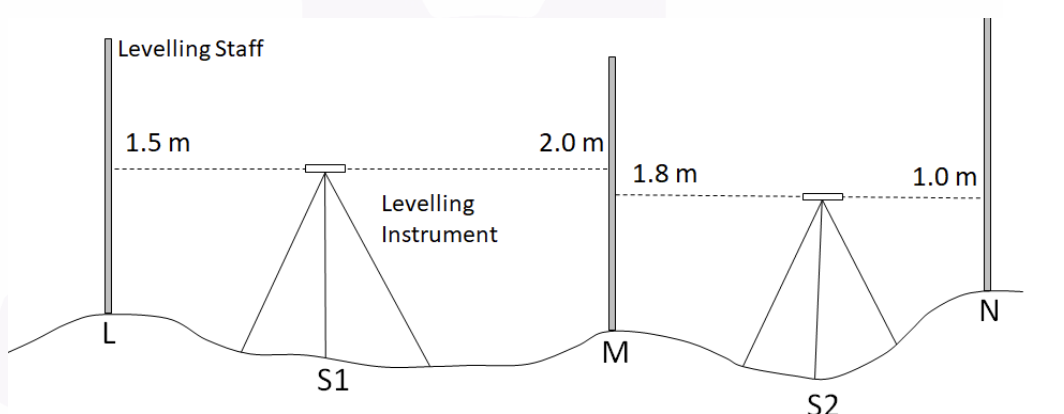
Column 1 Column 2 (P) 3.300 m (I) Sum of Back Sights (Q) 2.500 m (II) Sum of Fore Sights (R) 150.300 m (III) RL of Point N (S) 3.000 m (T) 150.500 m Matching the information given under Column 1 and Column 2, which one of the following options is CORRECT?
Which of the following errors can be eliminated by reciprocal measurements in differential leveling?
I. Error due to earth curvature
II. Error due to atmospheric refraction
Which of the following is the CORRECT ratio of refraction correction to curvature correction?
The following sights are taken on a “turning point”
________ is a relatively permanent point of reference whose elevation w.r.t. some assumed datum is known.


