
Question
For an ideal plug flow reactor, which of the following statements is/are true?
Understanding Ideal Plug Flow Reactor Properties
An ideal Plug Flow Reactor (PFR) is a fundamental concept in chemical reaction engineering. We evaluate each statement based on its defining characteristics:
-
1. Approximation by CSTRs in Series
This statement is considered true. The behavior of an ideal PFR can be seen as the limiting case of an infinite number of Continuous Stirred Tank Reactors (CSTRs) connected in series. Thus, a large number of CSTRs effectively approximates a PFR. -
2. Significant Back Mixing
This statement is false. Ideal PFRs are defined by the complete absence of back mixing. Fluid elements travel through the reactor without mixing in the reverse direction. -
3. Significant Axial Mixing
This statement is false. An ideal PFR specifically assumes no axial mixing (or dispersion) along the direction of flow. Fluid elements maintain their identities and order. -
4. Uniform Velocity Profile
This statement is true. In an ideal PFR, the fluid velocity is uniform across any given cross-section perpendicular to the flow path. All fluid particles at the same axial position move at the same velocity.
Identifying True Statements for PFR
Based on the analysis of the defining properties of an ideal PFR:
- Statement A is true because a PFR behaves like the limit of many CSTRs in series.
- Statement D is true as a uniform velocity profile is a key assumption for ideal plug flow.
Therefore, the correct options describing an ideal PFR are A and D.
Was this answer helpful?
Important Questions from Heterocyclic Chemistry
The major product formed in the following reaction sequences is
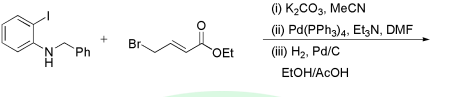
- The reaction(s) that yield(s) 2-methylquinoline as the major product is (are)
- Which one of the following bioreactor configurations is the basis for a trickling biological filter?
The major products M and N formed in the following reactions are

The structures of the major products W and X in the following synthetic scheme are
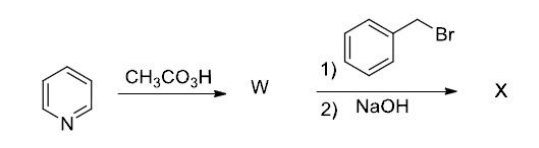
Need Expert Advice?


