
Find the odd one out from the given alternatives:
Tagore
Tansen, Birbal and Abul Fazl all belonged to Akbar's court as part of his famed Navaratnas (the nine jewels) in the 16th century — Tansen the musician, Birbal the wit, and Abul Fazl the historian who authored the Akbarnama.
Rabindranath Tagore, in contrast, was a 19th–20th century Bengali poet and Nobel laureate who has no connection with Akbar's court.
Hence the odd one out is Tagore.
Similar Questions
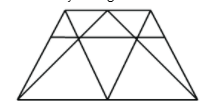
How many triangles are there in the given figure?
Find the odd word/letters/number pair from the given alternatives.
(A) Fire (B) Light (C) Gas (D) Water
Find the odd word/letters/number pair from the given alternatives.
Four letter-clusters have been given, out of which three are alike in some manner and one is different. Select the letter-cluster that is different.
Note: The odd one out is not based on the number of consonants/vowels or their position in the letter cluster.
Three of the following numbers are alike in a certain way and one is different. Pick the odd one out.
(NOTE: Operations should be performed on the whole numbers, without breaking down the numbers into their constituent digits. E.g. 13 – Operations on 13 such as adding/deleting/multiplying etc. to 13 can be performed. Breaking down 13 into 1 and 3 and then performing mathematical operations on 1 and 3 is not allowed.)
Three of the following numbers are alike in a certain way and one is different. Pick the odd one out. (NOTE: Operations should be performed on the whole numbers, without breaking down the numbers into its constituent digits. E.g. 13 – Operations on 13 such as adding/deleting/multiplying etc., to 13 can be performed. Breaking down 13 into 1 and 3 and then performing mathematical operations on 1 and 3 is not allowed.)
Four letter-clusters have been given, out of which three are alike in some manner and one is different. Select the letter-cluster that is different. Note: The odd one out is not based on the number of consonants/vowels or their position in the letter cluster.
Find the odd one out from the given alternatives:
Three of the following numbers are alike in a certain way and one is different. Pick the odd one out.
(NOTE : Operations should be performed on the whole numbers, without breaking down the numbers into its constituent digits. E.g. 13 – Operations on 13 such as adding /deleting /multiplying etc., to 13 can be performed. Breaking down 13 into 1 and 3 and then performing mathematical operations on 1 and 3 is not allowed.)Which group doesn't match the pattern?
Important Questions from Classification
Directions for the following 3 (three) items : consider the given information and answer the three items that follow.
A, B, C, D, E, F and G are Lecturers from different cities—Hyderabad, Delhi, Shillong, Kanpur, Chennai, Mumbai and Srinagar (not necessarily in the same order) who participated in a conference. Each one of them is specialized in a different subject, viz., Economics, Commerce, History, Sociology, Geography, Mathematics and Statistics (not necessarily in the same order).
Further 1. Lecturer from Kanpur is specialized in Geography
2. Lecturer D is from Shillong
3. Lecturer C from Delhi is specialized in Sociology
4. Lecturer B is specialized in neither History nor Mathematics
5. Lecturer A who is specialized in Economics does not belong to Hyderabad
6. Lecturer F who is specialized in Commerce belongs to Srinagar
7. Lecturer G who is specialized in Statistics belongs to Chennai
Who is specialized in Geography?
A, B, C, D, E, F and G are Lecturers from different cities—Hyderabad, Delhi, Shillong, Kanpur, Chennai, Mumbai and Srinagar (not necessarily in the same order) who participated in a conference. Each one of them is specialized in a different subject, viz., Economics, Commerce, History, Sociology, Geography, Mathematics and Statistics (not necessarily in the same order).
Further 1. Lecturer from Kanpur is specialized in Geography
2. Lecturer D is from Shillong
3. Lecturer C from Delhi is specialized in Sociology
4. Lecturer B is specialized in neither History nor Mathematics
5. Lecturer A who is specialized in Economics does not belong to Hyderabad
6. Lecturer F who is specialized in Commerce belongs to Srinagar
7. Lecturer G who is specialized in Statistics belongs to Chennai
To which city does the Lecturer specialized in Economics belong?
A, B, C, D, E, F and G are Lecturers from different cities—Hyderabad, Delhi, Shillong, Kanpur, Chennai, Mumbai and Srinagar (not necessarily in the same order) who participated in a conference. Each one of them is specialized in a different subject, viz., Economics, Commerce, History, Sociology, Geography, Mathematics and Statistics (not necessarily in the same order).
Further 1. Lecturer from Kanpur is specialized in Geography
2. Lecturer D is from Shillong
3. Lecturer C from Delhi is specialized in Sociology
4. Lecturer B is specialized in neither History nor Mathematics
5. Lecturer A who is specialized in Economics does not belong to Hyderabad
6. Lecturer F who is specialized in Commerce belongs to Srinagar
7. Lecturer G who is specialized in Statistics belongs to Chennai
Who of the following belongs to Hyderabad?
In a school, there are five teachers A, B, C, D and E. A and B teach Hindi and English. C and B teach English and Geography. D and A teach Mathematics and Hindi. E and B teach History and French. Who teaches maximum numb, of subjects?
How many triangles are there in the given figure?



