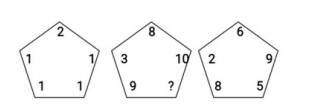
Find the missing number from the below options. 3 10 5 8 7 ? 5 8
6
Finding the Missing Number in the Sequence
The problem asks us to find the missing number in the given sequence: 3, 1, 0, 5, 8, 7, ?, 5, 8.
To solve this type of problem, we need to carefully observe the numbers in the sequence and look for a mathematical or logical pattern that connects them.
Analyzing the Number Sequence
Let's look at the differences or relationships between consecutive numbers:
- From 3 to 1: $1 - 3 = -2$
- From 1 to 0: $0 - 1 = -1$
- From 0 to 5: $5 - 0 = +5$
- From 5 to 8: $8 - 5 = +3$
- From 8 to 7: $7 - 8 = -1$
- From 7 to ?: ? - 7
- From ? to 5: $5 - ?$
- From 5 to 8: $8 - 5 = +3$
Let's list these differences:
| Transition | Operation |
|---|---|
| $3 \to 1$ | Add $-2$ |
| $1 \to 0$ | Add $-1$ |
| $0 \to 5$ | Add $+5$ |
| $5 \to 8$ | Add $+3$ |
| $8 \to 7$ | Add $-1$ |
| $7 \to ?$ | Add $X$ |
| $? \to 5$ | Add $Y$ |
| $5 \to 8$ | Add $+3$ |
Identifying the Pattern
The sequence of differences seems irregular initially: -2, -1, +5, +3, -1, X, Y, +3.
Let's look closer at the differences from the 5th term (which is 8):
- $8 \to 7$ is Add $-1$
- $? \to 5$ and $5 \to 8$. Notice the final difference is $+3$, which appeared earlier from $5 \to 8$ (4th to 5th term).
Consider the pattern of operations from the 5th term (8) onwards:
- $8$ (5th term) $\xrightarrow{\text{Add -1}} 7$ (6th term)
- $7$ (6th term) $\xrightarrow{\text{Add X}} ?$ (7th term)
- $?$ (7th term) $\xrightarrow{\text{Add Y}} 5$ (8th term)
- $5$ (8th term) $\xrightarrow{\text{Add +3}} 8$ (9th term)
Notice the sequence of additions for the last few terms: $-1, X, Y, +3$. Compare this to the additions we found: -2, -1, +5, +3, -1, X, Y, +3.
It appears there is a repeating or consistent pattern starting from the 5th term. The operations sequence is $-1, -1, -1, +3$.
Applying the Pattern to Find the Missing Number
Let's test the repeating pattern of additions $-1, -1, -1, +3$ starting from the 5th term (value 8):
- Start with the 5th term: $8$.
- Apply the first operation (Add $-1$): $8 + (-1) = 7$. This matches the 6th term.
- Apply the second operation (Add $-1$): $7 + (-1) = 6$. This should be the 7th term (the missing number).
- Apply the third operation (Add $-1$): $6 + (-1) = 5$. This matches the 8th term.
- Apply the fourth operation (Add $+3$): $5 + 3 = 8$. This matches the 9th term.
This pattern perfectly fits the sequence if the missing number is 6.
So, the complete sequence of additions between terms is: Add $-2$, Add $-1$, Add $+5$, Add $+3$, Add $-1$, Add $-1$, Add $-1$, Add $+3$.
The number that fits the pattern is 6.
Revision Table: Sequence Pattern Summary
| Term | Value | Operation to next term | Resulting next term |
|---|---|---|---|
| 1st | 3 | Add $-2$ | 1 (2nd term) |
| 2nd | 1 | Add $-1$ | 0 (3rd term) |
| 3rd | 0 | Add $+5$ | 5 (4th term) |
| 4th | 5 | Add $+3$ | 8 (5th term) |
| 5th | 8 | Add $-1$ | 7 (6th term) |
| 6th | 7 | Add $-1$ | 6 (7th term - Missing Number) |
| 7th | 6 | Add $-1$ | 5 (8th term) |
| 8th | 5 | Add $+3$ | 8 (9th term) |
Additional Information: Solving Number Series
Finding patterns in number series is a common type of logical reasoning question. Here are some common patterns to look for:
- Arithmetic Series: A constant difference between consecutive terms.
- Geometric Series: A constant ratio between consecutive terms.
- Differences: Look at the differences between consecutive terms. The differences themselves might form a pattern (e.g., an arithmetic series).
- Double Differences: Look at the differences of the differences.
- Alternating Series: The pattern might alternate between different operations or sequences for alternate terms.
- Squares or Cubes: Terms might be related to squares or cubes of natural numbers, or squares/cubes plus/minus a constant.
- Fibonacci-like Series: Each term is the sum of the previous two terms.
- Operations: Terms might be related by specific operations (addition, subtraction, multiplication, division) often involving small constants or previous terms.
- Composite Patterns: A combination of two or more simple patterns.
Solving number sequence problems requires careful observation, testing different possibilities, and logical deduction.
Similar Questions
In the following question, select the number which can be placed at the sign of question mark (?) from the given alternatives.
2
3
7
8
7
3
6
4
3
5
7
?
Find the missing number from the below options.
3
GNQ
8
3
RBS
9
4
TUA
2
2
FPC
5
3
OLH
?
Find the missing number from the below options.
4
9
9
7
4
?
11
13
19
Find the missing number from the below options.
16
25
81
36
49
9
10
12
?
Find the missing number from the below options.
7
3
58
8
2
?
Find the missing number from the below options.
117
6
9
?
5
4
Find the missing number from the below options.
8
2
520
7
3
370
6
4
?
Study the given pattern carefully and select the number that can replace the question mark (?) in it.
\(\begin{array}{} {25}&{40}&{10}\\ {81}&9&9\\ ?&{16}&8 \end{array}\)
Study the given pattern carefully and select the number that can replace the question mark (?) in it.
14
9
7
7
4
5
?
10
4
Select the option that can replace the question mark (?) in the third row.
Row1: 6, 4, 26
Row2: 3, 7, 29
Row3: 2, 6, ?
Important Questions from Missing Number in Matrix
- A clock buzzes 1 time at 1 o'clock, 2 times at 2 o'clock, 3 times at 3 o'clock and so on. How many total number of times will it buzz from 12 noon till 11 p.m. (including both)?
What is the value of the missing number?
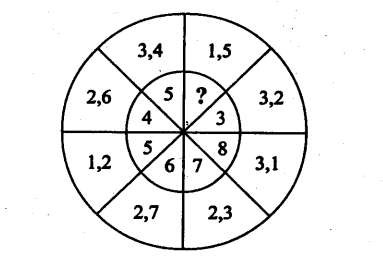
Consider the following figure :
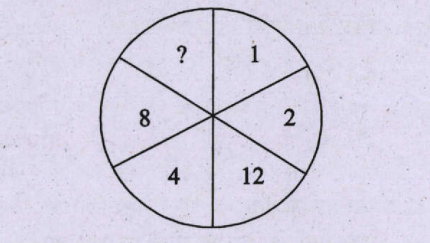
Find out the missing number from among the following:
Consider the following figure matrix
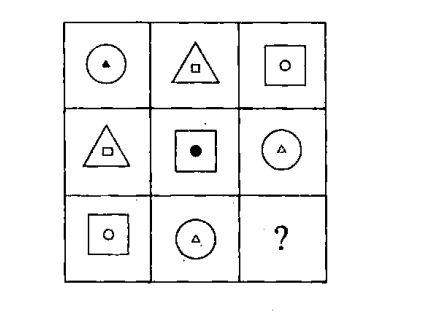
Study the given pattern carefully and select the number from among the given options that can replace the question mark (?) in it.