Understanding Weaving Risks During Beat-Up
Explanation of Increased Bumping Possibility
The 'beat-up' process in weaving involves the reed forcefully pushing the weft yarn into place. Certain conditions can increase the likelihood of 'bumping', which refers to damage or breakage of warp yarns during this stage. The key factors influencing this risk are warp tension and cloth fell displacement.
Analysis of Contributing Factors
The possibility of bumping increases significantly under the following combined conditions:
- Low Warp Tension: When warp yarns are not sufficiently taut, they have more slack. This allows them to move erratically and increases the chance of friction or snagging against the reed or adjacent warp yarns as the reed moves forward. Loose yarns are also more vulnerable to breaking under sudden stress.
- High Cloth Fell Displacement: This refers to a larger forward movement of the reed with each pick. A greater displacement means a more forceful action to pack the weft. When combined with low warp tension, this forceful beat-up action can put excessive stress on the already vulnerable warp yarns, leading to increased chances of friction damage and breakage (bumping).
Therefore, the combination of low warp tension and high cloth fell displacement creates the most hazardous conditions during beat-up, elevating the probability of warp yarn bumping.
Important Questions from FABR Loom Mechanisms Beating-up
- Amongst the following, producing a dense fabric in a weaving machine require(s)
Two shuttle looms (A and B), running at same picks per minute, have same mass of sley and associated system for beat up. The crank radius ($r$) and the eccentricity ratio ($e$) of the looms are
$r_A = 10 \text{ cm}; e_A = 0.5; r_B = 6 \text{ cm}; e_B = 0.4$
The ratio of the beat up force of loom A to that of loom B (rounded off to 1 decimal place) is ________- At front centre ($0^\circ$) and at back centre ($180^\circ$) of a shuttle loom,
- The force exerted by the reed on the cloth-fell at the instant of beat-up (weaving resistance) depends on
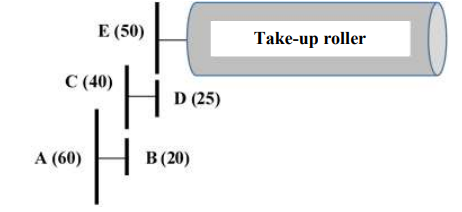
A take-up motion is shown below. The number of teeth on gear A, B, C, D and E are 60, 20, 40, 25 and 50, respectively. The circumference of the take-up roller is 40 cm. If one tooth is broken on gear B, then the wavelength (cm) of the fault in fabric (in integer) is _________________.