
Draw structure of cholesterol and explain its role in health and diseases.
Here is the structure of cholesterol:
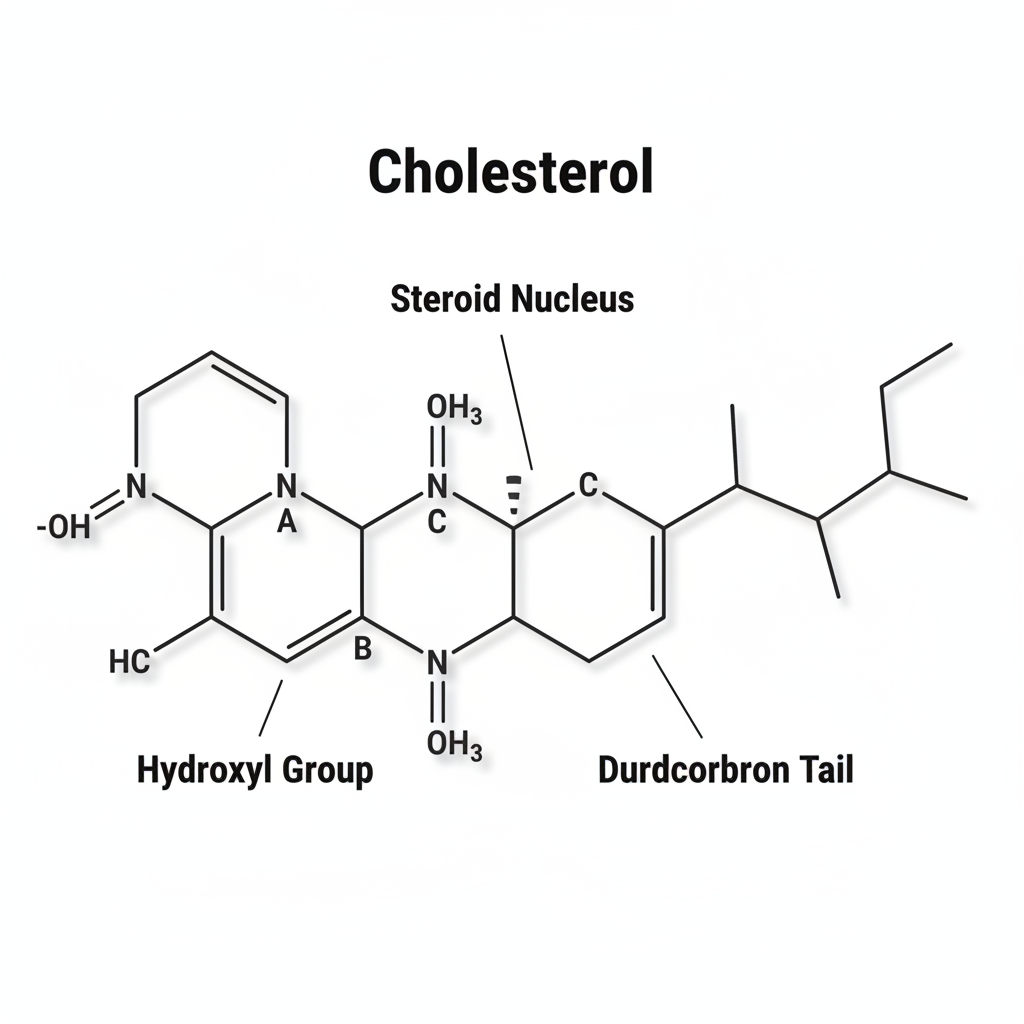
Cholesterol, a waxy, fat-like substance, is essential for numerous bodily functions, playing a dual role in health and disease. Structurally, it's a steroid alcohol characterized by four fused hydrocarbon rings (the steroid nucleus), a hydroxyl group, and a branched hydrocarbon chain.
In healthy individuals, cholesterol is vital. It's a fundamental component of cell membranes, providing fluidity and structural integrity. Without cholesterol, cell membranes would be rigid and permeable. It also serves as a precursor for synthesizing essential compounds, including steroid hormones like testosterone, estrogen, and cortisol, which regulate metabolism, immunity, and reproductive functions. Furthermore, cholesterol is crucial for producing vitamin D, vital for bone health, and bile acids, which aid in fat digestion and absorption in the small intestine.
However, an imbalance in cholesterol levels can significantly contribute to various diseases. High levels of low-density lipoprotein (LDL) cholesterol, often termed "bad" cholesterol, lead to atherosclerosis—the hardening and narrowing of arteries due to plaque buildup. This plaque, composed of cholesterol, fats, and other substances, can restrict blood flow, increasing the risk of heart attacks and strokes. Conversely, high-density lipoprotein (HDL) cholesterol, or "good" cholesterol, helps remove excess cholesterol from the arteries, transporting it back to the liver for excretion, thereby reducing cardiovascular disease risk. Managing dietary intake and lifestyle choices are key to maintaining healthy cholesterol levels and preventing associated diseases.
Cholesterol is a vital lipid with a unique four-ring steroid structure. It's crucial for healthy cell membranes, and serves as a precursor for steroid hormones, vitamin D, and bile acids. While essential, an excess of LDL ("bad") cholesterol can lead to atherosclerosis, increasing the risk of heart disease and stroke. HDL ("good") cholesterol, however, helps remove excess cholesterol, highlighting the delicate balance required for good health.
Answered By:
Sakshi Negi
Sakshi Negi is a Delhi-based journalist and content specialist with expertise in educational content and digital media, focusing particularly on government exam preparation and career guidance. With a degree in Journalism and Mass Communication from NRAI School of Mass Communication and her background as a Kendriya Vidyalaya alumna, she brings unique insights into the Indian education system and government sector opportunities.

Similar Questions
Write it in 150 words:- Protein sorting in Golgi apparatus
write it in 150 words :- Structure and function of Lampbrush chromosome
Write it in 150 words :- Symptoms, causes and treatment of thalassemia
Write it in 150 words :- Coupling and repulsion phases of linkage
Write a short note in 150 words :- Sympatric and allopatric speciation
Describe composition of plasma membrane.
Differentiate between facilitated and passive diffusion across the membrane with examples.
Explain how mutations affect variations in population and natural selection.
Draw pedigrees for autosomal recessive and sex-linked inheritance using examples from human.
Describe the synthetic theory of evolution.
Important Questions from Miscellaneous
How will you manage a case of misplaced copper-T (Cu-T)?
Describe the embryogenesis, clinical features and principles of management of cleft palate.
Write short notes in 150 words:
MetagenesisWrite short notes in 150 words:
Book lungsWrite short notes in 150 words:
Paedomorphosis



