
The credit policy of a firm is not decided for which combination of the following? a. Maximisation of sales b. Minimisation of bad debt losses c. Maximisation of collection from debtors d. Minimisation of adverse effect on the volume of sales Codes:
a, b and d
Concept: A firm's credit policy is framed by weighing the objectives of granting credit - chiefly boosting sales while containing the losses and risks that credit brings - whereas recovering dues already outstanding belongs to a separate collection policy.
The genuine objectives the credit policy balances are the maximisation of sales through liberal credit (a), the minimisation of bad-debt losses that credit brings (b), and the minimisation of any adverse effect on the volume of sales (d). These three trade-offs are what the credit policy is decided around.
Example: Extending easier credit terms lifts sales (a) but raises default risk (b), so the policy is tuned to gain volume without a bad-debt blow-up - illustrating exactly these trade-offs.
Maximisation of collection from debtors (c) belongs to the firm's collection policy - how outstanding dues are recovered - not to the credit-granting policy, so every option containing c is ruled out. The combination representing the credit policy is therefore a, b and d, which is the keyed option (4).
Hence the code is a, b and d.
Similar Questions
If the rate of return on investment opportunity is likely to be 15 percent, the opportunity cost of capital is 10 percent, the earnings per share is ₹ 10 and if the pay-out ratio is 40 percent, the price of share according to Walter Model will be :
If the total cash requirement of a company is ₹ 2 crore next year, the opportunity cost of funds is 15 percent per annum and the cost of conversion from securities to cash per transaction is ₹ 150, the optimum cash balance as per Baumol’s Model will be :
Let the face value of commercial paper be denoted by F.V., net amount realised from the commercial paper be NAR, maturity period of commercial paper be MP. The effective pre - tax cost of commercial paper shall be :
The average spread between the cost of goods sold and the sales revenue is indicated by :
EBIT - EPS indifference point is the level of :
The Gaia hypothesis was propounded in 1999 by :
From the following two statements of Assertion (A) and Reasoning (R), indicate the correct code:
Assertion (A): The quantity of a product demanded invariably changes inversely to changes in its price.
Reason (R): The price effect is the net result of the positive substitution effect and negative income effect.
Codes:
Which one of the following combinations may not render the investment multiplier inapplicable?
Match the items of the List-I with that of the List-II and suggest the correct code from the following:
List-I List-II i. Cost function a. Kinked demand ii. Supply function b. Isoquants iii. Production function c. Engineering method iv. Oligopoly d. Factor prices Codes:
Match the items of List-I with those of List-II and indicate the correct code from the following:
List-I List-II i. Sale of existing firm to the management a. Reverse synergy ii. Financing acquisition with substantial secured borrowings b. Management buyout iii. Firms demerged worth more to other firms c. Reverse capital budgeting iv. Cash inflows on demerger at present at the sacrifice in form of cash out-flow on transfer of division/asset d. Leveraged buyout Codes:
Important Questions from Miscellaneous
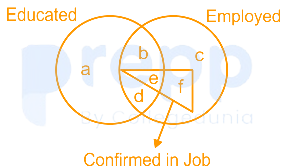
Read the given figure and find the region representing persons who are educated and employed but not confirmed in job.
The magazine in which Mahatma Gandhi mentioned what he wanted the Constitution to do is:
Which gas shields the surface of the earth from ultraviolet radiation from the sun?
Which event is marked as an Intangible Cultural Heritage of Humanity by UNESCO?
Who has been conferred with the rank of the Commander of the Order of the British Empire in 2018?



