
Consider the signal $$x(t) = \begin{cases} e^{-t} & , \ t \ge 0 \\ 0 & , \ t < 0 \end{cases}$$ Let $X(\omega)$ denote the Fourier transform of this signal. The integral $$\frac{1}{2\pi} \int_{-\infty}^{\infty} X(\omega) d\omega \text{ is }$$
Evaluating the Fourier Transform Integral
The question asks for the value of the integral part of the Inverse Fourier Transform formula evaluated at a specific point.
Inverse Fourier Transform Property
The Inverse Fourier Transform (IFT) of a signal $X(\omega)$ is given by:
$x(t) = \frac{1}{2\pi} \int_{-\infty}^{\infty} X(\omega) e^{j\omega t} d\omega$This formula connects the frequency-domain representation $X(\omega)$ back to the time-domain signal $x(t)$.
Calculating the Integral Value
To find the value of the specific integral $\frac{1}{2\pi} \int_{-\infty}^{\infty} X(\omega) d\omega$, we can evaluate the IFT formula at $t=0$:
- Set $t=0$ in the IFT equation: $x(0) = \frac{1}{2\pi} \int_{-\infty}^{\infty} X(\omega) e^{j\omega (0)} d\omega$
- Simplify the exponent $e^{j\omega (0)}$: Since $e^0 = 1$, the equation becomes: $x(0) = \frac{1}{2\pi} \int_{-\infty}^{\infty} X(\omega) (1) d\omega$ $x(0) = \frac{1}{2\pi} \int_{-\infty}^{\infty} X(\omega) d\omega$
- Determine the value of $x(0)$ from the given signal $x(t)$. The signal is defined as: $x(t) = \begin{cases} e^{-t} & , \ t \ge 0 \\ 0 & , \ t < 0 \end{cases}$ Evaluating $x(t)$ at $t=0$, we get $x(0) = e^{-0} = 1$.
- Equate the results from steps 2 and 3: $\frac{1}{2\pi} \int_{-\infty}^{\infty} X(\omega) d\omega = x(0) = 1$
Therefore, the value of the integral is 1.
Important Questions from Fourier Transform
- Match the LIST-I with LIST-IIChoose the correct answer from the options given below:
LIST-I LIST-II A. Continuous and periodic signal I. continuous time Fourier series B. Continuous and aperiodic signal II. discrete time Fourier series C. Discrete and periodic signal III. continuous time Fourier transform D. Discrete and aperiodic signal IV. discrete time Fourier transform - The Fourier transform of the signal $x(t)=e^{at}u(-t)$, $a0$ is
The Fourier transform for the given waveform.
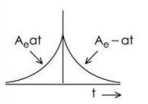
Fourier transform or Fourier integral of a function f(t) is given by
Match the following :
List - I List - II (spectrum |G(w)| in the original figure) (a) Rectangular Pulse (i) 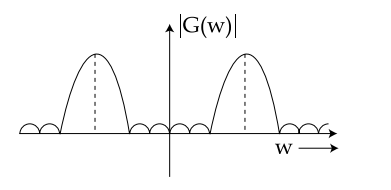
(b) Double-sided Exponential (ii) 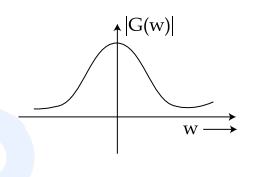
(c) Cosine Pulse (iii) 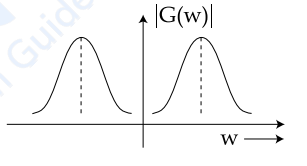
(d) Damped Sine (iv) 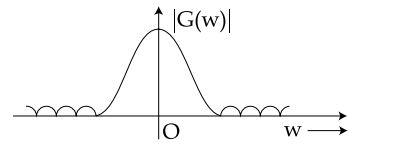
Codes :


