
(a) The Fourier transform of an impulse function is a constant function.
(b) The Fourier transform of an impulse function is a sine function
(c) The Fourier transform of a constant function is an impulse function.
(d) The Fourier transform of a constant function is a signum function.
Which of the above statements are correct ?
The question asks to identify the correct statements about the Fourier Transforms of an impulse function and a constant function.
Fourier Transform Properties Analysis
We need to evaluate the given statements based on the standard properties of the Fourier Transform:
- Fourier Transform of an Impulse Function: The Fourier Transform of the Dirac delta impulse function, $\delta(t)$, is a constant value. Using the angular frequency definition ($\omega$), the transform is often represented as $1$ or $2\pi$, depending on the convention. Mathematically, $\mathcal{F}\{\delta(t)\} = 1$.
- Statement (a) claims the Fourier transform of an impulse function is a constant function. This is correct.
- Statement (b) claims the Fourier transform of an impulse function is a sine function. This is incorrect.
- Fourier Transform of a Constant Function: The Fourier Transform of a constant function $C$ (defined for all time) is proportional to the Dirac delta function located at zero frequency. Mathematically, $\mathcal{F}\{C\} = 2\pi C \delta(\omega)$.
- Statement (c) claims the Fourier transform of a constant function is an impulse function. This is correct, as the result is $2\pi C \delta(\omega)$.
- Statement (d) claims the Fourier transform of a constant function is a signum function. This is incorrect.
Identifying Correct Statements
Based on the analysis:
- Statement (a) is correct.
- Statement (b) is incorrect.
- Statement (c) is correct.
- Statement (d) is incorrect.
Therefore, the correct statements are (a) and (c).
Conclusion
The combination of correct statements (a) and (c) corresponds to Option 4.
Important Questions from Fourier Transform
- Match the LIST-I with LIST-IIChoose the correct answer from the options given below:
LIST-I LIST-II A. Continuous and periodic signal I. continuous time Fourier series B. Continuous and aperiodic signal II. discrete time Fourier series C. Discrete and periodic signal III. continuous time Fourier transform D. Discrete and aperiodic signal IV. discrete time Fourier transform - The Fourier transform of the signal $x(t)=e^{at}u(-t)$, $a0$ is
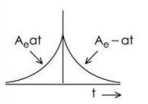
The Fourier transform for the given waveform.
Fourier transform or Fourier integral of a function f(t) is given by
Match the following :
List - I List - II (spectrum |G(w)| in the original figure) (a) Rectangular Pulse (i) 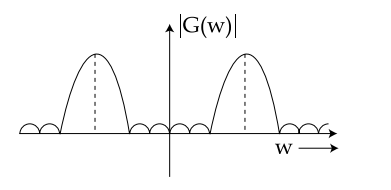
(b) Double-sided Exponential (ii) 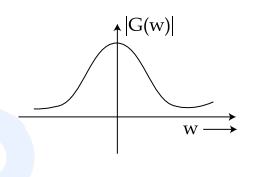
(c) Cosine Pulse (iii) 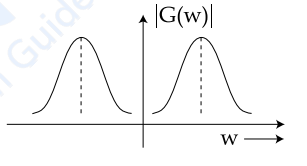
(d) Damped Sine (iv) 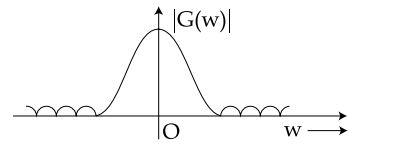
Codes :


