
If 99% of energy of $x(t)$ lies within $B\text{ Hz}$, then which of the following options is TRUE for the value of $B$?
Signal Energy Bandwidth for $x(t) = e^{-2t}$ Signal
The problem requires finding the bandwidth $B$ (in Hz) where 99% of the total energy of the signal $x(t) = e^{-2t}$ (for $t \ge 0$) resides. We assume bandwidth $B$ refers to the frequency range $[-B, B]$.
Calculate Total Signal Energy
The total energy $E_{total}$ of a signal $x(t)$ is calculated as:
$ E_{total} = \int_{-\infty}^{\infty} |x(t)|^2 dt $
For the given signal $x(t) = e^{-2t}$ where $t \ge 0$, this becomes:
$ E_{total} = \int_{0}^{\infty} (e^{-2t})^2 dt = \int_{0}^{\infty} e^{-4t} dt $
Evaluating the integral yields:
$ E_{total} = \left[ -\frac{1}{4} e^{-4t} \right]_{0}^{\infty} = 0 - \left( -\frac{1}{4} \right) = \frac{1}{4} $
Determine Power Spectral Density
The Fourier Transform of $x(t) = e^{-at}u(t)$ is $X(f) = \frac{1}{a+j2\pi f}$. With $a=2$, we have:
$ X(f) = \frac{1}{2+j2\pi f} $
The Power Spectral Density (PSD) is the magnitude squared of the Fourier Transform:
$ |X(f)|^2 = \left| \frac{1}{2+j2\pi f} \right|^2 = \frac{1}{2^2 + (2\pi f)^2} = \frac{1}{4 + 4\pi^2 f^2} $
Calculate Energy within Bandwidth B
The energy $E_B$ within the frequency band $[-B, B]$ is found by integrating the PSD:
$ E_B = \int_{-B}^{B} |X(f)|^2 df = \int_{-B}^{B} \frac{1}{4 + 4\pi^2 f^2} df $
Using the substitution $u = 2\pi f$, $du = 2\pi df$, the integral transforms to:
$ E_B = \frac{1}{2\pi} \int_{-2\pi B}^{2\pi B} \frac{1}{4 + u^2} du = \frac{1}{2\pi} \left[ \frac{1}{2} \arctan\left(\frac{u}{2}\right) \right]_{-2\pi B}^{2\pi B} $
This simplifies to:
$ E_B = \frac{1}{4\pi} \left( \arctan\left(\frac{2\pi B}{2}\right) - \arctan\left(\frac{-2\pi B}{2}\right) \right) = \frac{1}{2\pi} \arctan(\pi B) $
Apply 99% Energy Condition
The condition is that $E_B$ must contain 99% of the total energy:
$ E_B = 0.99 \times E_{total} $
Substituting the expressions for $E_B$ and $E_{total}$:
$ \frac{1}{2\pi} \arctan(\pi B) = 0.99 \times \frac{1}{4} $
Rearranging to solve for $\arctan(\pi B)$:
$ \arctan(\pi B) = \frac{0.99 \pi}{2} $
Solve for Bandwidth B
Taking the tangent of both sides gives:
$ \pi B = \tan\left(\frac{0.99 \pi}{2}\right) $
Since $\frac{0.99 \pi}{2}$ is very close to $\frac{\pi}{2}$, we can approximate $\tan\left(\frac{0.99 \pi}{2}\right)$. Let $\alpha = \frac{0.99 \pi}{2} = \frac{\pi}{2} - \frac{0.01 \pi}{2}$.
Using $\tan(\frac{\pi}{2} - z) = \cot(z)$ and the approximation $\cot(z) \approx 1/z$ for small $z$ (where $z = \frac{0.01 \pi}{2}$):
$ \tan\left(\frac{0.99 \pi}{2}\right) = \cot\left(\frac{0.01 \pi}{2}\right) \approx \frac{1}{\frac{0.01 \pi}{2}} = \frac{2}{0.01 \pi} = \frac{200}{\pi} $
Therefore, $\pi B \approx \frac{200}{\pi}$, which leads to:
$ B \approx \frac{200}{\pi^2} $
Calculating the approximate value:
$ B \approx \frac{200}{(3.14159)^2} \approx 20.26 \text{ Hz} $
Compare with Options
Evaluate the bounds of the relevant options:
- Option 2: Lower bound $63/\pi \approx 20.06$ Hz. Upper bound $64/\pi \approx 20.37$ Hz.
- Option 3: Lower bound $126/\pi \approx 40.11$ Hz. Upper bound $128/\pi \approx 40.74$ Hz.
The calculated value $B \approx 20.26$ Hz falls within the range $(20.06 \text{ Hz}, 20.37 \text{ Hz})$.
Important Questions from Fourier Transform
- Match the LIST-I with LIST-IIChoose the correct answer from the options given below:
LIST-I LIST-II A. Continuous and periodic signal I. continuous time Fourier series B. Continuous and aperiodic signal II. discrete time Fourier series C. Discrete and periodic signal III. continuous time Fourier transform D. Discrete and aperiodic signal IV. discrete time Fourier transform - The Fourier transform of the signal $x(t)=e^{at}u(-t)$, $a0$ is
The Fourier transform for the given waveform.
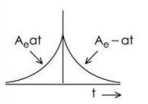
Fourier transform or Fourier integral of a function f(t) is given by
Match the following :
List - I List - II (spectrum |G(w)| in the original figure) (a) Rectangular Pulse (i) 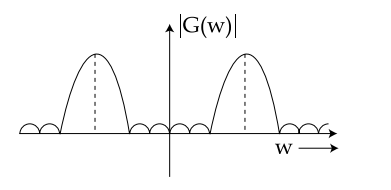
(b) Double-sided Exponential (ii) 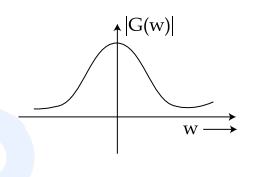
(c) Cosine Pulse (iii) 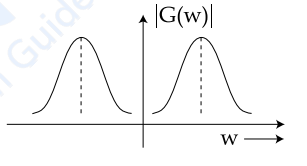
(d) Damped Sine (iv) 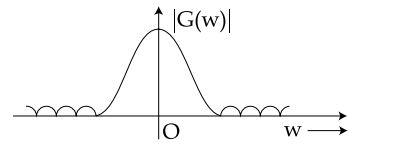
Codes :


