
In a carrom game, a striker of mass 15 g hits a coin of mass 5 g head on and the coin moves with a speed of 0.36 m/s. If the time of contact between the striker and the coin is 3 milliseconds, then what is the average force applied by the striker on the coin?
\(0.60\ N\)
By the impulse-momentum theorem applied to the coin (initially at rest), \(F \times t = \Delta p = m_{coin} v\).
Here \(m_{coin} = 5\ g = 0.005\ kg\), \(v = 0.36\ m/s\) and \(t = 3\ ms = 0.003\ s\).
So \(F = \dfrac{m_{coin} v}{t} = \dfrac{0.005 \times 0.36}{0.003} = \dfrac{0.0018}{0.003} = 0.6\ N\). Hence option (b) is correct.
Similar Questions
A metallic bob X of mass m is released from position A. It collides elastically with another identical bob Y placed at rest at position B on a horizontal frictionless table. The angle AOB is 30°.
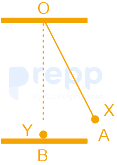
How high does the bob X rise immediately after the
A 100 g sphere is moving at a speed of 20 m/s and collides with another. sphere of mass 50 g. If the second sphere was at rest prior to the collision and the first sphere comes at rest immediately after the collision, considering the collision to be elastic, the speed of the second sphere would be
Important Questions from Collisions
Two bodies collide each other and the collision is perfectly elastic. The co-efficient of restitution of these two bodies is
During inelastic collision between two bodies, which of the following quantities always remain conserved?
A metallic bob X of mass m is released from position A. It collides elastically with another identical bob Y placed at rest at position B on a horizontal frictionless table. The angle AOB is 30°.
How high does the bob X rise immediately after the
A 100 g sphere is moving at a speed of 20 m/s and collides with another. sphere of mass 50 g. If the second sphere was at rest prior to the collision and the first sphere comes at rest immediately after the collision, considering the collision to be elastic, the speed of the second sphere would be



