
Two bodies collide each other and the collision is perfectly elastic. The co-efficient of restitution of these two bodies is
1
Understanding Perfectly Elastic Collisions and Coefficient of Restitution
When two bodies collide, the collision can be classified based on whether kinetic energy is conserved during the collision. A perfectly elastic collision is a type of collision where both momentum and kinetic energy are conserved.
What is the Coefficient of Restitution?
The coefficient of restitution, denoted by '$e$', is a dimensionless quantity that describes the degree to which a collision is elastic or inelastic. It is defined as the ratio of the relative velocity of separation of two bodies after collision to the relative velocity of approach before collision.
Mathematically, the coefficient of restitution is given by:
$$e = \frac{\text{Relative velocity of separation}}{\text{Relative velocity of approach}}$$
If body 1 has initial velocity $u_1$ and final velocity $v_1$, and body 2 has initial velocity $u_2$ and final velocity $v_2$, the relative velocity of approach is $|u_1 - u_2|$ (assuming $u_1 > u_2$ for approach) and the relative velocity of separation is $|v_2 - v_1|$ (assuming $v_2 > v_1$ for separation). So, we can write:
$$e = \frac{|v_2 - v_1|}{|u_1 - u_2|}$$
Coefficient of Restitution in Different Collision Types
- For a perfectly elastic collision, kinetic energy is conserved. This means the relative velocity of separation is equal to the relative velocity of approach. In this case, $e = 1$.
- For a perfectly inelastic collision, the two bodies stick together after collision. The relative velocity of separation is zero. In this case, $e = 0$.
- For an inelastic collision, kinetic energy is not conserved, but momentum is. The relative velocity of separation is less than the relative velocity of approach. In this case, $0 < e < 1$.
Determining 'e' for Perfectly Elastic Collision
As defined, a perfectly elastic collision conserves kinetic energy. A key property derived from the conservation laws (momentum and kinetic energy) for a perfectly elastic collision is that the relative velocity of separation between the colliding bodies is equal in magnitude to their relative velocity of approach.
Since $e = \frac{\text{Relative velocity of separation}}{\text{Relative velocity of approach}}$, and for a perfectly elastic collision, Relative velocity of separation = Relative velocity of approach, the value of $e$ becomes:
$$e = \frac{\text{Relative velocity of approach}}{\text{Relative velocity of approach}} = 1$$
Therefore, the coefficient of restitution for a perfectly elastic collision between two bodies is 1.
Important Questions from Collisions
During inelastic collision between two bodies, which of the following quantities always remain conserved?
A metallic bob X of mass m is released from position A. It collides elastically with another identical bob Y placed at rest at position B on a horizontal frictionless table. The angle AOB is 30°.
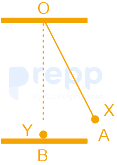
How high does the bob X rise immediately after the
A 100 g sphere is moving at a speed of 20 m/s and collides with another. sphere of mass 50 g. If the second sphere was at rest prior to the collision and the first sphere comes at rest immediately after the collision, considering the collision to be elastic, the speed of the second sphere would be
In a carrom game, a striker of mass 15 g hits a coin of mass 5 g head on and the coin moves with a speed of 0.36 m/s. If the time of contact between the striker and the coin is 3 milliseconds, then what is the average force applied by the striker on the coin?


