
A 100 g sphere is moving at a speed of 20 m/s and collides with another. sphere of mass 50 g. If the second sphere was at rest prior to the collision and the first sphere comes at rest immediately after the collision, considering the collision to be elastic, the speed of the second sphere would be
40 m/s
This problem involves a collision between two spheres. We are given the masses and initial velocity of both spheres, and the final velocity of the first sphere. We need to find the final velocity of the second sphere, considering the collision to be elastic.
In physics, for any collision occurring in an isolated system (where no external forces act), the total momentum of the system before the collision is equal to the total momentum of the system after the collision. This is known as the principle of conservation of momentum. For elastic collisions, kinetic energy is also conserved.
Collision Analysis: Conservation of Momentum
First, let's list the given values, converting mass to kilograms (SI unit):
- Mass of the first sphere, \(m_1 = 100 \text{ g} = 0.1 \text{ kg}\)
- Initial velocity of the first sphere, \(u_1 = 20 \text{ m/s}\)
- Mass of the second sphere, \(m_2 = 50 \text{ g} = 0.05 \text{ kg}\)
- Initial velocity of the second sphere (at rest), \(u_2 = 0 \text{ m/s}\)
- Final velocity of the first sphere (comes to rest), \(v_1 = 0 \text{ m/s}\)
- We need to find the final velocity of the second sphere, \(v_2\).
The principle of conservation of momentum states that the total momentum before the collision equals the total momentum after the collision. Mathematically, this is expressed as:
\(m_1 u_1 + m_2 u_2 = m_1 v_1 + m_2 v_2\)
Now, we substitute the given values into the equation:
\((0.1 \text{ kg})(20 \text{ m/s}) + (0.05 \text{ kg})(0 \text{ m/s}) = (0.1 \text{ kg})(0 \text{ m/s}) + (0.05 \text{ kg}) v_2\)
Let's simplify the equation:
\(2 \text{ kg} \cdot \text{m/s} + 0 = 0 + 0.05 v_2\)
\(2 = 0.05 v_2\)
To find \(v_2\), we rearrange the equation:
\(v_2 = \frac{2}{0.05}\)
\(v_2 = \frac{2}{\frac{5}{100}}\)
\(v_2 = \frac{2 \times 100}{5}\)
\(v_2 = \frac{200}{5}\)
\(v_2 = 40 \text{ m/s}\)
Thus, the speed of the second sphere immediately after the collision would be 40 m/s.
Understanding Elastic Collisions
An elastic collision is a type of collision where, in addition to the conservation of momentum, the total kinetic energy of the system is also conserved. This means that the total kinetic energy before the collision equals the total kinetic energy after the collision.
Another property of a one-dimensional elastic collision is that the relative velocity of separation after the collision is equal in magnitude and opposite in direction to the relative velocity of approach before the collision (\(v_2 - v_1 = -(u_2 - u_1)\)).
Collision Revision Table: Key Concepts
| Concept | Description | Formula (1D) |
|---|---|---|
| Momentum | Product of mass and velocity; a vector quantity. | \(p = mv\) |
| Conservation of Momentum | Total momentum before collision equals total momentum after collision in an isolated system. Applies to ALL types of collisions. | \(m_1 u_1 + m_2 u_2 = m_1 v_1 + m_2 v_2\) |
| Kinetic Energy | Energy due to motion; a scalar quantity. | \(KE = \frac{1}{2}mv^2\) |
| Elastic Collision | Collision where both momentum and kinetic energy are conserved. | \(m_1 u_1 + m_2 u_2 = m_1 v_1 + m_2 v_2\) AND \(\frac{1}{2} m_1 u_1^2 + \frac{1}{2} m_2 u_2^2 = \frac{1}{2} m_1 v_1^2 + \frac{1}{2} m_2 v_2^2\) |
| Relative Velocity (Elastic) | Relative speed of separation equals relative speed of approach. | \(v_2 - v_1 = u_1 - u_2\) |
Additional Information on Collisions
Collisions are broadly classified based on whether kinetic energy is conserved. Besides elastic collisions, there are inelastic collisions. In an inelastic collision, momentum is conserved, but kinetic energy is not. Some kinetic energy is typically lost as heat, sound, or deformation. A perfectly inelastic collision is one where the colliding objects stick together after impact, moving with a common final velocity.
Understanding the type of collision is crucial for applying the correct conservation laws to solve problems. For problems involving two objects colliding in one dimension, using conservation of momentum is always valid provided the system is isolated. If the collision is specified as elastic, then the conservation of kinetic energy or the relative velocity property can also be used as an additional equation.
Similar Questions
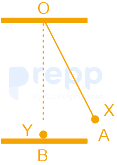
A metallic bob X of mass m is released from position A. It collides elastically with another identical bob Y placed at rest at position B on a horizontal frictionless table. The angle AOB is 30°.
How high does the bob X rise immediately after the
In a carrom game, a striker of mass 15 g hits a coin of mass 5 g head on and the coin moves with a speed of 0.36 m/s. If the time of contact between the striker and the coin is 3 milliseconds, then what is the average force applied by the striker on the coin?
Important Questions from Collisions
Two bodies collide each other and the collision is perfectly elastic. The co-efficient of restitution of these two bodies is
During inelastic collision between two bodies, which of the following quantities always remain conserved?
A metallic bob X of mass m is released from position A. It collides elastically with another identical bob Y placed at rest at position B on a horizontal frictionless table. The angle AOB is 30°.
How high does the bob X rise immediately after the
In a carrom game, a striker of mass 15 g hits a coin of mass 5 g head on and the coin moves with a speed of 0.36 m/s. If the time of contact between the striker and the coin is 3 milliseconds, then what is the average force applied by the striker on the coin?



