(Note: The odd one out is not based on the number of consonants/vowels or their position in the letter-cluster.)
Identifying the Odd Letter Cluster
The question requires finding the letter cluster that does not follow the pattern of the others based on English alphabetical order. The pattern involves the difference in positions between consecutive letters.
Alphabetical Positions
First, let's list the alphabetical positions for each letter in the clusters:
- MRY: M (13), R (18), Y (25)
- JOU: J (10), O (15), U (21)
- QVB: Q (17), V (22), B (2)
- DIO: D (4), I (9), O (15)
Calculating Positional Differences
Next, we calculate the difference between the positions of consecutive letters:
- MRY:
- R - M = \(18 - 13 = 5\)
- Y - R = \(25 - 18 = 7\)
- JOU:
- O - J = \(15 - 10 = 5\)
- U - O = \(21 - 15 = 6\)
- QVB:
- V - Q = \(22 - 17 = 5\)
- B - V: Since B comes after V when wrapping around the alphabet, the difference is calculated as \((26 - 22) + 2 = 4 + 2 = 6\).
- DIO:
- I - D = \(9 - 4 = 5\)
- O - I = \(15 - 9 = 6\)
Determining the Outlier
Three clusters (JOU, QVB, DIO) follow a pattern of positional differences +5, +6. The cluster MRY follows the pattern +5, +7.
Therefore, MRY is the letter cluster that does not belong to the group.
Similar Questions
Based on the English alphabetical order, three of the following four letter-cluster pairs are alike in a certain way and thus form a group. Which pair does not belong to that group?
(Note: The odd one out is not based on the number of consonants/vowels or their position in the letter cluster.)
Based on the English alphabetical order, three of the following four letter-cluster pairs are alike in a certain way and thus form a group. Which pair does not belong to that group?
(Note: The odd one out is not based on the number of consonants/vowels or their position in the letter-cluster.)
Based on the English alphabetical order, three of the following four letter-cluster pairs are alike in a certain way and thus form a group. Which pair does not belong to that group?
(Note: The odd one out is not based on the number of consonants/vowels or their position in the letter-cluster.)Based on the English alphabetical order, three of the following four letter-cluster pairs are alike in a certain way and thus form a group. Which pair does not belong to that group?
(Note: The odd one out is not based on the number of consonants/vowels or their position in the letter-cluster.)Based on the English alphabetical order, three of the following four letter-clusters are alike in a certain way and thus form a group. Which letter-cluster does not belong to that group?
(Note: The odd one out is not based on the number of consonants/vowels or their position in the letter cluster.)Based on the English alphabetical order, three of the following four letter-cluster pairs are alike in a certain way and thus form a group. Which pair does not belong to that group?
(Note: The odd one out is not based on the number of consonants/vowels or their position in the letter cluster.)
Based on the English alphabetical order, three of the following four letter-clusters are alike in a certain way and thus form a group. Which letter-cluster does not belong to that group?
(Note: The odd one out is not based on the number of consonants/vowels or their position in the letter-cluster.)
Based on the English alphabetical order, three of the following four letter-cluster pairs are alike in a certain way and thus form a group. Which pair does not belong to that group?
(Note: The odd one out is not based on the number of consonants/vowels or their position in the letter cluster.)
Based on the English alphabetical order, three of the following four letter-cluster pairs are alike in a certain way and thus form a group. Which pair does not belong to that group?
(Note: The odd one out is not based on the number of consonants/vowels or their position in the letter-cluster.)
- Based on the English alphabetical order, three of the following four letter-clusters are alike in a certain way and thus form a group. Which letter-cluster DOES NOT belong to that group? (Note: The odd one out is not based on the number of consonants/vowels or their position in the letter-cluster.)
Important Questions from Classification
Directions for the following 3 (three) items : consider the given information and answer the three items that follow.
A, B, C, D, E, F and G are Lecturers from different cities—Hyderabad, Delhi, Shillong, Kanpur, Chennai, Mumbai and Srinagar (not necessarily in the same order) who participated in a conference. Each one of them is specialized in a different subject, viz., Economics, Commerce, History, Sociology, Geography, Mathematics and Statistics (not necessarily in the same order).
Further 1. Lecturer from Kanpur is specialized in Geography
2. Lecturer D is from Shillong
3. Lecturer C from Delhi is specialized in Sociology
4. Lecturer B is specialized in neither History nor Mathematics
5. Lecturer A who is specialized in Economics does not belong to Hyderabad
6. Lecturer F who is specialized in Commerce belongs to Srinagar
7. Lecturer G who is specialized in Statistics belongs to Chennai
Who is specialized in Geography?
A, B, C, D, E, F and G are Lecturers from different cities—Hyderabad, Delhi, Shillong, Kanpur, Chennai, Mumbai and Srinagar (not necessarily in the same order) who participated in a conference. Each one of them is specialized in a different subject, viz., Economics, Commerce, History, Sociology, Geography, Mathematics and Statistics (not necessarily in the same order).
Further 1. Lecturer from Kanpur is specialized in Geography
2. Lecturer D is from Shillong
3. Lecturer C from Delhi is specialized in Sociology
4. Lecturer B is specialized in neither History nor Mathematics
5. Lecturer A who is specialized in Economics does not belong to Hyderabad
6. Lecturer F who is specialized in Commerce belongs to Srinagar
7. Lecturer G who is specialized in Statistics belongs to Chennai
To which city does the Lecturer specialized in Economics belong?
A, B, C, D, E, F and G are Lecturers from different cities—Hyderabad, Delhi, Shillong, Kanpur, Chennai, Mumbai and Srinagar (not necessarily in the same order) who participated in a conference. Each one of them is specialized in a different subject, viz., Economics, Commerce, History, Sociology, Geography, Mathematics and Statistics (not necessarily in the same order).
Further 1. Lecturer from Kanpur is specialized in Geography
2. Lecturer D is from Shillong
3. Lecturer C from Delhi is specialized in Sociology
4. Lecturer B is specialized in neither History nor Mathematics
5. Lecturer A who is specialized in Economics does not belong to Hyderabad
6. Lecturer F who is specialized in Commerce belongs to Srinagar
7. Lecturer G who is specialized in Statistics belongs to Chennai
Who of the following belongs to Hyderabad?
In a school, there are five teachers A, B, C, D and E. A and B teach Hindi and English. C and B teach English and Geography. D and A teach Mathematics and Hindi. E and B teach History and French. Who teaches maximum numb, of subjects?
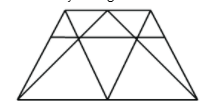
How many triangles are there in the given figure?