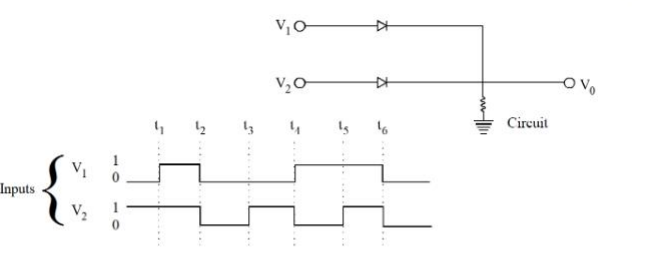
Reason (R) : In clipper circuit, the orientation of diode is very important and it decide the portion of the wave to be clipped. Clippers may be series or parallel type, depending upon the series/parallel connection of diode with the load.
The question provided is about clippers, which are circuits used in electronics to remove or "clip" portions of an input signal without significantly distorting the rest of the waveform. Let's analyze the given assertion and reason to determine their correctness and connection:
- Assertion (A): Clippers are networks that employ diodes to clip away a portion of an input signal without distorting the remaining part of the applied waveforms.
- This statement is true. Clippers are designed to remove specific portions of an input signal, generally positive or negative half cycles, using diodes. They are particularly useful in protecting circuits from unwanted voltage spikes or in shaping waveform signals without altering the remaining waveform portion significantly.
- Reason (R): In clipper circuits, the orientation of the diode is very important, and it decides the portion of the wave to be clipped. Clippers may be series or parallel type, depending upon the series/parallel connection of the diode with the load.
- This statement is true. The operation of a clipper circuit depends significantly on the orientation of the diode. Diodes conduct current in one direction, and this property determines which portion of the waveform is clipped. Clippers can be categorized as series or parallel based on their design, which affects the diode and load configuration.
While both the assertion and the reason are true, the reason provided "In clipper circuit, the orientation of diode is very important..." explains the operational aspect of clippers but does not directly explain how the clipping happens without distorting the remaining waveform, which is the core focus of the assertion. Therefore, reason (R) is not the correct explanation of assertion (A).
The correct answer is: Both (A) and (R) are true, but (R) is not the correct explanation of (A).
Important Questions from Diodes and Its Applications - Teaching
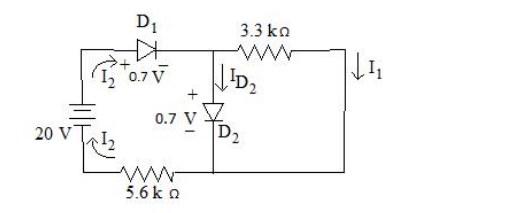
What current should flow through D2 diode? Consider the values given in circuit below.
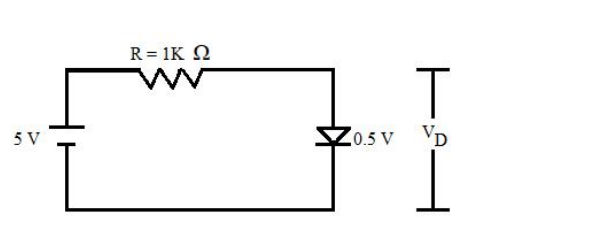
The diode used in fig. below has the threshold voltage of 0.5 V and a forward resistance of 4$\Omega$ Calculate the current flow ID through and the voltage drop VD across the diode.
Match the following lists :
List – I List – II a. Voltage doubler i. 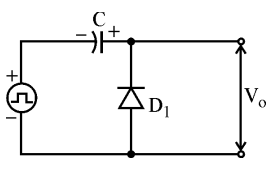
b. Halfwave rectifier ii. 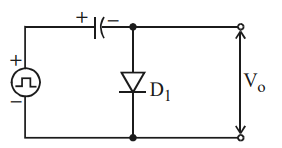
c. Positive clamping circuit iii. 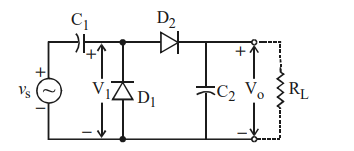
d. Negative clamping circuit iv. 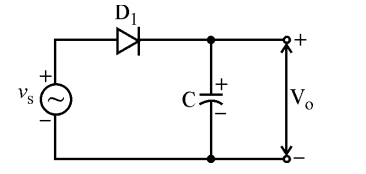
Codes :
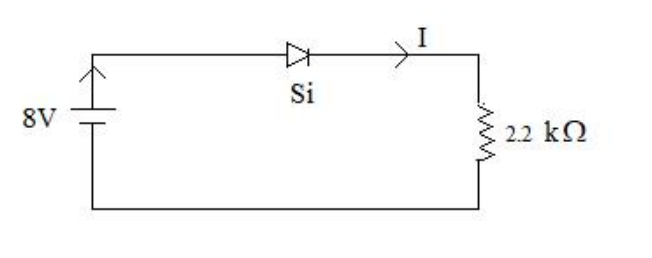
The value of current I flowing in the given circuit is:
In the following circuit, for the given inputs V1 and V2, the correct option for output V0 is