
A workshop assembly requires joining two metal plates to withstand vibrations without loosening over time. Which mechanical jointing method is most suitable for this requirement?
Using lock nuts and spring washers
The governing idea in fastener selection under vibration is retaining clamping force: a joint must keep its axial preload even while continuous shaking tries to loosen the nut.
Ordinary threaded fasteners loosen because vibration causes tiny relative slip between the threads, letting the nut slowly rotate back and shed its preload over time.
A lock nut counters this by adding a positive locking action, either extra thread friction from a nylon insert or a distorted thread, so the nut cannot spin free on its own.
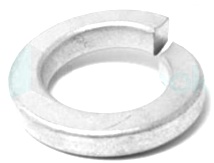
A spring washer stores elastic energy and keeps pushing outward, so even if the parts settle slightly the axial load is maintained and the threads stay pressed together.
Together they keep the joint tight yet still allow later dismantling for maintenance, which is exactly what a bolted assembly of two plates needs.
Spot welding and solid rivets do resist loosening, but they create permanent joints that cannot be taken apart, and standard threaded fasteners alone are the very things that back off under vibration.
Hence, the answer is Using lock nuts and spring washers.
Similar Questions
Identify the part shown in the following figure.
Torque wrench is used for:
What is the name of the device shown in the picture?
Identify the tool in the given figure.
Which type of washer is used for locking a nut?
How can we remove a broken bolt from a tapped hole?
Allen key is also known as a/an ___________.
Spring washers are used under nuts to prevent _______.
What are Tab washers used for?
Identify the locking arrangement in the following figure.
Important Questions from Fasteners
Identify the part shown in the following figure.
Torque wrench is used for:
What is the name of the device shown in the picture?
Identify the tool in the given figure.
Which type of washer is used for locking a nut?



