
A pure silicon crystal has \( 5 \times 10^{28} \) atoms m-3. It is doped by 2 ppm concentration of pentavalent arsenic. The number of holes are: Consider \( n_i = 1.5 \times 10^{16} \) m-3.
\( 2.25 \times 10^9 \) m-3
Understanding Hole Concentration in Doped Silicon
This problem asks us to find the number of holes (hole concentration) in a silicon crystal that has been doped with a pentavalent impurity, arsenic. Doping pure silicon transforms it into an extrinsic semiconductor, altering its electrical properties.
We are given the intrinsic properties of silicon and the concentration of the dopant. To solve this, we will first determine the concentration of the added impurity atoms, which act as donors in this case. Then, we can use the relationship between electron concentration, hole concentration, and intrinsic carrier concentration in a semiconductor.
Given Information
- Atom density of pure silicon: \( N_{Si} = 5 \times 10^{28} \) m\(^{-3}\)
- Doping concentration of pentavalent arsenic: 2 ppm
- Intrinsic carrier concentration: \( n_i = 1.5 \times 10^{16} \) m\(^{-3}\)
Calculating Donor Concentration (\(N_D\))
The doping concentration is given in parts per million (ppm). 2 ppm means that for every million silicon atoms, there are 2 arsenic atoms. Since arsenic is pentavalent and substitutes silicon, each arsenic atom acts as a donor impurity, contributing one free electron.
The number of donor atoms per unit volume (\(N_D\)) can be calculated as:
\( N_D = (\text{Doping concentration in ppm}) \times (\text{Atom density of Silicon}) \)
Convert ppm to a fraction:
\( 2 \text{ ppm} = \frac{2}{10^6} \)
Now, calculate \(N_D\):
\( N_D = \frac{2}{10^6} \times 5 \times 10^{28} \text{ m}^{-3} \)
\( N_D = 2 \times 10^{-6} \times 5 \times 10^{28} \text{ m}^{-3} \)
\( N_D = 10 \times 10^{(-6 + 28)} \text{ m}^{-3} \)
\( N_D = 10 \times 10^{22} \text{ m}^{-3} \)
\( N_D = 1 \times 10^{23} \text{ m}^{-3} \)
Electron Concentration in N-type Silicon
Since arsenic is a pentavalent impurity in silicon, it donates free electrons, making the semiconductor n-type. In an n-type semiconductor with donor concentration \(N_D\), the majority carrier (electron) concentration (\(n\)) is approximately equal to the donor concentration, assuming complete ionization and that the donor concentration is much greater than the intrinsic carrier concentration (\(N_D \gg n_i\)).
In this case, \( N_D = 1 \times 10^{23} \) m\(^{-3}\) and \( n_i = 1.5 \times 10^{16} \) m\(^{-3}\). Clearly, \(N_D \gg n_i\). Therefore, we can approximate:
\( n \approx N_D = 1 \times 10^{23} \text{ m}^{-3} \)
Calculating Hole Concentration (\(p\)) Using Mass Action Law
In any semiconductor (intrinsic or extrinsic) in thermal equilibrium, the product of electron concentration (\(n\)) and hole concentration (\(p\)) is constant and equal to the square of the intrinsic carrier concentration (\(n_i\)). This is known as the Mass Action Law:
\( n \times p = n_i^2 \)
We want to find the hole concentration (\(p\)). We can rearrange the formula:
\( p = \frac{n_i^2}{n} \)
Now, substitute the values for \(n_i\) and the calculated value for \(n\) (which is approximately \(N_D\)):
\( n_i^2 = (1.5 \times 10^{16} \text{ m}^{-3})^2 \)
\( n_i^2 = (1.5)^2 \times (10^{16})^2 \text{ m}^{-6} \)
\( n_i^2 = 2.25 \times 10^{32} \text{ m}^{-6} \)
Now, calculate \(p\):
\( p = \frac{2.25 \times 10^{32} \text{ m}^{-6}}{1 \times 10^{23} \text{ m}^{-3}} \)
\( p = 2.25 \times 10^{(32 - 23)} \text{ m}^{(-6 - (-3))} \)
\( p = 2.25 \times 10^9 \text{ m}^{-3} \)
The number of holes is \( 2.25 \times 10^9 \) m\(^{-3}\).
Comparing with Options
The calculated hole concentration is \( 2.25 \times 10^9 \) m\(^{-3}\).
- Option 1: \( 4.5 \times 10^9 \) m\(^{-3}\)
- Option 2: \( 2.25 \times 10^9 \) m\(^{-3}\)
- Option 3: \( 2.25 \times 10^{-9} \) m\(^{-3}\)
- Option 4: \( 4.5 \times 10^{-9} \) m\(^{-3}\)
Our result matches Option 2.
Revision Table: Semiconductor Carrier Concentrations
| Concept | Description | Relevant Formula |
|---|---|---|
| Intrinsic Semiconductor | Pure semiconductor, \(n = p = n_i\) | \(n_i\) depends on material and temperature |
| Extrinsic Semiconductor (Doped) | Semiconductor with impurities added | Can be n-type or p-type |
| N-type Semiconductor | Doped with donor impurities (e.g., P, As) | Majority carriers: electrons (\(n \approx N_D\)) Minority carriers: holes (\(p\)) |
| P-type Semiconductor | Doped with acceptor impurities (e.g., B, Al) | Majority carriers: holes (\(p \approx N_A\)) Minority carriers: electrons (\(n\)) |
| Mass Action Law | Product of electron and hole concentrations is constant in thermal equilibrium | \(n \times p = n_i^2\) |
| Donor Concentration (\(N_D\)) | Concentration of donor impurity atoms | Determines electron concentration in n-type |
| Acceptor Concentration (\(N_A\)) | Concentration of acceptor impurity atoms | Determines hole concentration in p-type |
Additional Information on Doped Semiconductors and Carrier Concentration
When an intrinsic semiconductor like silicon is doped with impurities, its electrical conductivity changes significantly. Doping allows us to control the concentration of charge carriers (electrons and holes).
Types of Doping
- Donor Doping (N-type): Adding elements from Group V (like Phosphorus, Arsenic, Antimony) to a Group IV semiconductor (like Silicon, Germanium). These elements have 5 valence electrons. Four electrons form covalent bonds with neighboring silicon atoms, and the fifth electron is loosely bound and becomes a free electron, increasing the electron concentration.
- Acceptor Doping (P-type): Adding elements from Group III (like Boron, Aluminum, Gallium) to a Group IV semiconductor. These elements have 3 valence electrons. They form covalent bonds with neighboring silicon atoms but create a deficiency of one electron, resulting in a "hole". These holes can accept electrons, increasing the hole concentration.
Carrier Concentration in Extrinsic Semiconductors
In thermal equilibrium, the Mass Action Law (\(n \times p = n_i^2\)) always holds. However, the individual concentrations \(n\) and \(p\) change dramatically upon doping.
- In N-type: \(n\) becomes much larger than \(p\). Approximately, \(n \approx N_D\) (if \(N_D \gg n_i\)). The hole concentration becomes \(p = n_i^2 / n \approx n_i^2 / N_D\). Holes are the minority carriers.
- In P-type: \(p\) becomes much larger than \(n\). Approximately, \(p \approx N_A\) (if \(N_A \gg n_i\)). The electron concentration becomes \(n = n_i^2 / p \approx n_i^2 / N_A\). Electrons are the minority carriers.
The problem we solved involves n-type silicon, where the electron concentration is boosted by the donor impurities, leading to a significant reduction in the hole concentration compared to the intrinsic state, as dictated by the mass action law.
Important Questions from Semiconductor and Electronic Devices
If the forward voltage in a p-n junction diode is increased, the width of the depletion region:
Two identical thin metal plates are given charges q1 and q2 (q2 < q1) respectively. If they are now brought close together to form a parallel plate capacitor with a capacitance 'C', then the potential difference between the plates is:
Displacement current (id) = ω0 dΦE / dt. Where symbols have their usual meanings. Which of the following options gives correct equation for displacement current?
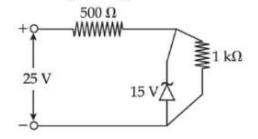
A Zener diode is used in a voltage regulator circuit as shown below. Its breakdown voltage is 15 V. What is the current flowing through the Zener diode?
Choose the correct experimental circuit arrangement for studying V-I characteristics of a p-n junction diode in forward bias:


