
A point divides a line segment joining \((4, 5)\) and \((-3, 3)\) internally in the ratio 2:3. Find the coordinates of the point.
6/5, 21/5
Section formula for internal division in ratio m:n: point = ((m·x₂ + n·x₁)/(m+n), (m·y₂ + n·y₁)/(m+n)).
Here m=2, n=3, (x₁,y₁)=(4,5), (x₂,y₂)=(−3,3). x = (2·(−3) + 3·4)/5 = (−6+12)/5 = 6/5. y = (2·3 + 3·5)/5 = (6+15)/5 = 21/5.
Hence, 6/5, 21/5.
Similar Questions
Find the area of a triangle whose vertices are A(3,2), B(11,6), and C(7,14).
If points A \((k, 2k)\), B \((3k, 2k)\), C \((3, 1)\) are collinear, find the value of \(k\).
If two straight lines x − 5y = 2 and x + 2y = 9 intersect at A and meet the positive x-axis at B and C respectively, find the area of triangle ABC.
Find the ratio in which the line \(4x + y = 13\) divides the line segment joining the two points (1,6) and (6,1).
Find the coordinates of the point which divides the line segment joining the points (-4, 4) and (4, 0) internally in the ratio 3:1.
Find the area of the triangle formed with the three straight lines represented by: i) \(x + y = 0\); ii) \(3x = 5y\); and iii) \(y = 3x - 12\)
Find the ratio in which line \(3x + 2y = 17\) divides the line segment joined by points \((2, 5)\) and \((5, 2)\).
Important Questions from Co-ordinate Geometry
A triangle is formed with vertices (0, 0), (0, 100) and (100, 100). What is the number of points inside the triangle with integer coordinates?
Suppose R is the region bounded by the two curves $Y = x^2$ and $Y = 2x^2 - 1$ as shown in the following diagram :
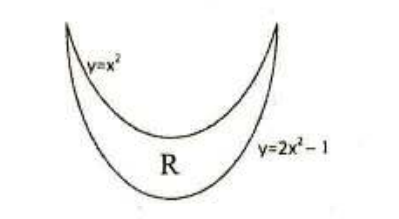
Two distinct lines are drawn such that each of these lines partitions the regions into at least two parts. If 'n' is the total number of regions generated by these lines, then :
- Let $x^2 + y^2 = 1$;
$u^2 + v^2 = 1$ and
$xu + yv = 0$, then
1. $x^2 + u^2 = 1$
2. $y^2 + v^2 = 1$
3. $xy + uv = 0$
Which of the above is/are true? - D is the midpoint of line segment AB. The co-ordinates of A and D are (2, 4) and (\(-1\), 3), respectively. The co-ordinates of B are:
- In which quadrant do the point (-16, 9) lies



