
Suppose R is the region bounded by the two curves $Y = x^2$ and $Y = 2x^2 - 1$ as shown in the following diagram : Two distinct lines are drawn such that each of these lines partitions the regions into at least two parts. If 'n' is the total number of regions generated by these lines, then :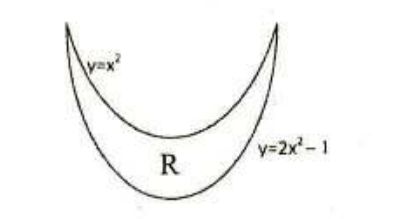
'n' can be 6
To solve this problem, we first need to understand the region bounded by the curves \(y = x^2\) and \(y = 2x^2 - 1\).
Step 1: Find Points of Intersection
First, we find the points of intersection between the curves:
\(x^2 = 2x^2 - 1\)
Rearranging gives:
\(x^2 - 1 = 0\)
Solving this equation, we find:
\(x = \pm 1\)
So, the points of intersection are \((-1, 1)\) and \((1, 1)\).
Step 2: Analyze the Partition by Two Lines
To determine how the lines partition the region \(R\), consider two distinct lines \(L_1\) and \(L_2\). The total number of regions \(n'\) created by two intersecting lines depends on their relative positions and intersections:
- If two lines intersect within the region, they can divide it into 4 regions.
- If these lines do not both intersect within the given boundary, they can still considerably divide the curve more.
For maximum partitioning, lines should intersect each other and additionally intersect the curves.
Step 3: Calculate Maximum Possible Regions
With two lines intersecting each other and both intersecting the boundary curves, we can partition the region into 6 distinct areas.
Conclusion
Considering the above possibilities, it's possible for the curves and the lines to create 6 distinct regions, satisfying the condition \(n'\) can be 6.
Correct Answer: 'n' can be 6.
Important Questions from Co-ordinate Geometry
The graphs of the linear equations 4x - 2y = 10 and 4x + ky = 2 intersect at a point (a, 4). The value of k is equal to:
The area (in sq. units) of the triangle formed by the graphs of 8x + 3y = 24, 2x + 8 = y and the x-axis is:
What is the area (in unit squares) of the triangle enclosed by the graphs of 2x + 5y = 12, x + y = 3 and the x-axis?
The graphs of the equations 3x - 20y - 2 = 0 and 11x - 5y + 61 = 0 intersect at P(a, b). What is the value of (a 2+ b 2- ab)/(a 2- b 2+ ab)?
The graphs of the linear equations 3x - 2y = 8 and 4x + 3y = 5 intersect at the point P(α, β). What is the value of (2 α - β)?


