
A dice has its faces named by three letters (L, M, N) and three symbols (β, π, θ). Two positions of the same dice are given below. Which face is opposite to face M?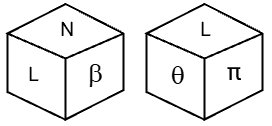
L
On a cube, a face is opposite to the one face that never appears next to it. If a face is seen touching four other faces, the remaining sixth face must be opposite to it.
Step 1 — First position: L is shown with N and β, so L is adjacent to N and β.
Step 2 — Second position: L is shown with θ and π, so L is adjacent to θ and π.
Step 3 — L therefore touches N, β, θ and π. The only face left is M, so M is opposite to L.
β appears beside L in the first position, N appears on top beside L in the first position, and θ appears beside L in the second position, so none of them can be opposite to L, and only L can be opposite to M.
L option is correct.
Similar Questions
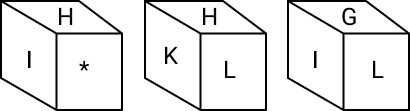
A dice has its faces marked by the letters G, H, I, J, K and L. Three positions of the dice are given below. One of the faces in the first image is masked by '*'. How many letters are there according to the English alphabetical order between the masked symbol '*' and the letter on the face opposite to it?
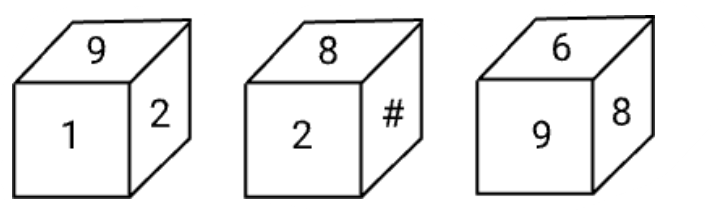
A dice has its faces marked by digits 1, 2, 5, 6, 8 and 9. Three positions of the dice are given below. One of the faces in the second image of the dice is masked by '#'.
Which of the following statements is/are true?
I) The product of the values of ‘#’ and the side opposite to it is 54.
II) The sum of the values of ‘#’ and the side opposite to ‘6’ is a prime number.
III) The square root of the sum of all the sides adjacent to ‘#’ gives a rational number.
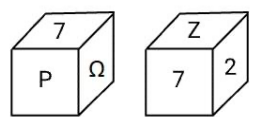
A dice has its faces named by two letters (P, Z), two numbers (2, 7) and two symbols (µ, Ω). Two positions of the same dice are given below. Which face is opposite to face µ?
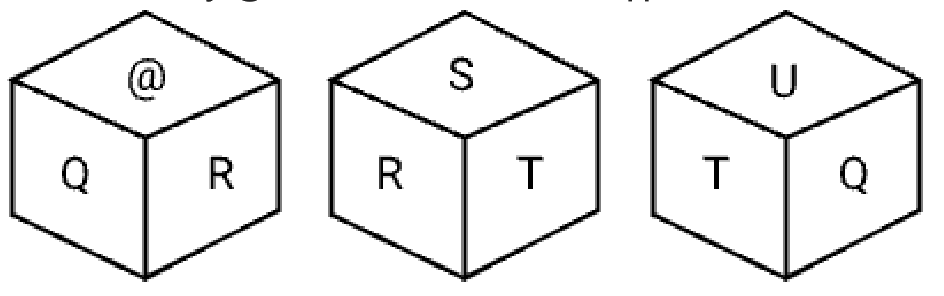
A dice has its faces marked by the letters P, Q, R, S, T and U. Three positions of the dice are given below. One of the faces in the first image of the dice is masked by '@'. How many letters are there according to the English alphabetical order between the letter masked by '@' and the letter on the face opposite to it?
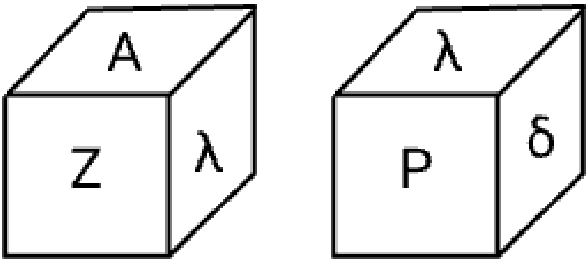
A dice has its faces named by three letters (A, P, Z) and three symbols (Ω, λ, δ). Two positions of the same dice are given below. Which face is opposite to face Ω?
Important Questions from Cube and Dice
A cube of side 4 cm is painted green on all its faces and then divided into smaller cubes of side 2 cm each. How many small cubes have been obtained?
Two adjacent faces of a solid cube are painted with black colour. The faces opposite to the black faces is painted with blue colour while the remaining faces are painted with yellow colour. After painting, this cube has been divided into 125 equal cubes. How many cubes have no faces painted?
A cube, whose two adjacent faces are coloured, is cut into 64 identical small cubes. How many of these small cubes are not coloured at all?
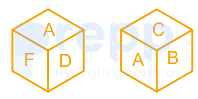
Two different positions of the same dice are shown, the six faces of which are marked with the letters A to F. Select the letter that will be on the face opposite to the one having A.
A Cube is coloured blue on all the faces. It is then cut into 64 smaller cubes. These cubes are now separated. The number of smaller cubes with no surface coloured is:



