Calculating Work Done Moving Electric Charge to Point P
This problem involves calculating the work done required to move an electric charge from an infinite distance to a specific point (P) in space, where another charge is already present. The work done in such a scenario is directly related to the electric potential at that point and the magnitude of the charge being moved.
Understanding Electric Potential and Work Done
The electric potential ($V$) at any point in space due to a point charge ($q_1$) is the amount of work needed per unit charge to move a test charge from infinity to that point. The formula for electric potential at a distance ($r$) from a point charge ($q_1$) is given by:
$V = k \frac{q_1}{r}$
where $k$ is Coulomb's constant, approximately $9 \times 10^9$ N m²/C².
The work done ($W$) in bringing another charge ($q_2$) from infinity to this point P is the product of the charge $q_2$ and the electric potential $V$ at point P:
$W = q_2 \times V$
Substituting the expression for $V$, we get the formula for work done:
$W = k \frac{q_1 q_2}{r}$
Given Values
- Magnitude of the first charge ($q_1$): $3 \times 10^{-7}$ C
- Magnitude of the second charge ($q_2$): $2 \times 10^{-9}$ C
- Distance from the first charge to point P ($r$): 0.09 m
- Coulomb's constant ($k$): $9 \times 10^9$ N m²/C²
Step-by-Step Calculation
To find the work done, we will substitute the given values into the work done formula:
- Write down the formula: The work done ($W$) is calculated using the formula $W = k \frac{q_1 q_2}{r}$.
- Substitute the values: Plug in the values for $k$, $q_1$, $q_2$, and $r$ into the formula.
$W = (9 \times 10^9 \, \text{N m}^2/\text{C}^2) \times \frac{(3 \times 10^{-7} \, \text{C}) \times (2 \times 10^{-9} \, \text{C})}{0.09 \, \text{m}}$
- Calculate the product of charges: Multiply the two charges together.
$q_1 \times q_2 = (3 \times 10^{-7}) \times (2 \times 10^{-9}) = 6 \times 10^{-16} \, \text{C}^2$
- Calculate the numerator: Multiply the result from step 3 by Coulomb's constant ($k$).
$k \times q_1 \times q_2 = (9 \times 10^9) \times (6 \times 10^{-16}) = 54 \times 10^{-7} \, \text{N m}^2/\text{C}$
- Divide by the distance: Divide the result from step 4 by the distance ($r$).
$W = \frac{54 \times 10^{-7} \, \text{N m}^2/\text{C}}{0.09 \, \text{m}}$
To simplify the division, we can write 0.09 as $9 \times 10^{-2}$.
$W = \frac{54 \times 10^{-7}}{9 \times 10^{-2}} \, \text{N m}/\text{C}$
$W = \left(\frac{54}{9}\right) \times 10^{(-7 - (-2))} \, \text{J}$
$W = 6 \times 10^{-7 + 2} \, \text{J}$
$W = 6 \times 10^{-5} \, \text{J}$
Therefore, the work done in bringing the charge of $2 \times 10^{-9}$ C from infinity to the point P is $6 \times 10^{-5}$ Joules.
Important Questions from Electric Charges and Fields
Two charged particles, placed at a distance d apart in vacuum, exert a force F on each other. Now, each of the charges is doubled. To keep the force unchanged, the distance between the charges should be changed to:
When a slab of insulating material 4 mm thick is introduced between the plates of a parallel plate capacitor of separation 4 mm, it is found that the distance between the plates has to be increased by 3.2 mm to restore the capacity to its original value. The dielectric constant of the material is:
Match List - I with List - II.
List - I List - II (A) Electric Field (I) [LTA] (B) Electric Flux (II) [L2] (C) Electric Dipole Moment (III) [ML3T−3A−1] (D) Area Vector Element (IV) [MLT−3A−1] Choose the correct answer from the options given below:
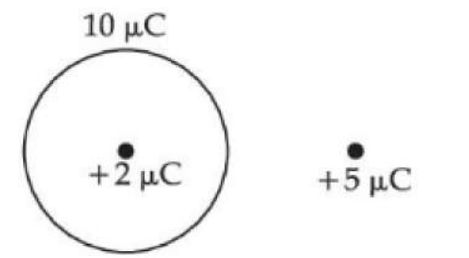
A thin metallic spherical shell contains a charge +10 μC on it. A point charge +2 μC is placed at the centre of the shell and another charge +5 μC is placed outside it as shown. The force on the charge +2 μC at the centre is:
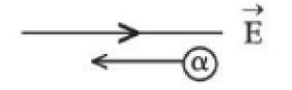
In the figure, an α-particle moves a distance l in a uniform electric field E as shown. Does the Electric Field do a positive or a negative work on the α-particle? Does the electric potential energy of the α-particle increase or decrease?