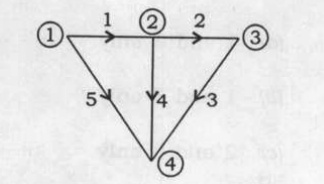
A certain tree has two vertices of degree 4, one vertex of degree 3 and one vertex of degree 2. If the other vertices have degree 1, how many vertices are there in the graph ?
11
A tree with n vertices has exactly \(n - 1\) edges, and by the handshaking lemma the sum of all vertex degrees equals twice the number of edges, i.e. \(2(n - 1)\).
Four vertices have degrees 4, 4, 3 and 2, adding up to 13. The remaining \(n - 4\) vertices are leaves of degree 1, contributing \(n - 4\).
So \(13 + (n - 4) = 2(n - 1)\), which gives \(n + 9 = 2n - 2\), hence \(n = 11\).
Check: 7 leaves plus 4 inner vertices give 11 vertices, degree sum \(13 + 7 = 20 = 2 \times 10\), matching 10 edges.
Hence, the answer is 11.
Similar Questions
Consider the Graph shown below :
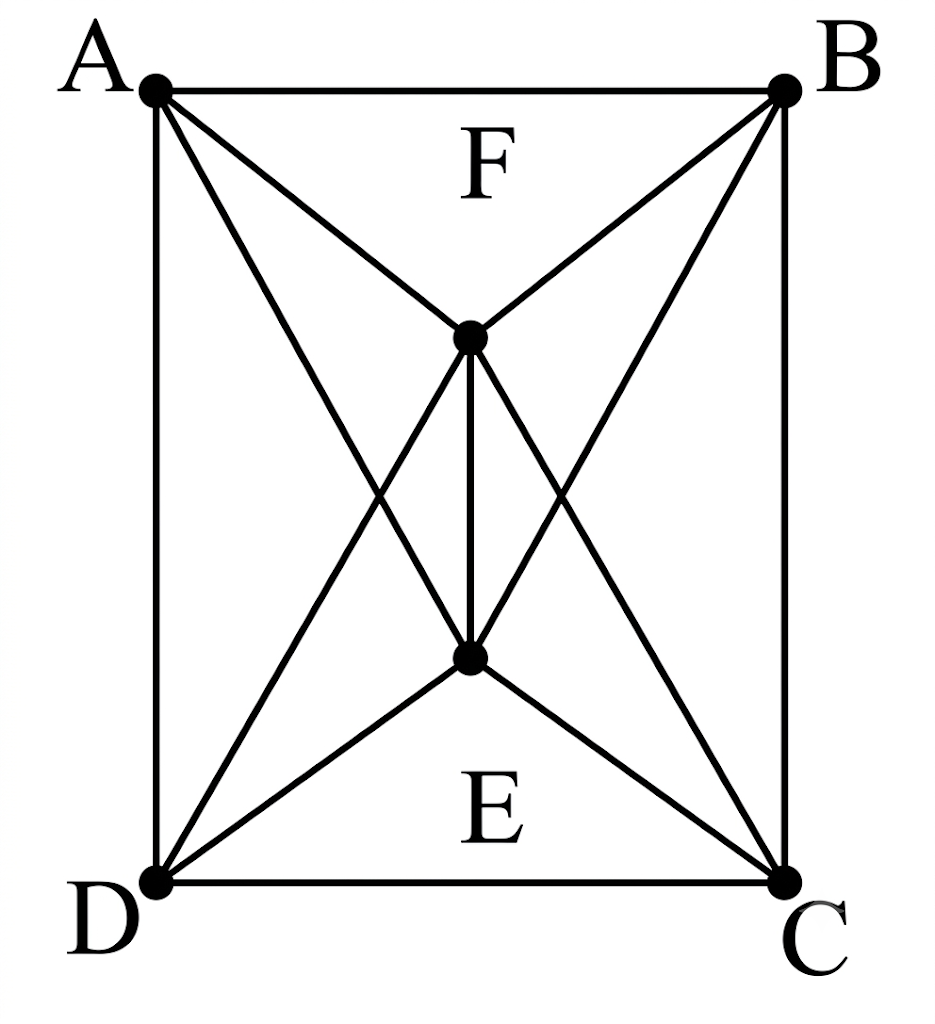
This graph is a __________.
A tree with n vertices is called graceful, if its vertices can be labelled with integers 1, 2,....n such that the absolute value of the difference of the labels of adjacent vertices are all different. Which of the following trees are graceful ?
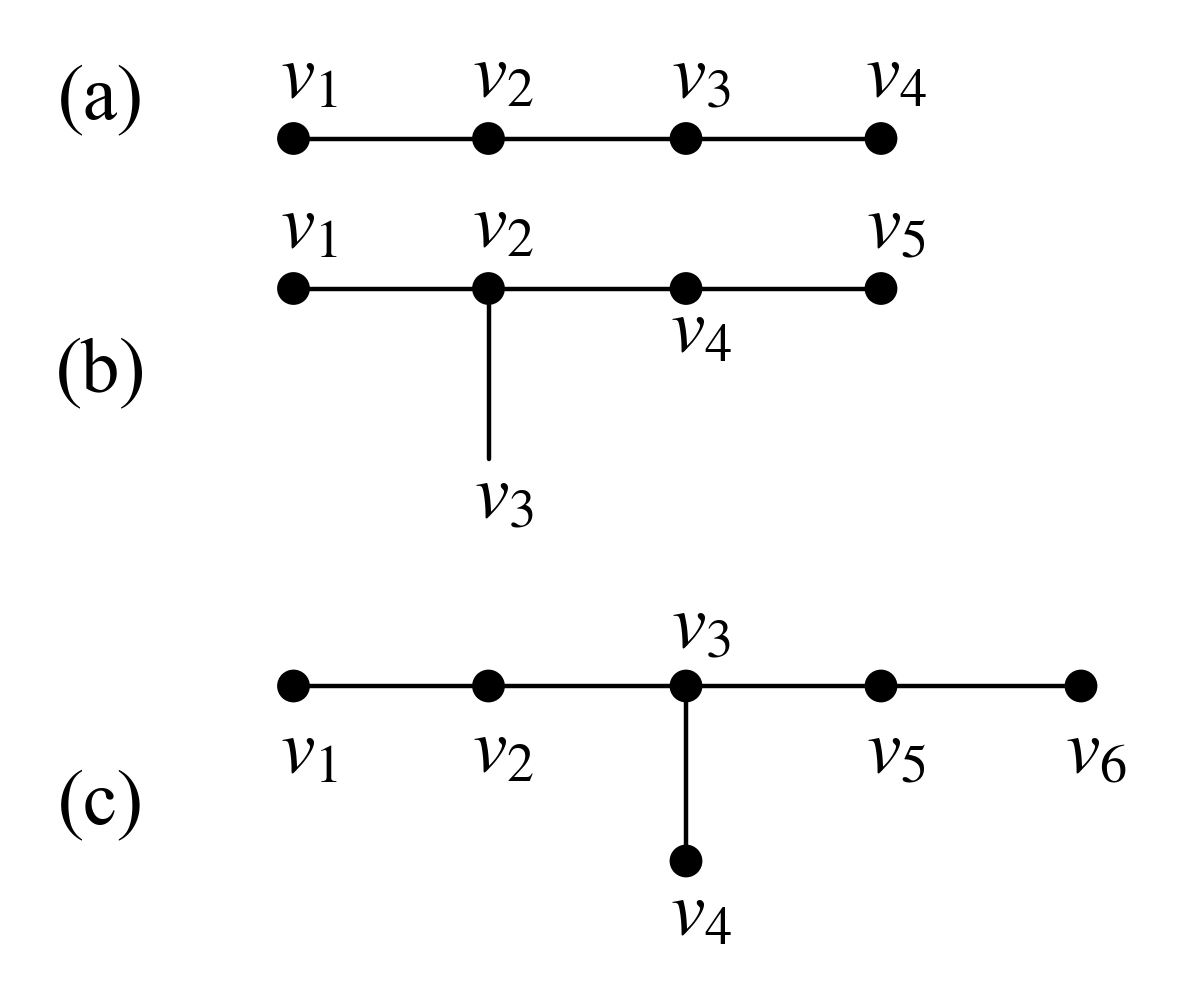
Codes :
Consider the graph given below :
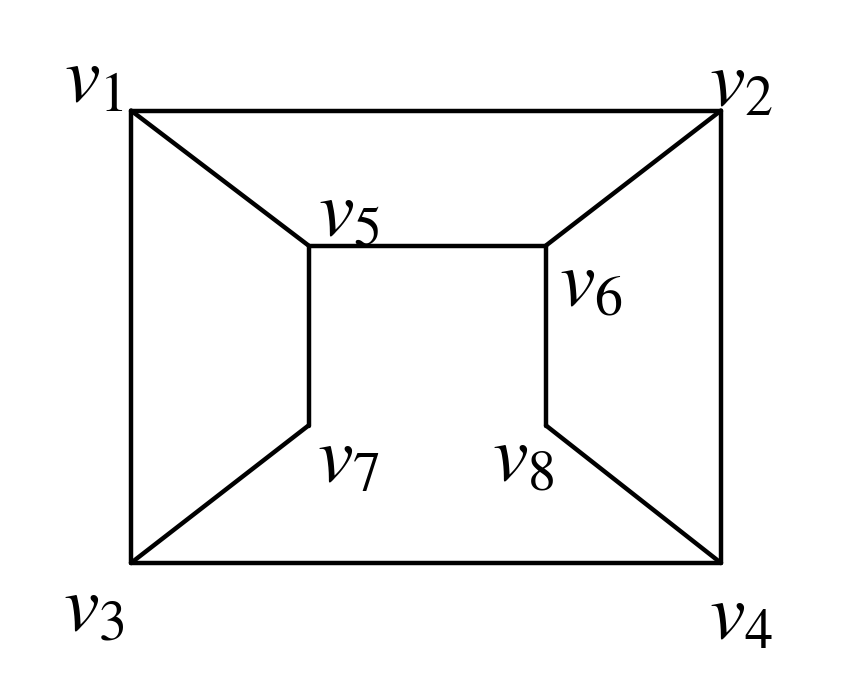
The two distinct sets of vertices, which make the graph bipartite are :
Which of the following statement(s) is/are false ?
(a) A connected multigraph has an Euler Circuit if and only if each of its vertices has even degree.
(b) A connected multigraph has an Euler Path but not an Euler Circuit if and only if it has exactly two vertices of odd degree.
(c) A complete graph \((K_{n})\) has a Hamilton Circuit whenever \(n \geq 3\).
(d) A cycle over six vertices \((C_{6})\) is not a bipartite graph but a complete graph over 3 vertices is bipartite.
Codes :
Consider a Hamiltonian Graph (G) with no loops and parallel edges. Which of the following is true with respect to this Graph (G) ?
(a) deg \((v) \geq n/2\) for each vertex of G
(b) \(|E(G)| \geq 1/2\ (n-1)(n-2)+2\) edges
(c) deg \((v)\) + deg \((w) \geq n\) for every \(v\) and \(w\) not connected by an edge
Consider the following statements :
(a) Depth - first search is used to traverse a rooted tree.
(b) Pre - order, Post-order and Inorder are used to list the vertices of an ordered rooted tree.
(c) Huffman’s algorithm is used to find an optimal binary tree with given weights.
(d) Topological sorting provides a labelling such that the parents have larger labels than their children.
Which of the above statements are true ?
Consider a complete bipartite graph \(k_{m,n}\). For which values of m and n does this, complete graph have a Hamilton circuit
Consider the graph given below as :
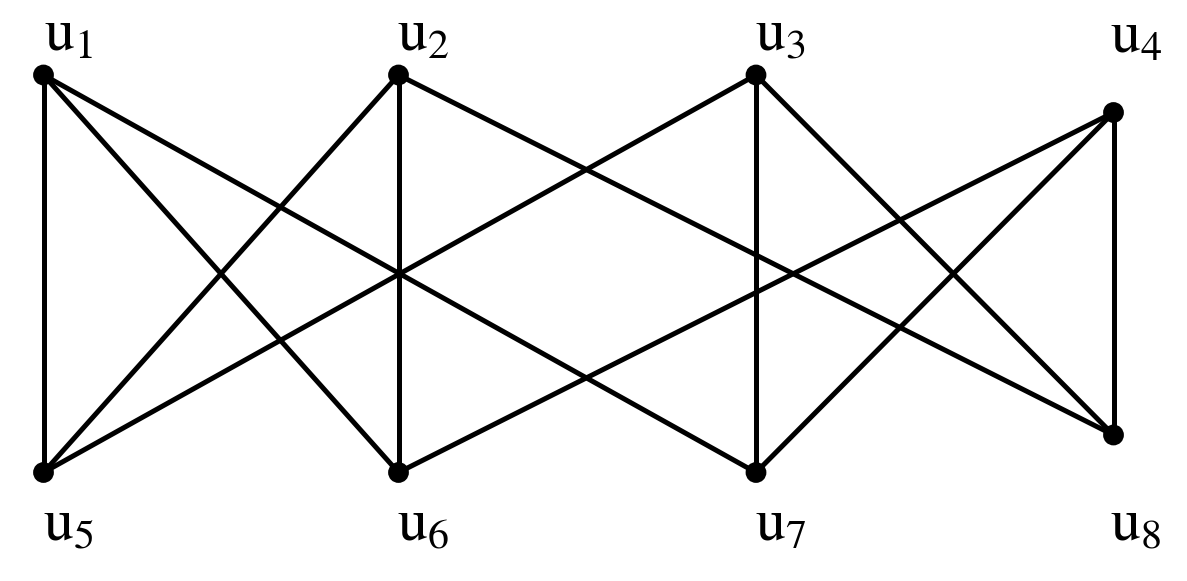
Which one of the following graph is isomorphic to the above graph ?
Arrange the following graph on the basis of number of edges in increasing order [for n = 4]
A. Kn (Complete Graph)
B. Cn (Cycle graph)
C. Wn (Wheel graph)
D. Kn,n (Complete Bipartite Graphs)
E. Qn (n-cubes graph)
Choose the correct answer from the options given below:
A graph G with number of vertices greater and equal than three i.e. (n ≥ 3) is a Hamiltonian graph, if the degree of each vertex is greater and equal to . . . .
Important Questions from Graph Theory
Let $G(V, E)$ be an undirected and unweighted graph with 100 vertices. Let $d(u, v)$ denote the number of edges in a shortest path between vertices $u$ and $v$ in $V$. Let the maximum value of $d(u, v)$, $u, v \in V$ such that $u \neq v$, be 30. Let T be any breadth-first-search tree of G. Which ONE of the given options is CORRECT for every such graph G?
Let G be a simple undirected planar graph on 10 vertices with 15 edges. If G is a connected graph, then the number of bounded faces in any embedding of G on plane is equal to_________.
- The number of possible rooted trees in a phylogeny of three species is ________.
Consider the following statements regarding graph theory :
1. Chord is that branch of the graph that does not belong to the particular tree.
2. Cut-set is a unique set with respect to a given tree of a connected graph containing one chord and all of the free branches contained in the free path formed between two vertices of the chord.
3. If M represents the number of branches and N the number of nodes, the minimum number of variables involved in analyzing a network is equal to $(M + N − 1)$.
Which of the above statements are not correct?
The incidence matrix of the graph shown