
The incidence matrix of the graph shown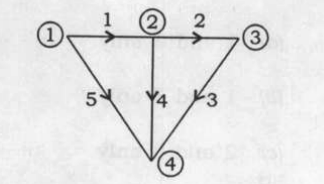
\(\begin{bmatrix} 1 & 0 & 0 & 0 & 1 \\ -1 & 1 & 0 & 1 & 0 \\ 0 & -1 & 1 & 0 & 0 \\ 0 & 0 & -1 & -1 & -1 \end{bmatrix}\)
The provided question requires determining the incidence matrix of the given directed graph. The incidence matrix is a way of representing a directed graph using a matrix. Each row of the matrix corresponds to a vertex, and each column corresponds to an edge. The elements of the matrix are typically 0, 1, or -1:
- 1 if the edge originates from the vertex.
- -1 if the edge terminates at the vertex.
- 0 if the edge is not incident with the vertex.
From the diagram, we can number the edges as follows:
- Edge 1: from vertex 1 to vertex 2
- Edge 2: from vertex 2 to vertex 3
- Edge 3: from vertex 3 to vertex 4
- Edge 4: from vertex 2 to vertex 4
- Edge 5: from vertex 4 to vertex 1
Based on this, we can construct the incidence matrix as:
| Edge 1 | Edge 2 | Edge 3 | Edge 4 | Edge 5 | |
|---|---|---|---|---|---|
| Vertex 1 | 1 | 0 | 0 | 0 | 1 |
| Vertex 2 | -1 | 1 | 0 | 1 | 0 |
| Vertex 3 | 0 | -1 | 1 | 0 | 0 |
| Vertex 4 | 0 | 0 | -1 | -1 | -1 |
Therefore, the correct incidence matrix is:
\(\begin{bmatrix} 1 & 0 & 0 & 0 & 1 \\ -1 & 1 & 0 & 1 & 0 \\ 0 & -1 & 1 & 0 & 0 \\ 0 & 0 & -1 & -1 & -1 \end{bmatrix}\)
This matches the given correct option.
Important Questions from Graph Theory
A principal node is a
Which of the following statement(s) is/are correct regarding about the undirected graph?
I. Number of odd degree vertices is even.
II. Sum of degrees of all vertices is even.
Let $G(V, E)$ be an undirected and unweighted graph with 100 vertices. Let $d(u, v)$ denote the number of edges in a shortest path between vertices $u$ and $v$ in $V$. Let the maximum value of $d(u, v)$, $u, v \in V$ such that $u \neq v$, be 30. Let T be any breadth-first-search tree of G. Which ONE of the given options is CORRECT for every such graph G?
- Let $G$ be an edge-weighted undirected graph with positive edge weights. Suppose a positive constant $\alpha$ is added to the weight of every edge.
Which ONE of the following statements is TRUE about the minimum spanning trees (MSTs) and shortest paths (SPs) in $G$ before and after the edge weight update? - Maintaining a graph in memory by means of its adjacency matrix is known as


