
$2A \xrightarrow{k} B$ is a zero-order reaction, where $k = 1.0\text{ mol L}^{-1}\text{ min}^{-1}$. If the initial concentration of A is $2\text{ M}$, then the time taken to complete 75% of the reaction will be
Zero-Order Reaction Time Calculation
For a zero-order reaction, the reaction rate is constant and independent of reactant concentrations. The integrated rate law relates the concentration of a reactant at time $t$ to its initial concentration and the rate constant.
The integrated rate law for a zero-order reaction involving reactant A is:
$ [A]_t = [A]_0 - kt $
Where:
- $[A]_t$ is the concentration of reactant A at time $t$.
- $[A]_0$ is the initial concentration of reactant A.
- $k$ is the rate constant.
- $t$ is the time taken.
Calculating Remaining Reactant Concentration
The question asks for the time taken to complete 75% of the reaction. This means 75% of the initial reactant A has been consumed.
The concentration of A remaining, $[A]_t$, will be:
$ [A]_t = [A]_0 - 0.75 \times [A]_0 $
$ [A]_t = (1 - 0.75) \times [A]_0 $
$ [A]_t = 0.25 \times [A]_0 $
Given the initial concentration $[A]_0 = 2\text{ M}$:
$ [A]_t = 0.25 \times 2\text{ M} = 0.5\text{ M} $
Determining the Time for 75% Completion
We can now use the integrated rate law to solve for the time $t$. Rearrange the equation:
$ t = \frac{[A]_0 - [A]_t}{k} $
Substitute the given values:
- Initial concentration, $[A]_0 = 2\text{ M}$
- Concentration at time t, $[A]_t = 0.5\text{ M}$
- Rate constant, $k = 1.0\text{ mol L}^{-1}\text{ min}^{-1}$
Perform the calculation:
$ t = \frac{2\text{ M} - 0.5\text{ M}}{1.0\text{ mol L}^{-1}\text{ min}^{-1}} $
$ t = \frac{1.5\text{ M}}{1.0\text{ mol L}^{-1}\text{ min}^{-1}} $
$ t = 1.5\text{ min} $
Thus, the time taken for 75% completion of the zero-order reaction is 1.5 minutes.
Similar Questions
Match List I with List II :
List I (Quantum Numbers )
$n$, $l$
List II (Orbital) A. 2, 1 I. 3d B. 4, 0 II. 2p C. 5, 3 III. 4s D. 3, 2 IV. 5f Choose the correct answer from the options given below :
- A solution of copper sulphate is electrolysed for $10 \text{ minutes}$ with a current of $1.5 \text{ amperes}$. The mass of copper deposited at cathode is :
(Given : Molar mass of Cu = $63 \text{ g mol}^{-1}$, $1 \text{ F} = 96487 \text{ C mol}^{-1}$) - Given below is an expression for the rate constant of a first order reaction occurring at a certain temperature, T (K).
$\ln k = 14.34 - \frac{1.25 \times 10^4}{T}$
The energy of activation in $\text{kcal mol}^{-1}$ for the reaction is :
(Given : $k \text{ in s}^{-1}$, $R = 1.987 \text{ cal mol}^{-1} \text{ K}^{-1}$) - The number of hydrogen atoms present in $5.4 \text{ g}$ of urea is :
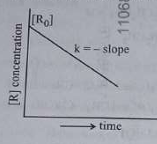
(Given : Molar mass of urea : $60 \text{ g mol}^{-1}$, $N_A : 6.022 \times 10^{23} \text{ particles mol}^{-1}$) For a certain reaction R $\rightarrow$ Product, the plot of [R] vs time has a negative slope as shown. The order of reaction is :
- Match List I with List II :
List I (Order of reaction) List II (Unit of rate constant) A. Zero order I. $mol^{-1} L s^{-1}$ B. First order II. $mol^{-2} L^2 s^{-1}$ C. Second order III. $s^{-1}$ D. Third order IV. $mol L^{-1} s^{-1}$
Choose the correct answer from the options given below : Calculate emf of the half cell given below :
$$Pt(s) | H_2 (g, 2 \text{ atm}) | HCl (aq, 0.02 \text{ M})$$
$$E_{H_2 /H^+}^\circ = 0 \text{ V}$$
(Given : $\frac{2.303 RT}{F} = 0.059$, $\log 2 = 0.3010$)At 298 K, a certain buffer solution contains equal concentrations of $X^{-}$ and $HX$. $K_b$ for $X^-$ is $10^{-10}$. What is the pH of this buffer solution ?
- Mixture of chloroform and acetone forms a solution with negative deviation from Raoult's law due to
- Identify the correct statements :
A. The molality of a 2.5 g of ethanoic acid (Molar mass : $60 \text{ g mol}^{-1}$) in 75 g of benzene solution is $0.556 \text{ m}$.
B. The molarity of a solution containing 5 g of NaOH (molar mass : $40 \text{ g mol}^{-1}$) in 450 mL of solution is 0.278 M at 298 K.
C. Aquatic species are more comfortable in cold water.
D. The solubility of gas increases with decrease in pressure.
E. For a binary mixture of A and B, the number of moles of A and B are $n_A$ and $n_B$ respectively, the mole fraction of B will be $x_B = \frac{n_A}{n_A + n_B}$.
Choose the correct answer from the options given below :
Important Questions from Physical Chemistry
$CaCO_3(s) + 2HCl(aq) \rightarrow CaCl_2(aq) + CO_2(g) + H_2O(l)$
Consider the above reaction, what mass of $CaCl_2$ will be formed if 250 mL of 0.76 M HCl reacts with 1000 g of $CaCO_3$ ?
(Given: Molar mass of Ca, C, O, H and Cl are 40, 12, 16, 1 and 35.5 g $mol^{-1}$, respectively)- According to Bohr's model of hydrogen atom, which of the following statement is incorrect?
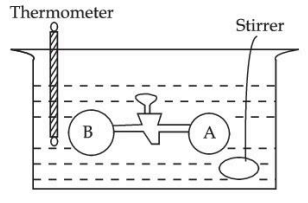
Two vessels A and B are connected via stopcock. The vessel A is filled with a gas at a certain pressure. The entire assembly is immersed in water and is allowed to come to thermal equilibrium with water. After opening the stopcock the gas from vessel A expands into vessel B and no change in temperature is observed in the thermometer. Which of the following statement is true ?Which of the following graphs correctly represents the plot of $K_H$ at 1 bar for gases in water versus temperature?
If equal volumes of $AB_2$ and $XY$ (both are salts) aqueous solutions are mixed, which of the following combination will give a precipitate of $AY_2$ at 300 K ?
(Given $K_{sp}$ (at 300 K) for $AY_2=5.2 \times 10^{-7}$)


