
Which of the following graphs correctly represents the plot of $K_H$ at 1 bar for gases in water versus temperature?
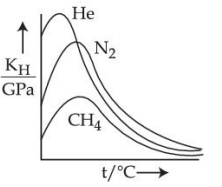
Understanding Henry's Law Constant ($K_H$) vs Temperature
Henry's Law describes the relationship between the partial pressure of a gas and its solubility in a liquid. The law is mathematically stated as:
$ P_{gas} = K_H \times x_{gas} $
In this equation:
- $P_{gas}$ represents the partial pressure of the gas.
- $K_H$ is the Henry's Law constant.
- $x_{gas}$ is the mole fraction of the gas in the liquid, indicating its solubility.
Temperature's Effect on Gas Solubility
Generally, the solubility of gases in liquids decreases as the temperature rises. This phenomenon occurs because dissolving gases in liquids is often an exothermic process (releases heat).
Relationship Between $K_H$ and Temperature
We can rearrange Henry's Law to solve for the constant:
$ K_H = \frac{P_{gas}}{x_{gas}} $
Consider a scenario with a constant partial pressure ($P_{gas}$):
- As temperature increases, the solubility ($x_{gas}$) of the gas in the liquid goes down.
- For $K_H$ to remain consistent with the law, if $x_{gas}$ decreases, $K_H$ must increase to keep the ratio $P_{gas}/x_{gas}$ valid.
Therefore, the Henry's Law constant ($K_H$) increases with increasing temperature.
Choosing the Correct Graph
The question asks for a plot of $K_H$ (y-axis) versus temperature (x-axis). Based on our reasoning, the plot must show an upward trend, indicating that $K_H$ increases with temperature.
- Option 1 shows a downward trend, which is incorrect.
- Options 2, 3, and 4 show upward trends.
Option D (the fourth graph) illustrates a linear increase in $K_H$ as temperature rises. While the actual relationship might be slightly curved (often exponential), a linear plot is a common and acceptable representation of this trend, especially in exam contexts.
Similar Questions
$CaCO_3(s) + 2HCl(aq) \rightarrow CaCl_2(aq) + CO_2(g) + H_2O(l)$
Consider the above reaction, what mass of $CaCl_2$ will be formed if 250 mL of 0.76 M HCl reacts with 1000 g of $CaCO_3$ ?
(Given: Molar mass of Ca, C, O, H and Cl are 40, 12, 16, 1 and 35.5 g $mol^{-1}$, respectively)- According to Bohr's model of hydrogen atom, which of the following statement is incorrect?
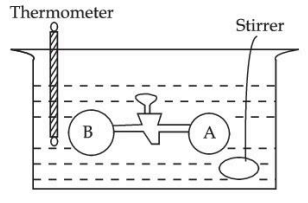
Two vessels A and B are connected via stopcock. The vessel A is filled with a gas at a certain pressure. The entire assembly is immersed in water and is allowed to come to thermal equilibrium with water. After opening the stopcock the gas from vessel A expands into vessel B and no change in temperature is observed in the thermometer. Which of the following statement is true ?If equal volumes of $AB_2$ and $XY$ (both are salts) aqueous solutions are mixed, which of the following combination will give a precipitate of $AY_2$ at 300 K ?
(Given $K_{sp}$ (at 300 K) for $AY_2=5.2 \times 10^{-7}$)On complete combustion 1.0 g of an organic compound (X) gave 1.46 g of $CO_2$ and 0.567 g of $H_2O$. The empirical formula mass of compound (X) is ________ g.
(Given molar mass in g $mol^{-1}$ C: 12, H: 1, O: 16)Consider the following electrochemical cell at standard condition.
$Au(s)$|$QH_2,Q$| $NH_4X(0.01 M)$ | | $Ag^+ (1M)$|$Ag(s)$ $E_{cell}$ = +0.4 V
The couple $QH_2/Q$ represents quinhydrone electrode, the half cell reaction is given below :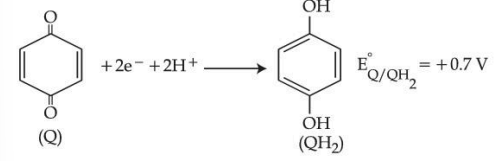
[Given: $E_{Ag^+/Ag}^ \circ$ = +0.8 V and $\frac{2.303RT}{F}$ = 0.06 V ]
The $pK_b$ value of the ammonium halide salt ($NH_4X$) used here is ________. (nearest integer)For the reaction A $\rightarrow$ products.
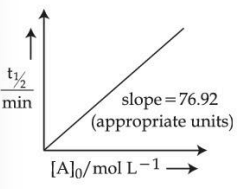
The concentration of A at 10 minutes is ________ $\times10^{-3}$ mol $L^{-1}$ (nearest integer).
The reaction was started with 2.5 mol $L^{-1}$ of A.Consider the following equilibrium,
$CO(g) + 2H_2(g) = CH_3OH(g)$
0.1 mol of CO along with a catalyst is present in a 2 $dm^3$ flask maintained at 500 K. Hydrogen is introduced into the flask until the pressure is 5 bar and 0.04 mol of $CH_3OH$ is formed. The $K_{p}^\theta$ is ________ $\times10^{-3}$ (nearest integer).
Given: R=0.08 $dm^3$ bar $K^{-1}$ $mol^{-1}$
Assume only methanol is formed as the product and the system follows ideal gas behaviour.0.1 mol of the following given antiviral compound (P) will weigh ________ $\times10^{-1}g$ (nearest integer).
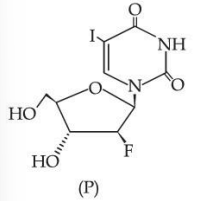
(Given : molar mass in g $mol^{-1}$ H : 1, C: 12, N : 14, O: 16, F: 19, I : 127)Among $10^{-9}$ g (each) of the following elements, which one will have the highest number of atoms? Element: Pb, Po, Pr and Pt
Important Questions from Physical Chemistry
$CaCO_3(s) + 2HCl(aq) \rightarrow CaCl_2(aq) + CO_2(g) + H_2O(l)$
Consider the above reaction, what mass of $CaCl_2$ will be formed if 250 mL of 0.76 M HCl reacts with 1000 g of $CaCO_3$ ?
(Given: Molar mass of Ca, C, O, H and Cl are 40, 12, 16, 1 and 35.5 g $mol^{-1}$, respectively)- According to Bohr's model of hydrogen atom, which of the following statement is incorrect?
Two vessels A and B are connected via stopcock. The vessel A is filled with a gas at a certain pressure. The entire assembly is immersed in water and is allowed to come to thermal equilibrium with water. After opening the stopcock the gas from vessel A expands into vessel B and no change in temperature is observed in the thermometer. Which of the following statement is true ?If equal volumes of $AB_2$ and $XY$ (both are salts) aqueous solutions are mixed, which of the following combination will give a precipitate of $AY_2$ at 300 K ?
(Given $K_{sp}$ (at 300 K) for $AY_2=5.2 \times 10^{-7}$)On complete combustion 1.0 g of an organic compound (X) gave 1.46 g of $CO_2$ and 0.567 g of $H_2O$. The empirical formula mass of compound (X) is ________ g.
(Given molar mass in g $mol^{-1}$ C: 12, H: 1, O: 16)


