
0.1 mol of the following given antiviral compound (P) will weigh ________ $\times10^{-1}g$ (nearest integer). 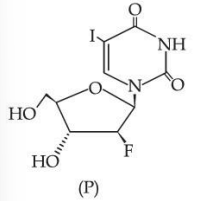
(Given : molar mass in g $mol^{-1}$ H : 1, C: 12, N : 14, O: 16, F: 19, I : 127)
To find the weight of 0.1 mol of the antiviral compound (P), follow these steps:
1. Determine the molecular formula of compound (P):
By counting the atoms in the given chemical structure:
- Carbon (C): 4 carbons in the base ring + 5 carbons in the sugar moiety = 9 atoms
- Hydrogen (H): 1 at C6, 1 at N3 (base), 1 at C1', 1 at C2', 1 at C3', 1 at C4', 2 at C5', 1 in the 3'-OH group, and 1 in the 5'-OH group = 10 atoms
- Nitrogen (N): 2 atoms in the base ring
- Oxygen (O): 2 in the base + 1 in the sugar ring + 2 in the hydroxyl groups = 5 atoms
- Fluorine (F): 1 atom at the C2' position
- Iodine (I): 1 atom at the C5 position
The molecular formula is C9H10FIN2O5.
2. Calculate the molar mass:
Using the given atomic masses:
Molar mass = (9 × 12) + (10 × 1) + (19) + (127) + (2 × 14) + (5 × 16)
Molar mass = 108 + 10 + 19 + 127 + 28 + 80
Molar mass = 372 g/mol
3. Calculate the mass of 0.1 mol:
Mass = moles × molar mass
Mass = 0.1 mol × 372 g/mol = 37.2 g
4. Convert to the required format (× 10-1 g):
37.2 g = 372 × 10-1 g
The value to be filled in the blank is 372.
Similar Questions
$CaCO_3(s) + 2HCl(aq) \rightarrow CaCl_2(aq) + CO_2(g) + H_2O(l)$
Consider the above reaction, what mass of $CaCl_2$ will be formed if 250 mL of 0.76 M HCl reacts with 1000 g of $CaCO_3$ ?
(Given: Molar mass of Ca, C, O, H and Cl are 40, 12, 16, 1 and 35.5 g $mol^{-1}$, respectively)- According to Bohr's model of hydrogen atom, which of the following statement is incorrect?
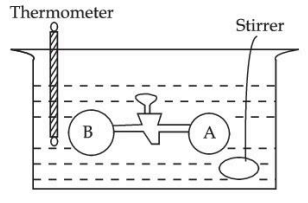
Two vessels A and B are connected via stopcock. The vessel A is filled with a gas at a certain pressure. The entire assembly is immersed in water and is allowed to come to thermal equilibrium with water. After opening the stopcock the gas from vessel A expands into vessel B and no change in temperature is observed in the thermometer. Which of the following statement is true ?Which of the following graphs correctly represents the plot of $K_H$ at 1 bar for gases in water versus temperature?
If equal volumes of $AB_2$ and $XY$ (both are salts) aqueous solutions are mixed, which of the following combination will give a precipitate of $AY_2$ at 300 K ?
(Given $K_{sp}$ (at 300 K) for $AY_2=5.2 \times 10^{-7}$)On complete combustion 1.0 g of an organic compound (X) gave 1.46 g of $CO_2$ and 0.567 g of $H_2O$. The empirical formula mass of compound (X) is ________ g.
(Given molar mass in g $mol^{-1}$ C: 12, H: 1, O: 16)Consider the following electrochemical cell at standard condition.
$Au(s)$|$QH_2,Q$| $NH_4X(0.01 M)$ | | $Ag^+ (1M)$|$Ag(s)$ $E_{cell}$ = +0.4 V
The couple $QH_2/Q$ represents quinhydrone electrode, the half cell reaction is given below :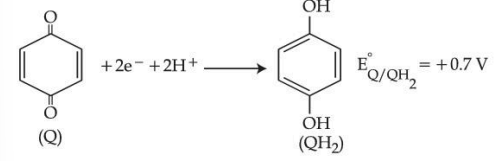
[Given: $E_{Ag^+/Ag}^ \circ$ = +0.8 V and $\frac{2.303RT}{F}$ = 0.06 V ]
The $pK_b$ value of the ammonium halide salt ($NH_4X$) used here is ________. (nearest integer)For the reaction A $\rightarrow$ products.
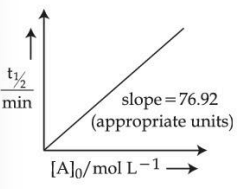
The concentration of A at 10 minutes is ________ $\times10^{-3}$ mol $L^{-1}$ (nearest integer).
The reaction was started with 2.5 mol $L^{-1}$ of A.Consider the following equilibrium,
$CO(g) + 2H_2(g) = CH_3OH(g)$
0.1 mol of CO along with a catalyst is present in a 2 $dm^3$ flask maintained at 500 K. Hydrogen is introduced into the flask until the pressure is 5 bar and 0.04 mol of $CH_3OH$ is formed. The $K_{p}^\theta$ is ________ $\times10^{-3}$ (nearest integer).
Given: R=0.08 $dm^3$ bar $K^{-1}$ $mol^{-1}$
Assume only methanol is formed as the product and the system follows ideal gas behaviour.Among $10^{-9}$ g (each) of the following elements, which one will have the highest number of atoms? Element: Pb, Po, Pr and Pt
Important Questions from Physical Chemistry
$CaCO_3(s) + 2HCl(aq) \rightarrow CaCl_2(aq) + CO_2(g) + H_2O(l)$
Consider the above reaction, what mass of $CaCl_2$ will be formed if 250 mL of 0.76 M HCl reacts with 1000 g of $CaCO_3$ ?
(Given: Molar mass of Ca, C, O, H and Cl are 40, 12, 16, 1 and 35.5 g $mol^{-1}$, respectively)- According to Bohr's model of hydrogen atom, which of the following statement is incorrect?
Two vessels A and B are connected via stopcock. The vessel A is filled with a gas at a certain pressure. The entire assembly is immersed in water and is allowed to come to thermal equilibrium with water. After opening the stopcock the gas from vessel A expands into vessel B and no change in temperature is observed in the thermometer. Which of the following statement is true ?Which of the following graphs correctly represents the plot of $K_H$ at 1 bar for gases in water versus temperature?
If equal volumes of $AB_2$ and $XY$ (both are salts) aqueous solutions are mixed, which of the following combination will give a precipitate of $AY_2$ at 300 K ?
(Given $K_{sp}$ (at 300 K) for $AY_2=5.2 \times 10^{-7}$)


