UPSC Political Science Syllabus - Download PSIR Optional Syllabus
Union Public Service Commission provides the candidates with an option to choose one optional subject among a list of 48 subjects. The IAS (UPSC CSE) Political Science or PSIR is one of the most opted UPSC optional subjects. The UPSC Political Science and International Relations (PSIR) subject consist of 2 papers. Each paper consists of 250 marks.
In this article, we will discuss the detailed UPSC syllabus of Political Science Paper 1 and Paper 2 along with recommended books for PSIR optional. The students should go through the syllabus and make notes.
|
Table of Contents |
Political Science Optional Syllabus for UPSC
The syllabus of PSIR optional for UPSC consists of certain topics such as freedom struggle and Indian Politics, the Constitution of India, International economic system and trade, International organization, India’s foreign policy, peacekeeping, etc. Certain topics in Political Science optional overlap with the GS syllabus of UPSC Mains. The candidates can check the previous year's question papers to know about the types of questions asked.
PSIR Paper 1 Syllabus
Political Science Optional Paper I subject is mainly divided into two components namely Political Theory and Indian Politics, and Indian Government and Politics.
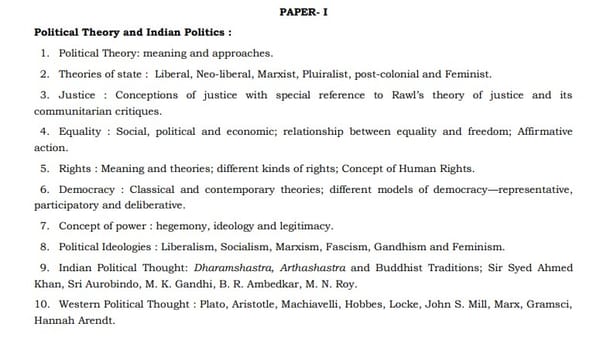
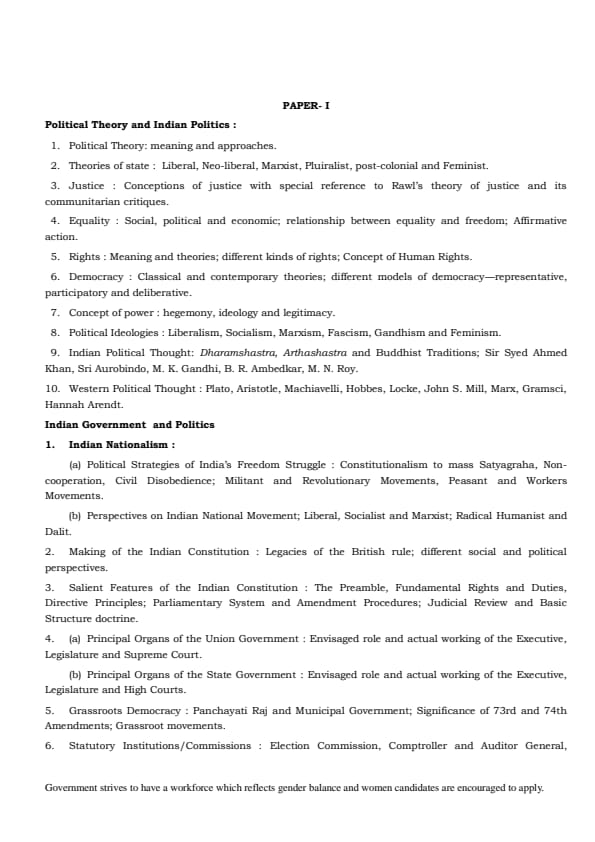
Political Theory and Indian Politics
The PSIR optional syllabus consists mainly of Political Theory, State theories, Justice, Equality, Rights, Democracy, etc. The detailed topics are given in the table below.
| Topics | Subtopics |
|---|---|
| Political Theory | Meaning, Definition, and Approaches |
| State Theories | Liberal, Neo-Liberal, Marxist, Feminist, Postcolonial, and Pluralist |
| Justice | Concept of Justice with special reference to Rawl’s theory of justice and its communitarian critiques |
| Equality | Social, political, and economic. Relationship between equality and freedom. Affirmative action. |
| Rights | Meaning and theories. Different kinds of rights. Concept of Human Rights |
| Democracy | Classical and contemporary theories. Democracy models like participatory, representative and deliberative. |
| Concept of Power | Hegemony, ideology, and legitimacy |
| Political Ideologies | Liberalism, Marxism, Socialism, Fascism, and Gandhism, etc. |
| Indian Political Thought | Dharmashastra Arthashastra and Buddhist Traditions. Sir Syed Ahmed Khan, Sir Aurobindo, MK Gandhi, BR Ambedkar, and MN Roy. |
| Western Political Thought | Plato, Machiavelli, Locke, John S. Mill, Marx, Aristotle, Gramsci, Hobbes, Hannah Arendt. |
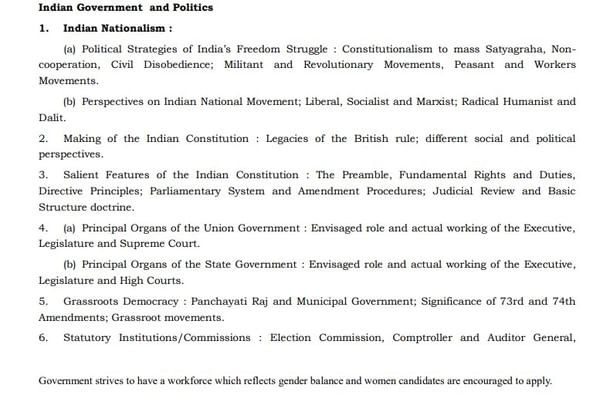
Indian Government and Politics
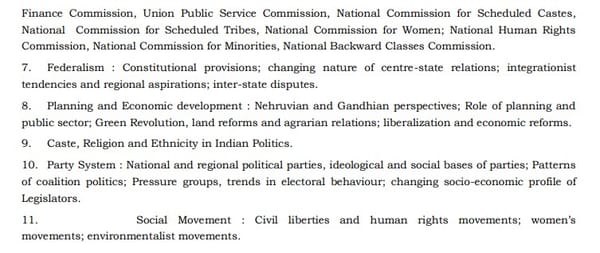
The syllabus of the Indian Government and Politics component of PSIR optional consists mainly of Indian Nationalism, Indian Constitution, Federalism, Party system, etc. The candidates can refer to NCERT Indian Polity notes for this section. The detailed topics are given in the tabulated below.
| Topics | Subtopics |
|---|---|
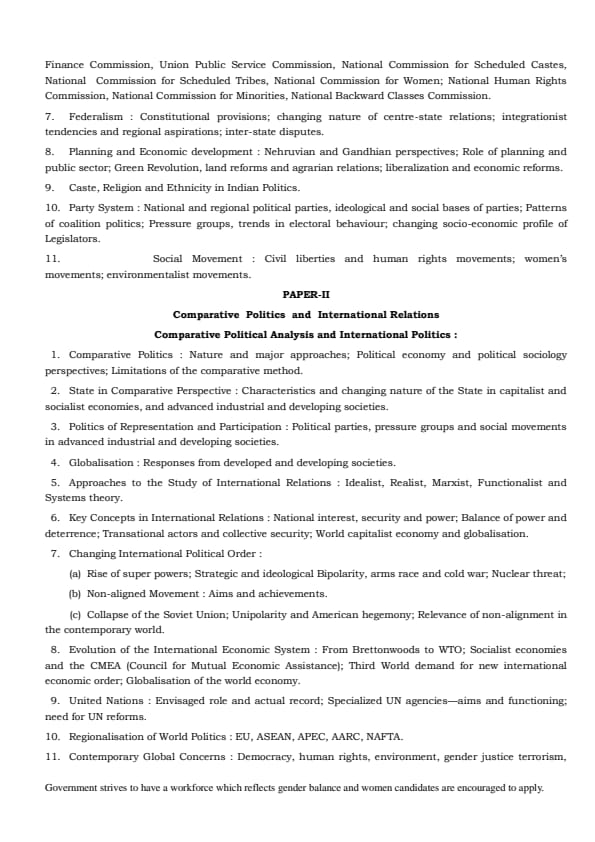
| Indian Nationalism |
|
| Making of Indian Constitution | Legacies of British rule. Different social and political perspectives. |
| Features of the Indian Constitution | Preamble, Fundamental Rights, Fundamental Duties, DPSPs, Parliamentary System, Judicial Review, Amendment Procedure, and Basic Structure. |
| Organs of Union Government | Role and actual working of Executive, Legislature, and Supreme Court. |
| Organs of State Government | Role and actual working of Executive, Legislature, and High Court. |
| Grassroots Democracy | Panchayati Raj Institutions. Municipal Government. Significance of 73rd and 74th Amendments. Movements at the Grassroot level. |
| Statutory Institutions/Commissions | Election Commission of India. Comptroller and Auditor General. Finance Commission, UPSC. National Commission for Scheduled Castes. National Commission for Scheduled Tribes. National Commission for Women. National Human Rights Commission. National Commission for Minorities. National Backward Classes Commission. |
| Federalism | changing nature of center-state relations, regional aspirations, and inter-state disputes. |
| Planning and Economic Development | Nehruvian and Gandhian perspectives. Role of planning and public sector. Green revolution. Land reforms. Agrarian relations. Liberalization and economic reforms. |
| Party System | National and regional political parties. Ideological and social bases of parties. Patterns of coalition politics. Pressure groups. Trends in electoral behaviour. Changing the socio-economic profile of legislators. |
| Social Movement | Civil liberties and human rights movements. Women’s movements. Environmentalist movements. |
PSIR Paper 2 Syllabus
Political Science Optional Paper 2 subject is mainly divided into two components namely Comparative Politics and International Relations, and India and World.
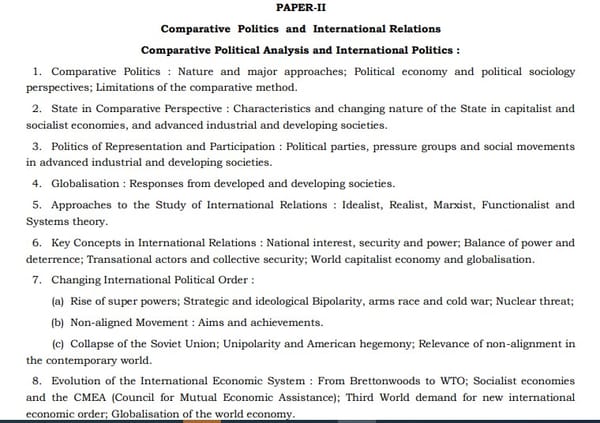
Comparative Politics and International Relations
The UPSC Mains syllabus of Comparative Politics and International Relations component of PSIR optional consists mainly of Comparative Politics, Participation, and Representation, Globalisation, International Relations, etc. The detailed topics are given in the table below.
| Topics | Subtopics |
|---|---|
| Comparative Politics | Nature and major approaches. Political economy and political sociology perspectives. Limitations of the comparative method |
| State in Comparative Perspective | Characteristics and changing nature of State in capitalist, socialist, advanced industrial and developing societies. |
| Politics of Representation and Participation | Political parties. Pressure groups. Social movements in advanced industrial and developing societies. |
| Globalization | Responses from developed and developing societies |
| Approaches to Study of International Relations | Idealist, Realist, Marxist, Functionalist, and Systems theory. |
| Key Concepts in International Relations | National Interest. Security and power. Balance of power and deterrence. Transnational actors and collective security. World capitalist economy and globalization. |
| Changing International Political Order |
|
| Evolution of the International Economic System | Bretton woods to WTO. Socialist economies and Council for Mutual Economic Assistance. Third World demand for new international economic order. Globalization of the world economy. |
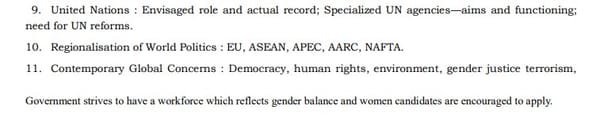
| United Nations | Envisaged role and actual record. Specialized UN agencies – aims and functioning. Need for UN reforms. |
| World Politics Regionalization | European Union, NAFTA, ASEAN, and APEC, etc. |
| Contemporary Global Concerns | Democracy, Human Rights, Environment, Gender Justice terrorism, and nuclear proliferation. |
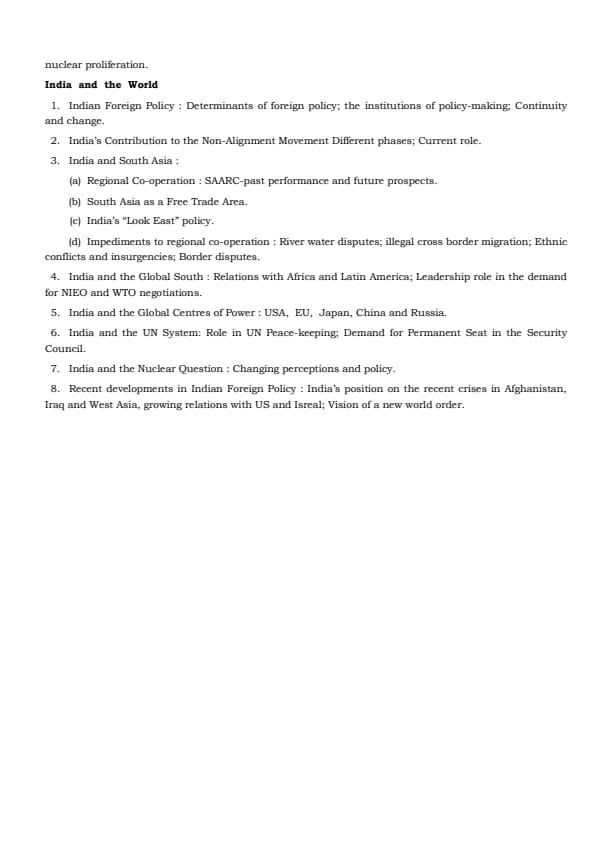
India and the World
The syllabus of India and the World component of PSIR optional consists mainly of Foreign Policy, India and S. Asia, India’s Contribution to NAM, UN system Global Centres of Power, etc.
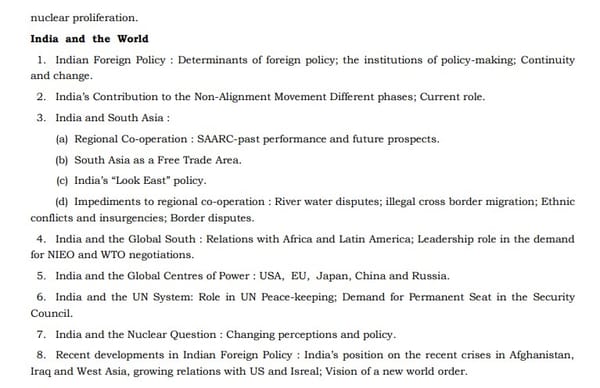
| Topics | Subtopics |
|---|---|
| Indian Foreign Policy | Determinants of foreign policy. Institutions of policymaking. Continuity and change. |
| India’s Contribution to Non-Alignment Movement | Different phases. Current role |
| India and South Asia |
|
| India and Global Centres of Power | USA, EU, Japan, China, and Russia |
| India and the UN system | Role of India in UN Peace Keeping. Demand for Permanent Seat in Security Council |
| India and Nuclear Question | Changing perceptions and policy |
| Recent developments in the Foreign Policy of India | India’s position on crises in Afghanistan, Iraq, and West Asia, etc. Growing relations with the US and Israel. A vision of new world order. |
Download UPSC Polity & PSIR Syllabus PDF
PSIR Optional Books
The civil services aspirants who have chosen their optional subject as Political Science and International Relations (PSIR) must mandatorily refer to the given books and plan their Mains strategies to score higher marks in the subject.
Books for Paper 1
- An Introduction to Constitution by DD Basu
- An Introduction to Political Theory by OP Gauba
- A History of Political Thought: Plato to Marx by Mukherjee and Sushila Ramaswamy
- Foundations of Indian political thought by VR Mehta
- A new look at Modern Indian history by BL Grover and Alka Mehta
- India’s Struggle for Independence by Bipin Chandra
- Indian Government and Politics by BL Fadia etc.
| Relevant Links | ||
|---|---|---|
| IAS Preparation Tips | IAS Prelims Syllabus | UPSC Question Papers |
| UPSC Indian Polity Notes | International Relations Preparation Notes | Governance Study Notes |
Books for Paper 2
- India’s foreign policy by VP Dutt
- International Relations by Khanna
- Challenge and Strategy: Rethinking India’s Foreign Policy by Rajiv Sikri
- Does Elephant Dance: Contemporary Indian Foreign Policy by David M. Malone
- Global Politics by Andrew Heywood etc.
Political Science and International Relations is one of the popular optional subjects that have been chosen by most toppers of the UPSC IAS exam. The aspirants are advised to take a look at the syllabus of the paper before finalizing it as their optional paper in the Mains exam. PSIR as an optional paper is a bit non-technical and aspirants can study the subject even if they don't have political science as their background. Concepts are general and anybody who reads newspapers regularly will be able to comprehend them. Any civil services aspirant must have a stronghold over the fundamentals of political science, even if their optional is not Political Science.
IAS Political Science FAQs
Ques. Is Political Science optional scoring in the UPSC exam?
Ans. Yes, Political Science is considered as one of the scoring and best optional subjects among UPSC aspirants. It is opted by the aspirants because the subject can be easily understood by anybody and doesn’t need a political science background.
Ques. Is coaching important for PSIR optional?
Ans. If an aspirant can understand the content of the paper by referring to multiple standard books and practising answer writing by themselves, coaching is not essential. The aspirants can pay for answer-writing mock tests to get their answers evaluated by experts and minimize errors. If the aspirants are not confident and not clear with basic concepts of the PSIR paper and need guidance, then coaching is advised.
Ques. Is Laxmikant's book enough for PSIR?
Ans. When it comes to polity, the Laxmikant book is enough to clear prelims. However, PSIR optional paper requires more conceptual clarity and knowledge. Therefore, along with Laxmikant, aspirants need to cover the recommendatory books given in this article.
Ques. Is Polity is different from Political Science?
Ans. Yes, Polity and Political Science are different. Political Science studies, researches and reconsiders existing notions of political power, right, and responsibilities. Polity is the system of government that works towards framing and implementing of policies and strategies.
Ques. Why is PSIR so popular as an optional subject amongst aspirants?
Ans. There are multiple reasons why PSIR is one of the most popular optional subjects amongst students. It is dynamic and easily comprehensible which makes it interesting to study. It also fetches more marks than many other subjects.
Download the PREPP App and attempt FREE IAS Exam Mock Tests and get complete study material!
UPSC IAS : CSAT - Mini Live Test

Live Test : UPSC CSE Prelims CSAT (Paper-II) (Oct 20 - 23)
Full Test - 04: UPSC CSE Prelims CSAT (Paper-II)
Full Test - 03: UPSC CSE Prelims CSAT (Paper-II)
UPSC CSE Prelims 2026 GS Paper 1 Question Paper (24-May-2026)
UPSC CSE Prelims 2026 CSAT Paper 2 Question Paper (24-May-2026)

17 February 2025 | The Hindu Must Read Articles | Current Affairs

16 February 2026 | The Hindu Must Read Articles | Current Affairs

13 February 2026 | The Hindu Must Read Articles | Current Affairs









Comments