UPSSSC PET 2026 Question Paper and Answer Key, Download PDF
UPSSSC PET 2026 Question Paper and Answer Key PDFs will be available here after each examination shift. UPSSSC PET 2026 is scheduled for October 25, October 30 and November 1, 2026, with Shift 1 from 10:00 AM to 12:00 PM and Shift 2 from 3:00 PM to 5:00 PM. Candidates will be able to use the shift-wise question papers, answer keys and solutions to check their responses and understand the latest difficulty level of the examination.
UPSSSC PET 2026 Question Paper and Answer Key PDF
| Question Paper PDF | Answer Key PDF | Detailed Solution |
|---|---|---|
UPSSSC PET 2026 Question Paper and Answer Key PDF (Oct 25, 2026) (Shift 1) |
Available Soon | Available Soon |
| UPSSSC PET 2026 Question Paper and Answer Key PDF (Oct 25, 2026) (Shift 2) |
Available Soon | Available Soon |
| UPSSSC PET 2026 Question Paper and Answer Key PDF (Oct 30, 2026) (Shift 1) |
Available Soon | Available Soon |
| UPSSSC PET 2026 Question Paper and Answer Key PDF (Oct 30, 2026) (Shift 2) |
Available Soon | Available Soon |
| UPSSSC PET 2026 Question Paper and Answer Key PDF (Nov 01, 2026) (Shift 1) |
Available Soon | Available Soon |
| UPSSSC PET 2026 Question Paper and Answer Key PDF (Nov 01, 2026) (Shift 2) |
Available Soon | Available Soon |
 Never Miss a Sarkari Job Alert! Get instant notifications and exam news right inside your chat.
 Click here to join Prepp on WhatsApp
 Boost Your Preparation with Free Resources! Get daily quizzes, current affairs PDFs, and study notes directly on Telegram. Click here to join Prepp on Telegram
UPSSSC PET 2026 Exam Pattern
UPSSSC PET question paper consists of 100 objective-type questions carrying 100 marks. Candidates receive 2 hours to complete the examination.
A penalty of 0.25 mark is applied for every incorrect answer.
| Subject | Questions | Marks |
|---|---|---|
| Indian History | 5 | 5 |
| Indian National Movement | 5 | 5 |
| Geography | 5 | 5 |
| Indian Economy | 5 | 5 |
| Indian Constitution & Public Administration | 5 | 5 |
| General Science | 5 | 5 |
| Elementary Arithmetic | 5 | 5 |
| General Hindi | 5 | 5 |
| General English | 5 | 5 |
| Logic & Reasoning | 5 | 5 |
| Current Affairs | 10 | 10 |
| General Awareness | 10 | 10 |
| Analysis of Hindi Unseen Passages | 10 | 10 |
| Graph Interpretation | 10 | 10 |
| Table Interpretation & Analysis | 10 | 10 |
| Total | 100 | 100 |
The paper covers a broad range of subjects instead of concentrating on a single academic area. This requires candidates to maintain balanced preparation across static subjects, current affairs, reasoning and data interpretation.
High-Weightage Areas in UPSSSC PET 2026
Not every section carries the same weightage. Five areas together contribute 50 marks:
- Current Affairs
- General Awareness
- Hindi Unseen Passage
- Graph Interpretation
- Table Interpretation
Each of these carries 10 marks.
The remaining subjects generally contribute 5 marks each. Candidates should therefore avoid spending disproportionate preparation time on a single five-mark subject while neglecting data interpretation or general awareness.
Graph and table-based questions can be particularly useful for improving the score because regular practice can significantly reduce the time required to interpret numerical information.
UPSSSC PET 2026 Marking Scheme
Understanding the marking scheme is important because incorrect answers reduce the overall score.
| Response Type | Marks |
|---|---|
| Correct Answer | +1 |
| Incorrect Answer | -0.25 |
| Unattempted | 0 |
Candidates should avoid random guessing when they cannot eliminate any option confidently.
For example, if a candidate answers 80 questions correctly and 12 incorrectly:
Marks for correct answers = 80
Negative marks = 12 × 0.25 = 3
Estimated raw score = 80 – 3 = 77 marks
This calculation can be used with the provisional answer key to estimate performance before the result is announced.
How to Analyse the UPSSSC PET 2026 Question Paper?
Candidates should analyse the question paper beyond simply counting correct answers.
A useful approach is to divide mistakes into separate categories:
- Conceptual mistakes: Questions answered incorrectly because the underlying concept was unclear.
- Factual mistakes: Incorrect answers caused by weak revision in subjects such as History, Current Affairs or General Awareness.
- Calculation mistakes: Errors in Arithmetic, Graph Interpretation or Table Interpretation despite knowing the correct method.
- Time-management mistakes: Questions that could have been solved correctly but were left because too much time was spent elsewhere.
This type of analysis provides a clearer picture of preparation quality and helps candidates improve before appearing for UPSSSC Mains examinations or future PET cycles.
How Previous Year Papers Can Improve UPSSSC PET Preparation?
Previous year papers are particularly useful for PET because of the wide syllabus.
Candidates can use them to identify:
- Frequently tested History and Geography concepts.
- Important areas of Indian Polity and Economy.
- Recurring arithmetic and reasoning patterns.
- The level of Current Affairs questions.
- Types of graphs and tables used in the exam.
- The difficulty level of Hindi passages.
- The amount of time required to complete 100 questions.
A candidate who regularly solves full-length papers can also develop a practical section order instead of deciding how to attempt the paper during the actual examination.
| Download UPSSSC PET Previous Year Question Papers | |
|---|---|
| UPSSSC PET 2025 Question Paper | UPSSSC PET 2023 Question Paper |
| UPSSSC PET 2022 Question Paper | UPSSSC PET 2021 Question Paper |
Best Attempt Strategy for UPSSSC PET 2026
Candidates should begin with the sections they can solve accurately and quickly. Spending too much time on difficult numerical or interpretation questions during the first phase can reduce the number of easier questions attempted later.
A practical approach is to complete straightforward static GK, language and reasoning questions first.
The second phase can be used for arithmetic, graphs, tables and questions requiring longer calculations.
The final few minutes should be reserved for checking unanswered questions and verifying marked responses.
Because negative marking applies, attempting every question without sufficient confidence may not always improve the final score.
Importance of Current Affairs in UPSSSC PET
Current Affairs directly carries 10 marks and also overlaps with General Awareness.
Candidates should therefore revise major national, international and Uttar Pradesh-specific developments rather than depending only on static GK.
Important preparation areas may include:
- Government schemes
- Important appointments
- Awards and honours
- Sports events
- Reports and indexes
- Science and technology
- National and international events
- Important days
- Uttar Pradesh government initiatives
- Major economic developments
Revision through short notes can be more effective than attempting to study large current-affairs compilations immediately before the exam.
Graph and Table Interpretation in UPSSSC PET
Graph and table interpretation together account for 20 marks, making them a major scoring component.
Questions may require candidates to compare values, calculate differences, determine percentages or identify trends from the given data.
These questions are generally less dependent on memorisation than History or Current Affairs. As a result, candidates who practise data interpretation regularly can use these sections to strengthen their overall score.
While practising, candidates should focus on calculation speed, approximation and careful reading of units.
Role of PET Score in UPSSSC Recruitment
PET serves as an initial eligibility mechanism for subsequent UPSSSC recruitments.
When the Commission issues a Main Examination notification for a particular post, eligible PET candidates may be shortlisted according to the criteria specified in that recruitment notice.
Recruitments connected with PET may include posts such as Lekhpal, Junior Assistant and various other Group C positions, depending on the notifications issued by UPSSSC.
Candidates should therefore aim to obtain the strongest possible PET score rather than treating the examination merely as a pass-or-fail test.
| Relevant Links | ||
|---|---|---|
| UPSSSC PET Eligibility | UPSSSC PET Syllabus | UPSSSC PET Exam Dates |
| UPSSSC PET Exam Pattern | UPSSSC PET Best Books | UPSSSC PET Previous Year Paper |
UPSSSC PET 2026 Question Paper FAQs
Ques: How many questions will be asked in UPSSSC PET 2026?
Ans: The question paper contains 100 objective-type questions carrying a total of 100 marks. Candidates get 120 minutes to complete the paper, so effective time management is important because the syllabus covers 15 different areas.
Ques: Is there negative marking in UPSSSC PET 2026?
Ans: Yes. One-fourth of a mark, or 0.25 mark, is deducted for every incorrect response. Candidates should therefore avoid excessive guessing and prioritise accuracy while attempting questions for which they can reasonably determine the correct option.
Ques: When will the UPSSSC PET 2026 Question Paper and Answer Key PDF be available?
Ans: Shift-wise question papers will become available after the respective examinations are completed. The provisional official answer key is expected after the examination cycle, and candidates should follow UPSSSC notices for the answer-key viewing and objection process.
Ques: Which sections have the highest weightage in UPSSSC PET?
Ans: Current Affairs, General Awareness, Hindi Passage Analysis, Graph Interpretation and Table Interpretation carry 10 marks each. Together, these areas account for half of the complete 100-mark paper, making them particularly important for candidates targeting a competitive score.
Ques: Is UPSSSC PET itself a recruitment examination for a particular post?
Ans: No. PET functions primarily as an eligibility and shortlisting examination for subsequent recruitments conducted by UPSSSC. Candidates may need to use their PET score to become eligible for the Main Examination or further selection stages of specific posts notified separately.
Ques: How should candidates use UPSSSC PET previous year question papers?
Ans: Previous papers should first be solved topic-wise to understand the question style and then as complete two-hour mock tests. Candidates should analyse incorrect answers, calculation errors and time-consuming questions after every attempt so that revision is based on actual weaknesses rather than only the final mock score.
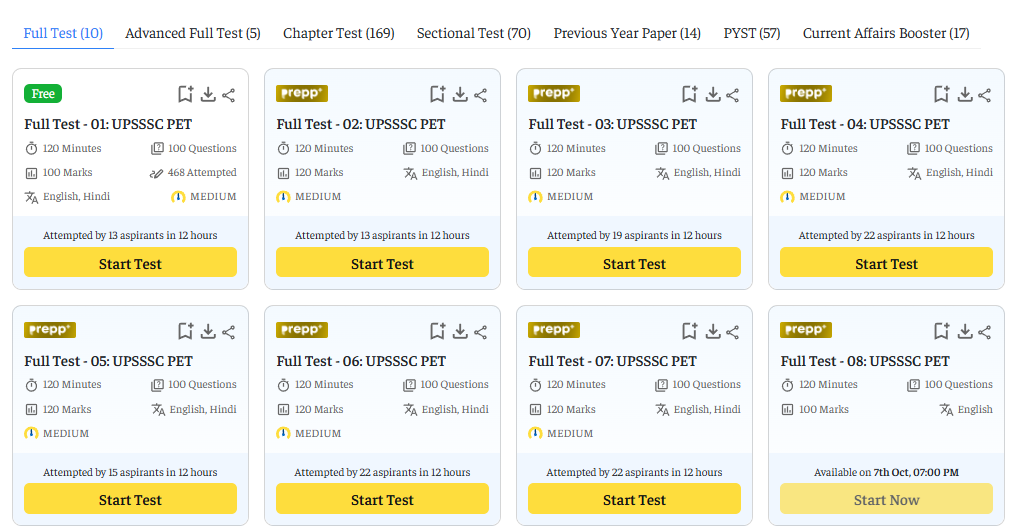
Download the PREPP App and attempt FREE UPSSSC PET Mock Tests and get complete study material!

Full Test - 10: UPSSSC PET
Full Test - 09: UPSSSC PET
UPSSSC PET 2025 Question Paper (06-Sep-2025) (Shift-2)
UPSSSC PET 2025 Question Paper (07-Sep-2025) (Shift-2)

17 February 2025 | The Hindu Must Read Articles | Current Affairs

16 February 2026 | The Hindu Must Read Articles | Current Affairs

13 February 2026 | The Hindu Must Read Articles | Current Affairs









Comments