UPSC EPFO Syllabus 2026: APFC Exam Pattern & Subject-wise Topics
UPSC EPFO Syllabus and Exam Pattern 2026 covers the subjects, questions, marks, duration and negative marking for the exam. 2026 recruitment is for 80 APFC vacancies, while the earlier EO/AO vacancies are not included in the current notification. UPSC EPFO 2026 syllabus covers General English, Polity, Economy, Labour Laws, Social Security, General Science and Computer Applications.
UPSC EPFO Syllabus and Exam Pattern 2026 Highlights
| Particulars | APFC | EO/AO |
|---|---|---|
| Post Name | Assistant Provident Fund Commissioner | Enforcement Officer/Accounts Officer |
| Vacancies | 80 | Withdrawn for the current 2026 cycle |
| Exam Level | National Level | National Level |
| Exam Mode | Offline (Objective Type) | Offline (Objective Type) |
| Exam Duration | 2 Hours | 2 Hours |
| Selection Process | Recruitment Test + Interview | Recruitment Test + Interview |
| Pay Level | Level 10 | Level 8 |
| Official Website | upsc.gov.in | upsc.gov.in |
Note: UPSC EPFO 2026 notification has been issued for 80 APFC vacancies. The earlier EO/AO vacancies have been withdrawn and are not part of the current 2026 recruitment cycle. The EO/AO column is should be used to distinguish the two EPFO posts and their respective recruitment status.
UPSC EPFO APFC And EO/AO Exam Pattern 2026
UPSC EPFO Exam Pattern 2026 helps candidates understand how the recruitment process works for EO/AO and APFC posts. Although the basic written exam structure is similar for both posts, APFC candidates have additional syllabus areas to prepare.
UPSC EPFO APFC Exam Pattern 2026
UPSC EPFO APFC Exam Pattern 2026 consists of an objective recruitment test followed by an interview. The written test carries 300 marks and is conducted for two hours.
| Exam Component | Details |
|---|---|
| Mode | Offline |
| Type of Questions | Objective-type MCQs |
| Total Questions | 120 |
| Maximum Marks | 300 |
| Duration | 2 Hours |
| Language | English and Hindi |
| Negative Marking | 1/3 of the marks assigned to the question |
| Interview | 100 Marks |
| Final Weightage | RT 75% + Interview 25% |
UPSC EPFO APFC Exam Pattern Part-wise
UPSC EPFO APFC exam pattern is divided into broad syllabus components, with General English forming one area and the remaining subjects covering general studies, labor, social security, accountancy, and other prescribed areas.
| Part | Subjects Covered |
|---|---|
| Part I | General English |
| Part II | Indian Culture, Heritage and Freedom Movements; Developmental Issues and Present Trends in Indian Economy; Governance and Constitution of India; General Science and Basic Knowledge of Computer Applications |
| Part III | Elementary Mathematics, Statistics and General Mental Ability; Industrial Relations, Labour Codes and Social Security in India; Principles of Accountancy, Auditing and Insurance; Current Events of National and International Importance |
Note; UPSC does not prescribe separate marks or question counts for these three parts. The recruitment test is a 120-question, 300-mark paper. The Part-wise grouping should therefore be used to understand the syllabus structure, not as a separate sectional eexam scheme.
UPSC EPFO APFC Negative Marking 2026
UPSC EPFO APFC Negative Marking 2026 applies to incorrect answers in the Recruitment Test. One-third of the marks assigned to a question is deducted for an incorrect response.
| Response | Marking |
|---|---|
| Correct Answer | Full marks |
| Incorrect Answer | 1/3 marks deducted |
| Unanswered Question | No negative marking |
| Multiple Options Marked | Treated as incorrect |
Since UPSC EPFO Previous year Question papers contain negative marking, candidates need to distinguish between questions that can be answered with reasonable certainty and questions involving excessive guesswork.
UPSC EPFO APFC Qualifying Marks 2026
UPSC EPFO APFC Qualifying Marks 2026 determine the minimum interview score required for candidates to remain eligible for final selection. The interview carries 100 marks.
| Category | Minimum Interview Marks |
|---|---|
| General/EWS | 50 |
| OBC | 45 |
| SC/ST/PwBD | 40 |
The Interview marks are considered along with the recruitment test performance according to the prescribed final weightage. Meeting the minimum interview qualifying marks alone does not guarantee final selection.
UPSC EPFO APFC Selection Process 2026
UPSC EPFO APFC Selection Process 2026 includes the Recruitment Test and Interview. Candidates shortlisted through the recruitment test appear for the interview, after which the final merit is prepared.
| Stage | Maximum Marks | Weightage |
|---|---|---|
| Recruitment Test | 300 | 75% |
| Interview | 100 | 25% |
| Final Selection | 400 | 100% |
UPSC EPFO APFC Recruitment Test is the first stage of the selection process. Candidates who qualify for the next stage are considered for the Interview, and the final selection is based on performance in the prescribed selection stages and applicable eligibility conditions.
Is EO/AO Included in UPSC EPFO Recruitment 2026?
UPSC EPFO Recruitment 2026 is currently for the APFC post only, with 80 vacancies notified. EO/AO is not included in the current recruitment cycle.
| Post | Recruitment Status |
|---|---|
| APFC | 80 Vacancies |
| EO/AO | Not included in current recruitment |
Therefore, this article focuses on the APFC syllabus and exam pattern. EO/AO syllabus from previous recruitment cycles should not be treated as part of the 2026 notification.
Note: This distinction is important because the syllabus and eexam structure available from earlier UPSC EPFO EO/AO and APFC recruitments may not represent the requirements of the current recruitment.
UPSC EPFO APFC Syllabus 2026
UPSC EPFO APFC Syllabus 2026 covers nine broad areas ranging from General English and Indian Culture to Labour Codes, Social Security, Accountancy, Auditing, Insurance and Current Affairs.
| No. | Syllabus Area |
|---|---|
| 1 | General English |
| 2 | Indian Culture, Heritage and Freedom Movements |
| 3 | Developmental Issues and Present Trends in Indian Economy |
| 4 | Governance and Constitution of India |
| 5 | General Science and Basic Knowledge of Computer Applications |
| 6 | Elementary Mathematics, Statistics and General Mental Ability |
| 7 | Industrial Relations, Labour Codes and Social Security in India |
| 8 | Principles of Accountancy, Auditing and Insurance |
| 9 | Current Events of National and International Importance |
UPSC EPFO APFC 2026 syllabus combines conventional competitive-exam subjects with specialised areas directly related to labor administration and social security. Candidates therefore need to prepare both general studies topics and domain-oriented subjects such as Labour Codes, Social Security, Accountancy, Auditing and Insurance.
UPSC EPFO APFC Syllabus: Subject-wise Topics
UPSC EPFO APFC Syllabus contains broad subject areas rather than a chapter-wise official list. The following table expands each official area into important preparation topics while retaining the scope of the prescribed syllabus.
| Subject | Important Topics |
|---|---|
| General English | Grammar, vocabulary, comprehension, sentence correction, error detection, synonyms, antonyms, idioms and phrases |
| Indian Culture & Heritage | Art, architecture, literature, music, dance, monuments, cultural traditions and heritage |
| Freedom Movements | Revolt of 1857, INC, Swadeshi Movement, Home Rule Movement, Non-Cooperation Movement, Civil Disobedience Movement, Quit India Movement and constitutional developments |
| Indian Economy | GDP, national income, inflation, unemployment, banking, RBI, fiscal policy, monetary policy, taxation, poverty and economic development |
| Governance & Constitution | Preamble, Fundamental Rights, DPSP, Fundamental Duties, Parliament, President, Judiciary, constitutional bodies, Centre-State relations and local government |
| General Science | Physics, Chemistry, Biology, health, environment, ecology and everyday science |
| Computer Applications | Hardware, software, memory, operating systems, MS Office, internet, email, networking and cybersecurity |
| Mathematics | Number system, percentage, ratio, average, profit and loss, interest, time and work, time-speed-distance and data interpretation |
| Statistics | Data collection, classification, tabulation, mean, median, mode, dispersion, probability and data interpretation |
| General Mental Ability | Analogy, classification, series, coding-decoding, ranking, direction, logical reasoning and analytical ability |
| Industrial Relations | Trade unions, collective bargaining, industrial disputes, strikes, lockouts and labour welfare |
| Labour Codes | Labour Codes, major provisions and their application to workers and employers |
| Social Security | EPFO, provident fund, pension, insurance, social security schemes, organised and unorganised workers |
| Accountancy | Accounting principles, journal, ledger, trial balance, depreciation, final accounts and balance sheet |
| Auditing | Audit principles, types of audit, internal control, audit evidence, verification and audit reports |
| Insurance | Insurance principles, insurable interest, indemnity, contribution, subrogation and risk |
| Current Affairs | National and international events, government schemes, economy, labour, social security, reports, awards and appointments |
The topics in this table are expanded preparation areas, not a separate UPSC-issued chapter-wise syllabus. The official syllabus uses broad subject descriptions, so candidates should use these topics to organise their study material without treating every listed subtopic as an independently prescribed UPSC heading.
UPSC EPFO APFC Syllabus: Labour Codes and Social Security
UPSC EPFO APFC syllabus gives specific coverage to Industrial Relations, Labour Codes and Social Security in India. These topics are directly relevant to EPFO's area of work and should be studied using the latest applicable provisions and official government material.
| Area | Topics |
|---|---|
| Industrial Relations | Employer-employee relations, trade unions, collective bargaining and industrial disputes |
| Labour Welfare | Worker welfare, labour standards and employment conditions |
| Labour Codes | Major provisions of applicable Labour Codes |
| Social Security | Social insurance, social assistance and worker benefits |
| EPFO | Provident fund, pension, insurance and EPFO functions |
| Workers | Organised and unorganised workers |
| Social Security Schemes | Major government social security programmes |
For this part of the syllabus, candidates should pay attention to the relationship between labour regulation and social-security administration. Topics related to provident fund, pension, insurance and worker welfare are particularly relevant because they connect directly with the functional areas covered by EPFO.
UPSC EPFO APFC Syllabus: Accountancy, Auditing and Insurance
UPSC EPFO APFC Syllabus includes fundamental concepts from Accountancy, Auditing and Insurance. These areas can be prepared together because all three are included under the same broad syllabus component.
| Subject | Important Topics |
|---|---|
| Accountancy | Accounting concepts, journal, ledger, trial balance, cash book, depreciation, reserves, provisions and final accounts |
| Auditing | Objectives, types, audit planning, internal control, audit evidence, verification, valuation and audit reports |
| Insurance | Insurance principles, insurable interest, utmost good faith, indemnity, contribution, subrogation and insurance claims |
The focus should remain on fundamental concepts and their application. Candidates should also understand standard accounting terminology and basic audit procedures rather than restricting preparation to definitions alone.
UPSC EPFO APFC Syllabus: Mathematics, Statistics and Mental Ability
UPSC EPFO APFC Syllabus combines elementary mathematics, statistics and general mental ability in one broad section. The preparation focuses on basic numerical concepts, statistical measures and logical reasoning.
| Area | Important Topics |
|---|---|
| Mathematics | Number system, percentage, ratio, average, profit and loss, interest, time and work |
| Data Interpretation | Tables, charts and basic data-based calculations |
| Statistics | Mean, median, mode, range, variance and standard deviation |
| Probability | Basic probability concepts |
| Mental Ability | Analogy, classification, series, coding-decoding and ranking |
| Reasoning | Direction sense, logical reasoning and problem-solving |
These topics cover the elementary level of quantitative and reasoning skills indicated by the syllabus. Candidates should also practise calculations under time constraints because the Recruitment Test has a fixed two-hour duration.
UPSC EPFO APFC Previous Year Question Papers and Mock Test
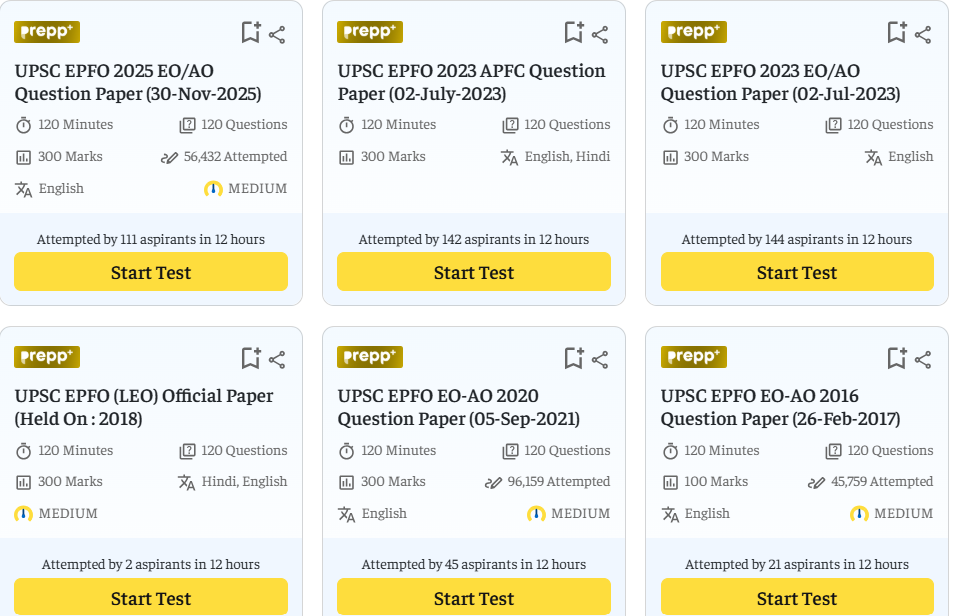
UPSC EPFO APFC Previous Year Question Papers and Mock Test help candidates understand the question trend and practice the 120-question, 300-mark Recruitment Test.
| Practice | Purpose |
|---|---|
| Previous Year Papers | Understand question trend, difficulty and repeated topics |
| Mock Tests | Practise the 120-question, 300-mark exam within 2 hours |
| Paper Analysis | Identify weak areas, mistakes and accuracy |
Candidates should solve PYQs first to understand the exam pattern and then use mock tests for timed practice and performance analysis.
UPSC EPFO APFC Books 2026
UPSC EPFO APFC books should cover the major static subjects, while official government sources should be used for labor codes, social security, and current developments.
| Subject | Recommended Book/Source |
|---|---|
| Indian Polity | Indian Polity - M. Laxmikanth |
| Modern History | A Brief History of Modern India - Rajiv Ahir |
| Indian Economy | Indian Economy - Ramesh Singh |
| General English | Objective General English - S.P. Bakshi |
| Quantitative Aptitude | Quantitative Aptitude for Competitive Eexam s - R.S. Aggarwal |
| Reasoning | A Modern Approach to Verbal & Non-Verbal Reasoning - R.S. Aggarwal |
| Indian Culture | Indian Art and Culture - Nitin Singhania |
| Accountancy | ICAI Study Material |
| Labour & Social Security | EPFO and Ministry of Labour & Employment official material |
| General Science | Lucent's General Science |
| Current Affairs | PIB and official government sources |
UPSC EPFO APFC Preparation 2026
UPSC EPFO APFC Preparation 2026 covers the complete syllabus through subject-wise study, previous year questions, and mock-test practice. Labor codes, Social Security, Accountancy, Auditing and Insurance should be covered alongside the general subjects rather than left for the final stage.
| Preparation Component | Coverage |
|---|---|
| Syllabus Coverage | Complete APFC syllabus |
| Concept Building | Polity, Economy, Labour, Accountancy and other static subjects |
| Current Affairs | National, international, economic, labour and social-security developments |
| PYQs | Subject-wise and full-paper practice |
| Mock Tests | Full-length 300-mark papers |
| Revision | Facts, concepts, provisions, formulas and mistakes |
A complete preparation framework should cover the syllabus in parallel rather than treating the specialised subjects as an optional add-on. Current developments should also be linked with static concepts, particularly in areas such as the economy, governance, labour legislation and social security.
UPSC EPFO Syllabus 2026 FAQs
Ques: Is the UPSC EPFO APFC syllabus the same as the previous EO/AO syllabus?
Ans: No. The current recruitment is for APFC, and candidates should follow the syllabus applicable to the current APFC recruitment. Previous EO/AO recruitment material should not be assumed to form part of the present notification.
Ques: Does UPSC provide a chapter-wise APFC syllabus?
Ans: No separate chapter-wise list is provided in the broad syllabus structure. UPSC specifies major subject areas, which candidates can further break down into topics such as Indian Polity, Economy, Labour Codes, Accountancy, Auditing and Insurance for preparation.
Ques: Which APFC syllabus areas are directly related to EPFO?
Ans: Industrial Relations, Labour Codes, Social Security in India and topics covering provident fund, pension and insurance have a direct functional connection with EPFO. Accountancy, Auditing and Insurance are also included as specialised areas of the APFC syllabus.
Ques: How should candidates study Labour Codes and Social Security for APFC?
Ans: Candidates should combine conceptual study with the latest applicable provisions, government schemes and official information. Labour legislation and social-security topics should not be prepared only from outdated static notes because the applicable framework may change.
Ques: the topics listed under the APFC subject-wise syllabus officially prescribed by UPSC?
Ans: The nine broad areas are part of the prescribed syllabus, while the chapter-level topics in the subject-wise table are an expanded preparation framework. They are intended to organise the broad UPSC syllabus and should not be interpreted as a separate official chapter-wise notification
Download the PREPP App and attempt FREE UPSC EPFO Mock Tests and get complete study material!

French revolution
Full Test - 03 : UPSC EPFO Personal Assistant
UPSC EPFO 2025 EO/AO Question Paper (30-Nov-2025)
UPSC EPFO 2023 APFC Question Paper (02-July-2023)

17 February 2025 | The Hindu Must Read Articles | Current Affairs

16 February 2026 | The Hindu Must Read Articles | Current Affairs

13 February 2026 | The Hindu Must Read Articles | Current Affairs









Comments