X-rays of wavelength λ gets reflected from parallel planes of atoms in a crystal with spacing d between two planes as shown in the figure. If the two reflected beams interfere constructively, then the condition for maxima will be, (n is the order of interference fringe)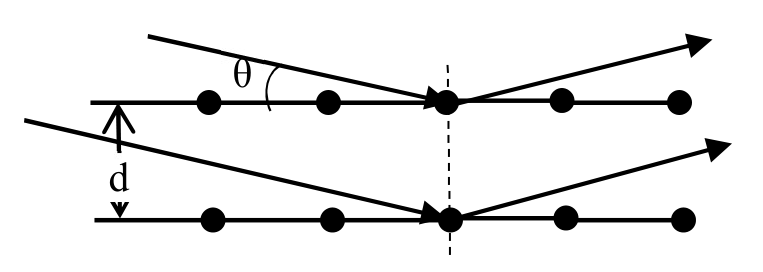
2d sin θ = nλ
This is Bragg reflection. Each atomic plane reflects part of the X-ray beam, and the beams reflected from neighbouring planes interfere. In the figure the angle θ is measured between the incident ray and the atomic plane (the glancing angle).
Step 1 — The ray reflected from the lower plane travels an extra distance before and after reflection; each part equals \(d\sin\theta\), so the path difference is \(\Delta = 2d\sin\theta\).
Step 2 — Constructive interference needs the path difference to be a whole number of wavelengths: \(2d\sin\theta = n\lambda\), n = 1, 2, 3, ….
The expressions d sin θ = nλ and d tan θ = nλ miss the factor 2 from the two legs of the extra path (and tan has no geometric basis here), while 2d cos θ = nλ would be the condition if θ were measured from the normal to the planes, not from the planes as drawn.
2d sin θ = nλ option is correct.
Similar Questions
- A ray of light travelling in air is incident on one face of a parallel glass slab of thickness $t$ and refractive index $\mu$ at an angle of incidence $i$. Total time spent by the ray inside the slab is
- Beyond what distance, the ray optics is sufficiently valid when the aperture is $6\text{ mm}$ wide and the wavelength is $6000\text{ \AA}$?
- A plano-convex lens fits exactly into a plano-concave lens. Their plane surfaces are parallel to each other. If lenses are made of different materials of refractive indices $\mu_1$ and $\mu_2$ and $R$ is the radius of curvature of the curved surface of the lenses, then the focal length of the combination is
- A person has a minimum distance of distinct vision of 50 cm. The power of lenses required to read a book at a distance of 25 cm is
- An electromagnetic wave, whose wave normal makes an angle of $45^{\circ}$ with the vertical, is travelling in air and strikes a horizontal liquid surface. While travelling through the liquid, it gets deviated by $15^{\circ}$. If the speed of electromagnetic wave in air is $3 \times 10^{8}\text{ m/s}$, then the speed of electromagnetic wave in the liquid will be
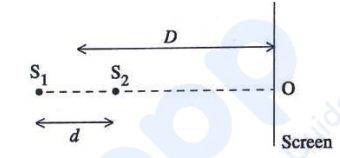
Two points of monochromatic and coherent sources of light of wavelength $\lambda$ each, are placed as shown in figure. The initial phase difference between the sources is zero, ($D \gg d$). Mark the correct statement(s).
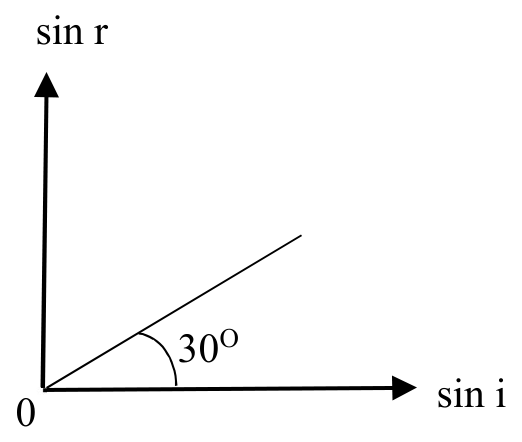
A ray of monochromatic light is incident on the plane surface of separation between two media X and Y with angle of incidence ‘i’ in medium X and angle of refraction ‘r’ in medium Y. The given graph shows the relation between sin i and sin r. If VX and VY are the velocities of the ray in media X and Y respectively, then which of the following is true ?
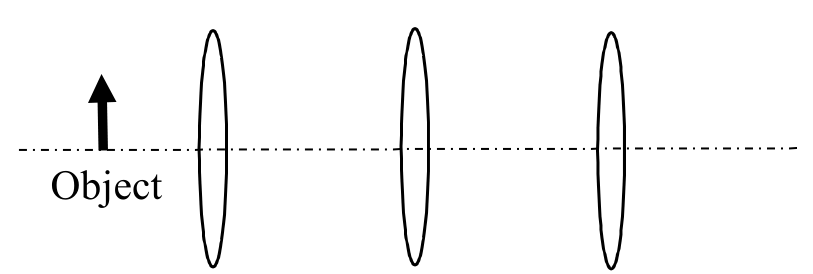
Three identical convex lenses each of focal length f are placed in a straight line separated by a distance f from each other. An object is located at f/2 in front of the leftmost lens. Then,
An interference pattern is obtained with two coherent sources of intensity ratio n:1. The ratio \(\dfrac{I_{Max} - I_{Min}}{I_{Max} + I_{Min}}\) will be maximum if
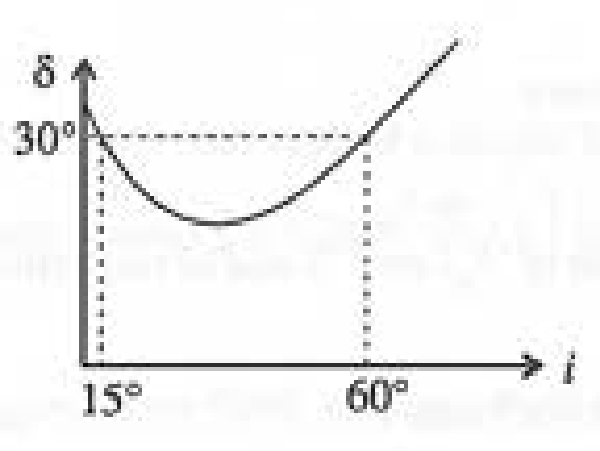
Figure shows the graph of angle of deviation δ versus angle of incidence i for a light ray striking a prism. The prism angle is
Important Questions from Optics
- In a microscope the objective is having focal length $f_o = 2 \text{ cm}$ and eye-piece is having focal length $f_e = 4 \text{ cm}$. The tube length is $32 \text{ cm}$. The magnification produced by this microscope for normal adjustment is ____________.
- A collimated beam of light of diameter $2 \text{ mm}$ is propagating along x-axis. The beam is required to be expanded in a collimated beam of diameter $14 \text{ mm}$ using a system of two convex lenses. If first lens has focal length $40 \text{ mm}$, then the focal length of second lens is ____________ $\text{mm}$.
- In a Young's double slit experiment set up, the two slits are kept $0.4\text{ mm}$ apart and screen is placed at $1\text{ m}$ from slits. If a thin transparent sheet of thickness $20 \, \mu\text{m}$ is introduced in front of one of the slits then center bright fringe shifts by $20\text{ mm}$ on the screen. The refractive index of transparent sheet is given by $\frac{\alpha}{10}$, where $\alpha$ is __________.
- In two separate Young's double-slit experimental set-ups and two monochromatic light sources of different wavelengths are used to get fringes of equal width. The ratios of the slits separations and that of the wavelengths of light used are $2 : 1$ and $1 : 2$ respectively. The corresponding ratio of the distances between the slits and the respective screens ($D_1/D_2$) is ___________.
- The size of the images of an object, formed by a thin lens are equal when the object is placed at two different positions $8 \text{ cm}$ and $24 \text{ cm}$ from the lens. The focal length of the lens is ________ $\text{cm}$.