An interference pattern is obtained with two coherent sources of intensity ratio n:1. The ratio \(\dfrac{I_{Max} - I_{Min}}{I_{Max} + I_{Min}}\) will be maximum if
n = 1
For two coherent waves of intensities I1 and I2, \(I_{\text{Max}} = (\sqrt{I_1} + \sqrt{I_2})^2\) and \(I_{\text{Min}} = (\sqrt{I_1} - \sqrt{I_2})^2\). The given ratio is the fringe visibility, a measure of contrast.
Step 1 — \(I_{\text{Max}} - I_{\text{Min}} = 4\sqrt{I_1 I_2}\) and \(I_{\text{Max}} + I_{\text{Min}} = 2(I_1 + I_2)\).
Step 2 — With \(I_1 = nI_2\), the ratio is \(\dfrac{2\sqrt{I_1 I_2}}{I_1 + I_2} = \dfrac{2\sqrt{n}}{n + 1}\).
Step 3 — By the AM–GM inequality, \(n + 1 \ge 2\sqrt{n}\), so the ratio is at most 1, with equality only when n = 1.
For n = 2 the ratio is \(\dfrac{2\sqrt{2}}{3} \approx 0.943\), for n = 3 it is \(\dfrac{2\sqrt{3}}{4} \approx 0.866\) and for n = 4 it is \(\dfrac{4}{5} = 0.8\); all are less than the value 1 reached for equal intensities.
n = 1 option is correct.
Similar Questions
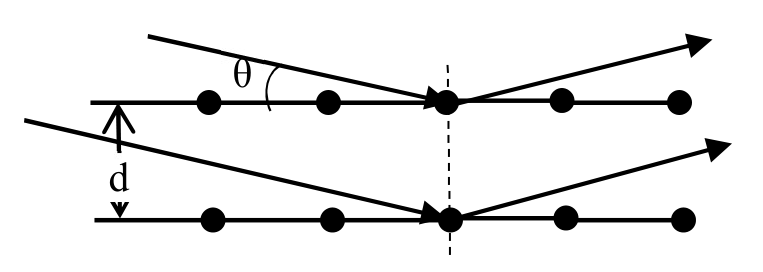
X-rays of wavelength λ gets reflected from parallel planes of atoms in a crystal with spacing d between two planes as shown in the figure. If the two reflected beams interfere constructively, then the condition for maxima will be, (n is the order of interference fringe)
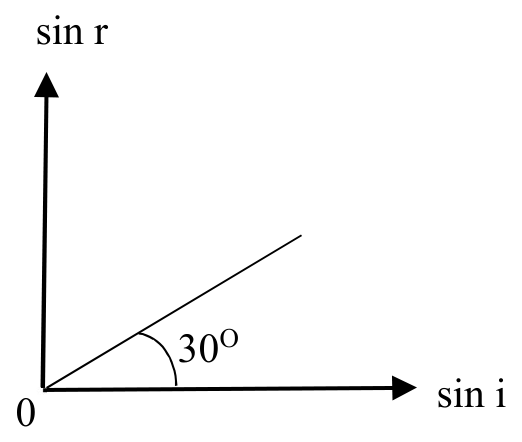
A ray of monochromatic light is incident on the plane surface of separation between two media X and Y with angle of incidence ‘i’ in medium X and angle of refraction ‘r’ in medium Y. The given graph shows the relation between sin i and sin r. If VX and VY are the velocities of the ray in media X and Y respectively, then which of the following is true ?
Three identical convex lenses each of focal length f are placed in a straight line separated by a distance f from each other. An object is located at f/2 in front of the leftmost lens. Then,
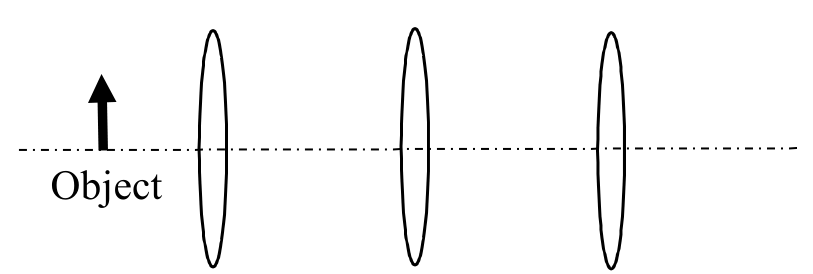
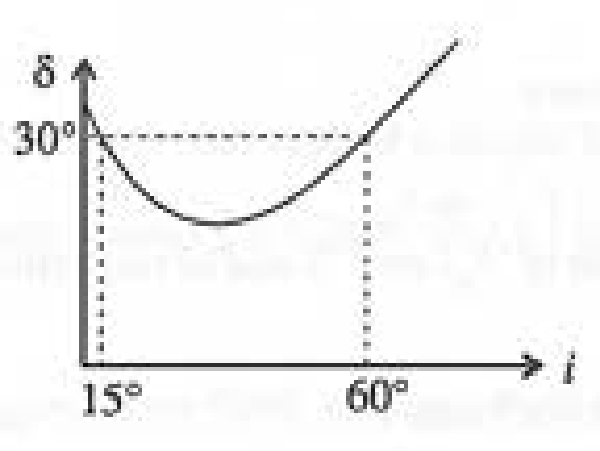
Figure shows the graph of angle of deviation δ versus angle of incidence i for a light ray striking a prism. The prism angle is
A single slit diffraction pattern is obtained using a beam of red light. If red light is replaced by blue light then
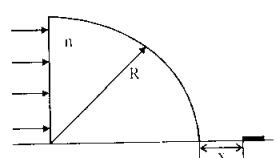
A parallel beam of light is incident on a glass prism in the shape of a quarter cylinder of radius R = 0.05 m and refractive index n = 1.5, placed on a horizontal table as shown in the figure. Beyond the cylinder, a patch of light is found whose nearest distance x from the cylinder is
A point object is held above a thin equiconvex lens at its focus. The focal length is 0.1 m and the lens rests on a horizontal thin plane mirror. The final image will be formed at
Two monochromatic coherent light beams A and B have intensities L and \(\frac{L}{4}\) respectively. If these beams are superposed, the maximum and minimum intensities will be
The ratio of the diameter of the sun to the distance between the earth and the sun is approximately 0.009. The approximate diameter of the image of the sun formed by a concave spherical mirror of radius of curvature 0.4 m is
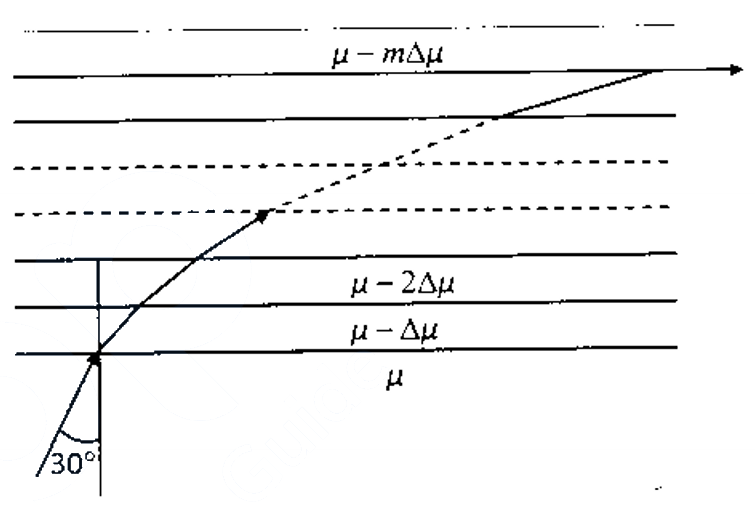
A glass slab consists of thin uniform layers of progressively decreasing refractive indices RI (see figure) such that the RI of any layer is \(\mu - m\Delta\mu\). Here \(\mu\) and \(\Delta\mu\) denote the RI of \(0^{th}\) layer and the difference in RI between any two consecutive layers, respectively. The integer \(m = 0, 1, 2, 3 \ldots\) denotes the numbers of the successive layers. A ray of light from the \(0^{th}\) layer enters the \(1^{st}\) layer at an angle of incidence of \(30^\circ\). After undergoing the \(m^{th}\) refraction, the ray emerges parallel to the interface. If \(\mu = 1.5\) and \(\Delta\mu = 0.015\), the value of \(m\) is
Important Questions from Optics
- A collimated beam of light of diameter $2 \text{ mm}$ is propagating along x-axis. The beam is required to be expanded in a collimated beam of diameter $14 \text{ mm}$ using a system of two convex lenses. If first lens has focal length $40 \text{ mm}$, then the focal length of second lens is ____________ $\text{mm}$.
- In a Young's double slit experiment set up, the two slits are kept $0.4\text{ mm}$ apart and screen is placed at $1\text{ m}$ from slits. If a thin transparent sheet of thickness $20 \, \mu\text{m}$ is introduced in front of one of the slits then center bright fringe shifts by $20\text{ mm}$ on the screen. The refractive index of transparent sheet is given by $\frac{\alpha}{10}$, where $\alpha$ is __________.
- In two separate Young's double-slit experimental set-ups and two monochromatic light sources of different wavelengths are used to get fringes of equal width. The ratios of the slits separations and that of the wavelengths of light used are $2 : 1$ and $1 : 2$ respectively. The corresponding ratio of the distances between the slits and the respective screens ($D_1/D_2$) is ___________.
- The size of the images of an object, formed by a thin lens are equal when the object is placed at two different positions $8 \text{ cm}$ and $24 \text{ cm}$ from the lens. The focal length of the lens is ________ $\text{cm}$.
- If sunlight is focused on a paper using convex lens, it starts burning the paper in shortest time when the lens is kept at $30\text{ cm}$ above the paper. If the radius of curvature of the lens is $60\text{ cm}$ then the refractive index of the lens material is $\frac{\alpha}{10}$. The value of $\alpha$ is __________.