
Problem Analysis
We need to find the maximum value of the objective function $f(X, Y) = 3X + 6Y$ given the constraints:
- $2X + Y \le 6$
- $X + 2Y \le 8$
- $X > 0$
- $Y > 0$
This is a linear programming problem. The maximum value of a linear function subject to linear constraints occurs at one of the vertices (corner points) of the feasible region defined by the constraints.
Finding the Critical Vertex
The critical vertex within the feasible region is often found at the intersection of the boundary lines of the main constraints. We solve the system of equations:
- $2X + Y = 6$
- $X + 2Y = 8$
From equation (1), we get $Y = 6 - 2X$. Substituting this into equation (2):
$X + 2(6 - 2X) = 8$
$X + 12 - 4X = 8$
Combining terms:
$-3X = 8 - 12$
$-3X = -4$
$X = \frac{4}{3}$
Now, substitute the value of $X$ back into the expression for $Y$:
$Y = 6 - 2\left(\frac{4}{3}\right) = 6 - \frac{8}{3} = \frac{18}{3} - \frac{8}{3} = \frac{10}{3}$
The intersection point is $\left(\frac{4}{3}, \frac{10}{3}\right)$.
Verifying Options and Evaluating the Function
We check if the given options satisfy the constraints and evaluate the objective function $f(X, Y) = 3X + 6Y$ at the valid points.
Option 1: $\left(\frac{4}{3}, \frac{10}{3}\right)$
- Check constraints:
- $2\left(\frac{4}{3}\right) + \frac{10}{3} = \frac{8}{3} + \frac{10}{3} = \frac{18}{3} = 6 \le 6$ (Satisfied)
- $\frac{4}{3} + 2\left(\frac{10}{3}\right) = \frac{4}{3} + \frac{20}{3} = \frac{24}{3} = 8 \le 8$ (Satisfied)
- $X = \frac{4}{3} > 0$ and $Y = \frac{10}{3} > 0$ (Satisfied)
- Evaluate $f(X, Y)$: $f\left(\frac{4}{3}, \frac{10}{3}\right) = 3\left(\frac{4}{3}\right) + 6\left(\frac{10}{3}\right) = 4 + 2(10) = 4 + 20 = 24$
Option 2: $\left(\frac{8}{3}, \frac{20}{3}\right)$
- Check constraints:
- $2\left(\frac{8}{3}\right) + \frac{20}{3} = \frac{16}{3} + \frac{20}{3} = \frac{36}{3} = 12$. Since $12 \not\le 6$, this point is not feasible.
Option 3: $\left(\frac{8}{3}, \frac{10}{3}\right)$
- Check constraints:
- $2\left(\frac{8}{3}\right) + \frac{10}{3} = \frac{16}{3} + \frac{10}{3} = \frac{26}{3}$. Since $\frac{26}{3} \approx 8.67 \not\le 6$, this point is not feasible.
Option 4: $\left(\frac{4}{3}, \frac{20}{3}\right)$
- Check constraints:
- $2\left(\frac{4}{3}\right) + \frac{20}{3} = \frac{8}{3} + \frac{20}{3} = \frac{28}{3}$. Since $\frac{28}{3} \approx 9.33 \not\le 6$, this point is not feasible.
Conclusion
Only Option 1, $\left(\frac{4}{3}, \frac{10}{3}\right)$, lies within the feasible region defined by the constraints. Therefore, it yields the maximum value for the function $f(X, Y)$. The maximum value is 24.
Important Questions from Numerical Relations
- If $3 \le X \le 5$ and $8 \le Y \le 11$ then which of the following options is TRUE?
- Match the drug/chemicals listed in Column I with the developmental/physiological defects listed in Column II.
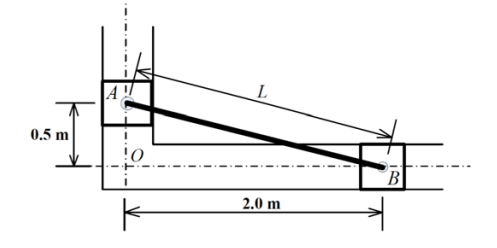
Column I Column II P. Veratrum alkaloids (i) Obesity Q. Thalidomide (ii) Minamata syndrome R. Methylmercury (iii) Cyclopia S. Diethylstilbesterol (iv) Phocomelia Two sliders A and B, connected by a rigid link of length L, slide in two mutually perpendicular and frictionless guide-ways. At a particular instance, the slider A is moving in the downward direction with a speed of 0.05 m/s. At this instance, the magnitude of the velocity of slider B (in m/s) is ……[up to two decimal places]
- The product of the digits of a three-digit number is 70. The sum of the digits of this three-digit number is _____


