
Problem Analysis
We are given the ranges for two variables, X and Y:
- $3 \le X \le 5$
- $8 \le Y \le 11$
We need to determine the possible range for the fraction $\frac{X}{Y}$. To do this, we find the minimum and maximum possible values of the fraction.
Finding the Range of X/Y
The value of a fraction $\frac{X}{Y}$ is minimized when the numerator (X) is at its minimum and the denominator (Y) is at its maximum. Conversely, it is maximized when the numerator (X) is at its maximum and the denominator (Y) is at its minimum.
Minimum Value Calculation
Using the minimum value for X and the maximum value for Y:
- Minimum X = 3
- Maximum Y = 11
- Minimum value of $\frac{X}{Y}$ = $\frac{\min(X)}{\max(Y)}$ = $\frac{3}{11}$
Maximum Value Calculation
Using the maximum value for X and the minimum value for Y:
- Maximum X = 5
- Minimum Y = 8
- Maximum value of $\frac{X}{Y}$ = $\frac{\max(X)}{\min(Y)}$ = $\frac{5}{8}$
Determining the Correct Inequality
Combining the minimum and maximum values, we establish the range for $\frac{X}{Y}$:
$\frac{3}{11} \le \frac{X}{Y} \le \frac{5}{8}$
This inequality represents the correct range for the fraction $\frac{X}{Y}$ given the constraints on X and Y. Comparing this with the options provided, Option 2 accurately reflects this derived range.
Important Questions from Numerical Relations
- $X$ and $Y$ are two positive real numbers such that $2X + Y \le 6$ and $X + 2Y \le 8$. For which of the following values of $(X, Y)$ the function $f(X, Y) = 3X + 6Y$ will give maximum value?
- Match the drug/chemicals listed in Column I with the developmental/physiological defects listed in Column II.
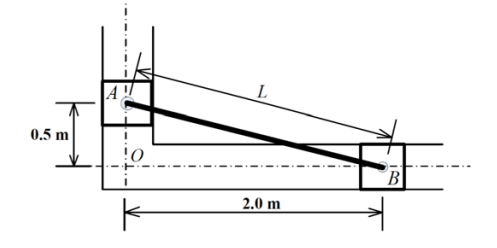
Column I Column II P. Veratrum alkaloids (i) Obesity Q. Thalidomide (ii) Minamata syndrome R. Methylmercury (iii) Cyclopia S. Diethylstilbesterol (iv) Phocomelia Two sliders A and B, connected by a rigid link of length L, slide in two mutually perpendicular and frictionless guide-ways. At a particular instance, the slider A is moving in the downward direction with a speed of 0.05 m/s. At this instance, the magnitude of the velocity of slider B (in m/s) is ……[up to two decimal places]
- The product of the digits of a three-digit number is 70. The sum of the digits of this three-digit number is _____


