
Two sliders A and B, connected by a rigid link of length L, slide in two mutually perpendicular and frictionless guide-ways. At a particular instance, the slider A is moving in the downward direction with a speed of 0.05 m/s. At this instance, the magnitude of the velocity of slider B (in m/s) is ……[up to two decimal places]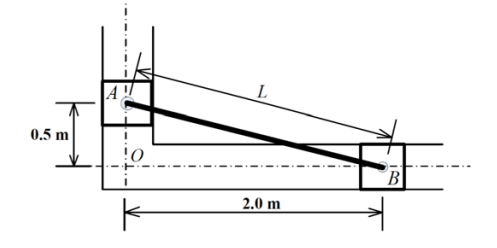
To find the velocity of slider B, we use the geometric relationship and principles of relative motion.
Given:
Slider A's downward velocity, \( v_a = 0.05 \, \text{m/s} \).
The length of the rigid link \( L \) remains constant.
We note that sliders A and B move along perpendicular directions. For the link AB:
At any instance, the squared length of link \( ab \) is given by:
\( (x)^2 + (y)^2 = L^2 \)
Where:
\( x \) and \( y \) are horizontal and vertical displacements of sliders B and A, respectively.
Taking the derivative with respect to time \( t \):
\( 2x \frac{dx}{dt} + 2y \frac{dy}{dt} = 0 \)
Given \( \frac{dy}{dt} = -0.05 \, \text{m/s} \) (negative since it's downward), we find:
\( x \frac{dx}{dt} = -y \frac{dy}{dt} \)
We solve for \( \frac{dx}{dt} \) to find B's velocity:
\( \frac{dx}{dt} = -\frac{y}{x} \frac{dy}{dt} \)
At the instant when \( y = 0.5 \, \text{m} \) and \( x = 2.0 \, \text{m} \), substituting:
\( \frac{dx}{dt} = -\left(\frac{0.5}{2.0}\right)(-0.05) = 0.0125 \, \text{m/s} \)
The velocity of slider B is 0.0125 m/s, confirming the calculated value falls within the given range of 0.01 to 0.02 m/s.
Important Questions from Numerical Relations
- If $3 \le X \le 5$ and $8 \le Y \le 11$ then which of the following options is TRUE?
- $X$ and $Y$ are two positive real numbers such that $2X + Y \le 6$ and $X + 2Y \le 8$. For which of the following values of $(X, Y)$ the function $f(X, Y) = 3X + 6Y$ will give maximum value?
- Match the drug/chemicals listed in Column I with the developmental/physiological defects listed in Column II.
Column I Column II P. Veratrum alkaloids (i) Obesity Q. Thalidomide (ii) Minamata syndrome R. Methylmercury (iii) Cyclopia S. Diethylstilbesterol (iv) Phocomelia - The product of the digits of a three-digit number is 70. The sum of the digits of this three-digit number is _____


