
Column I Column II P. Veratrum alkaloids (i) Obesity Q. Thalidomide (ii) Minamata syndrome R. Methylmercury (iii) Cyclopia S. Diethylstilbesterol (iv) Phocomelia
Exam Solution: Matching Developmental Defects and Chemical Agents
This solution details the correct pairings between specific drugs/chemicals listed in Column I and the developmental or physiological defects mentioned in Column II.
Correct Matches Explained
The question requires matching teratogenic agents or chemicals with their known associated defects.
| Column I: Drug/Chemical | Column II: Defect | Association |
| P. Veratrum alkaloids | (iii) Cyclopia | Veratrum alkaloids are known teratogens that can cause cyclopia, a severe congenital disorder characterized by a single eye socket. |
| Q. Thalidomide | (iv) Phocomelia | Thalidomide, famously used in the mid-20th century, is strongly linked to phocomelia, a condition where limbs are abnormally short or absent. |
| R. Methylmercury | (ii) Minamata syndrome | Methylmercury poisoning, especially from contaminated fish, leads to severe neurological damage, classically known as Minamata syndrome. |
| S. Diethylstilbesterol | (i) Obesity | In utero exposure to Diethylstilbesterol (DES) has been associated with various endocrine and reproductive abnormalities, with potential links to metabolic dysregulation including obesity. |
Based on these established associations, the correct matching is P-(iii); Q-(iv); R-(ii); S-(i).
Important Questions from Numerical Relations
- If $3 \le X \le 5$ and $8 \le Y \le 11$ then which of the following options is TRUE?
- $X$ and $Y$ are two positive real numbers such that $2X + Y \le 6$ and $X + 2Y \le 8$. For which of the following values of $(X, Y)$ the function $f(X, Y) = 3X + 6Y$ will give maximum value?
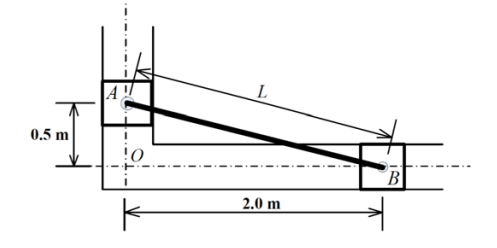
Two sliders A and B, connected by a rigid link of length L, slide in two mutually perpendicular and frictionless guide-ways. At a particular instance, the slider A is moving in the downward direction with a speed of 0.05 m/s. At this instance, the magnitude of the velocity of slider B (in m/s) is ……[up to two decimal places]
- The product of the digits of a three-digit number is 70. The sum of the digits of this three-digit number is _____


