
Walking Difficulty on Sand vs. Concrete
Walking involves pushing backward against the ground. According to Newton's Third Law, the ground pushes forward on you, enabling movement. The effectiveness of this forward push depends on the surface's ability to resist your backward push.
Surface Properties Comparison
- Concrete Pavement: Concrete is a hard, solid surface. When you step on it, it provides a firm base and exerts a strong forward force (pushback) against your foot. This firm pushback makes walking efficient.
- Sand Surface: Sand consists of loose, granular particles. When you step on sand, the particles beneath your foot shift and move aside (displace).
Reason for Difficulty on Sand
The displacement of sand particles means the surface is not firm and does not provide significant pushback. Instead of pushing forward effectively, much of your energy is spent compacting or displacing the sand. This reduced pushback makes it harder to propel yourself forward, resulting in a feeling of difficulty when walking on sand compared to a solid surface like concrete.
Therefore, the correct explanation is that sand displaces, reducing the pushback needed for efficient walking.
Important Questions from Laws of Motion
Which one of the following is an example of Second Class Lever?
A uniform meter scale of mass 0.24 kg is made of steel. It is kept on two wedges, W1 and W2 , in a horizontal position. W1 is at a distance of 0.2 m from one of its ends, while W2 is at distance of 0.4 m from the other end. If the force on the scale is N1 due to W1 and N2 due to W2, then : (take g =10·0 m s-2
Consider a journey by a car represented by the graph given below in three parts A, B and C. The speed of the car in these parts is Va, Vb and Vc, respectively:
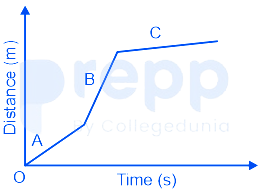
Which one of the following is correct in this case?
Rocket works on the principle of:
A rocket is launched to travel vertically upward with a constant velocity of 20 m/s. After travelling for 35 seconds, the rocket develops a snag and its fuel supply is cut off. The rocket then travels like a free body. The height achieved by it is:



